











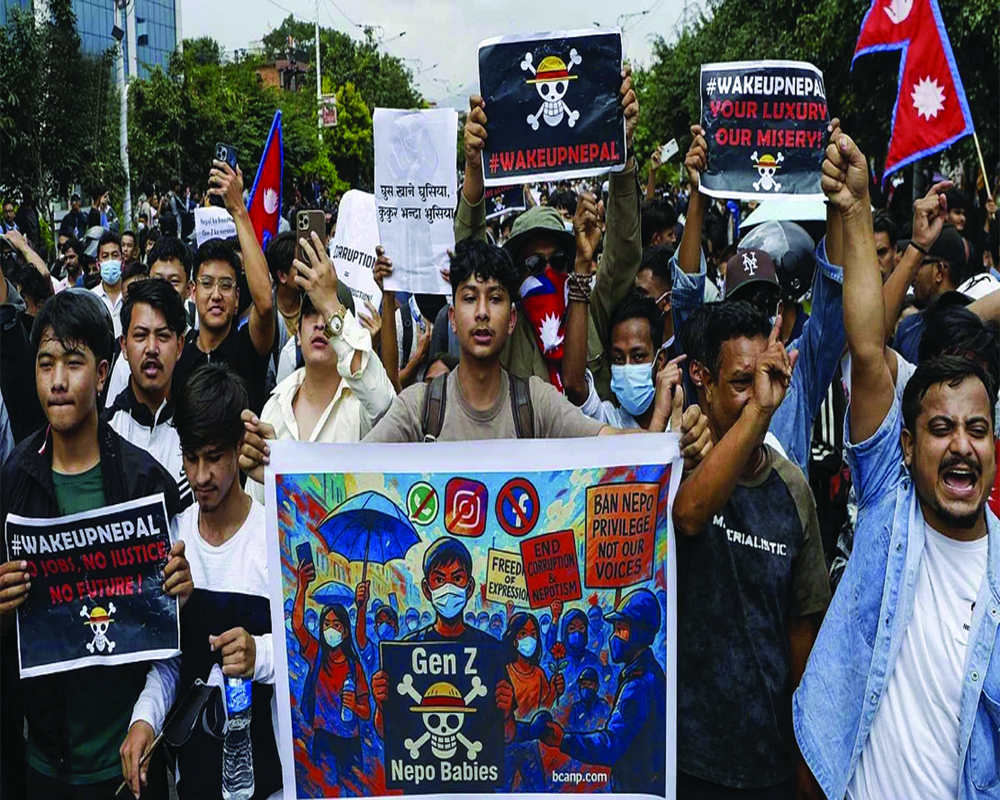
What began as memes and Discord chats became a nationwide uprising, leading to Sushila Karki’s election as Nepal’s interim prime minister. The September Kranti has shaken Nepalese politics like never before
Nine-year-old Parum Gurung is a digital wizard from Lame Ahal, Pokhara. When Nepal banned TikTok in 2024, he managed to override the ban. In October 1959, when I first walked across Nepal, it belonged to a primitive planet, the forbidden Shangri-La. Subina Shreshtha (Nieman Report, 19 September) tells you how “real-time narratives” of Gen Z revolt were provided on social media, and its online memes precipitated the collapse of the government, undermining credibility and fidelity of legacy media usually seen as complicit with the establishment.
Different labels embellish Nepal’s algorithmic war — a Nepal ma bane ko digital revolution. At 10 pm on September 9, the uprising was literally switched off, the government having crumbled and politics in tatters. On 12 September, Sushila Karki was elected online prime minister, followed by a seven-member interim cabinet of bureaucrats, technocrats, and a journalist. Elections were announced for 5 March 2026.
Gen Z leaders are churning their demands, notably Miraj Dhungana’s call for a stable, non-coalition government that is accountable and unrelenting to corruption. Sudan Gurung, the emerging face of Gen Z who has had a brush with both Army Chief, Gen. Ashok Sigdel, and PM Karki, gave his most comprehensive interview to Al Jazeera (27 September). He mentioned: forming a “people’s government” (phrase first used by Maoists); readiness to become PM “if people want”; forming, through Discord and other platforms, a political party by uniting various Gen Z groups; anticipating the former regime to take revenge but Gen Z will ensure they are put behind bars for their crimes; and adding: “They have dragged us into politics and we will fight to the end to form a people’s government. This is a now-or-never struggle.”
It was unclear from the interview whether Gen Z will prevent the old regime from participating in elections or join the interim cabinet. Karki, in her message on 19 September (Constitution Day), lauded the courageous youth, their democratic movement, and cri de coeur against corruption, adding: “I salute the youth.” She thanked the brave army and police, singled out India by thanking PM Modi for his telephone call (September 18).
Perfect in propriety, Karki did not criticise anyone; instead she resolved to fix all the issues. She ordered a judicial enquiry investigating the death of 75 persons during the protests within 45 days. Former PM KP Oli and former Home Minister Ramesh Lekhak have been banned from leaving the country. Two other enquiries — to fix responsibility for arson and vandalism, and to expose and prosecute corruption in high political office — will follow. To facilitate the investigation of the Anti-Corruption Commission, Manoj Kumar KC, who was removed by the Oli government from CIB, has been reappointed to continue investigating the Bhutanese refugee scam, which involves senior politicians and officials. There are scams galore! Meanwhile, the report by the Atlantic Council (September 19) has put the cost of damage during riots at $22.5 billion, which is half of Nepal’s GDP, noting that Nepal failed to diversify beyond a remittance and tourism-based economy and create jobs. Most of the political parties have condemned the dissolution of Parliament as unconstitutional. Former PM Prachanda has welcomed elections, resigned as President of CPN (Maoist) to become its Coordinator, and laid the foundation stone for rebuilding the party office, a victim of arson.
Another Maoist PM, Baburam Bhattarai, has quit politics. PM Oli (CPN UML) and former PM Deuba (Nepali Congress) are being urged to resign their party presidency so that these parties can be rebranded. Little is heard about Rabi Lamichhane of the Rashtriya Swatantra Party, who is back in jail. Former King Gyanendra Shah was apparently approached by some Gen Z to return as constitutional monarch once President Poudel resigned, according to former PM Madhav Nepal, but Poudel refused. Mr Shah wanted all the political parties to agree to his return. Once Oli was prompted by Sigdel to quit, Karki was brought in. On September 24, Poudel issued an ordinance for an amendment to the Voter Registration Act to include new voters. To meet Gen Z’s demand for a stable single-party government, the 2015 Constitution relating to the electoral system will need to be amended. It has bequeathed seven governments since 2015, provided six PMs, and institutionalised the charade of musical chairs with Prachanda as its biggest beneficiary. In a House of 275 members, 165 are FPTP directly elected. The rest come from proportional representation. This ensures no single party can win a majority to form the government. NC’s senior leader, Shekhar Koirala, told me in July that a draft amendment bill to make elections to the House FPTP, removing PR, was ready, but Oli was dithering. The President, as the ultimate custodian of the Constitution, can establish a Constitution Amendment Commission. In her interview to the BBC (Nepali) on September 15, Karki was emphatic about holding elections on time with at most a few days’ or a month’s extension. She declared 8/9 Martyrs’ Day and attended their cremation ceremonies. India has escaped the usual blame game, though the Indian Embassy gate in Kathmandu was briefly attacked. There were stray cases against Indian journalists for getting it all wrong, calling it Godi media. The uprising is a great opportunity for Delhi to reset relations by investing political, diplomatic, and economic capital.Today is Dasain Tika, one of the most venerated days in the calendar. Royalists will take their tika from Raja Gyanendra, while others take it from family elders and the priests. In Gorkha battalions, the Commanding Officer and Baman Baje (Religious Teacher) apply tika to the soldiers, followed by more feasting and revelry. Soon after Diwali will be Tihar and Bhai Tika, with the festive season culminating with Chhath in Madhes, which will move the clock to the end of October. The September Kranti was as innovative and transformative as it was self-destructive and bloody, resembling mob plunder. Nepal’s lust for blood in the guise of sacrifice is legendary; its appetite for violence equally profound.
In Lame Ahal, veterans said: “Kukura marne gaye theo. Bagh mare ra aayo” (went to hunt a chicken and slayed a tiger). Every Andolan promised transformative change, but a real New Nepal has not yet materialised. Time will tell if Gen Z has chosen the right path.
The writer, a retired Major General, was Commander of the IPKF (South) in Sri Lanka and a founder member of the Defence Planning Staff, now part of the Integrated Defence Staff



