










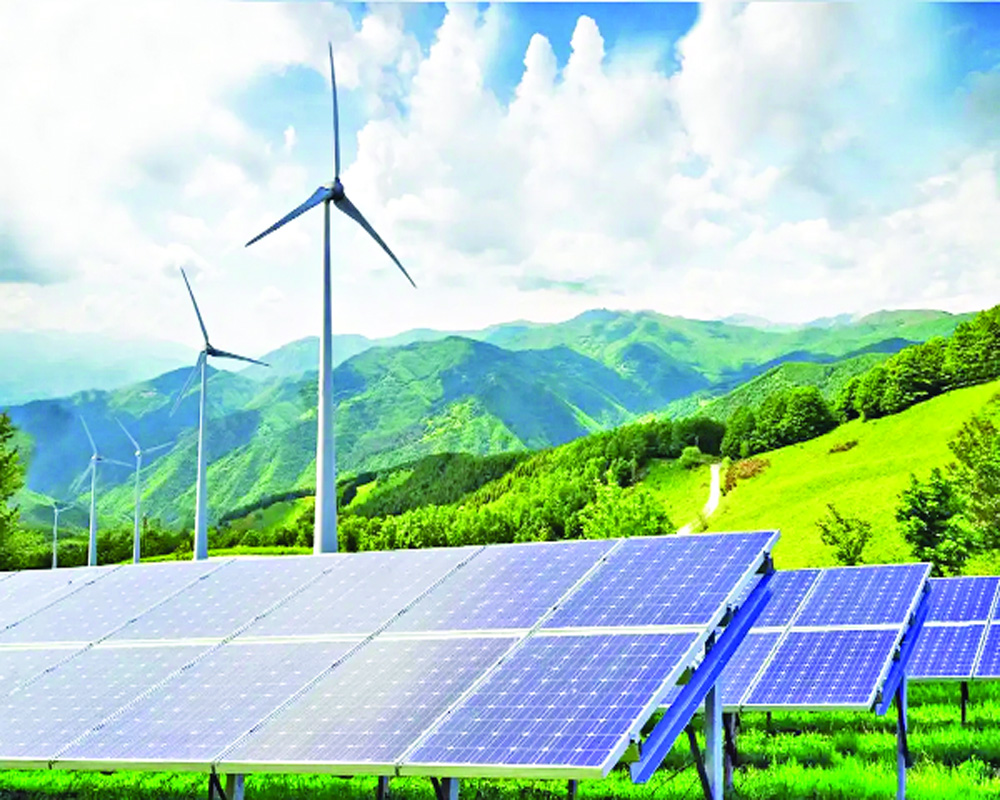
As climate impacts intensify and investment gaps widen, green bonds have emerged as a powerful financial tool bridging sustainability goals with the evolving interests of investors seeking responsible, climate — aligned opportunities
The energy sector is the backbone of the global economy, and transitioning from fossil fuels to renewables demands massive upfront capital — often beyond the reach of public budgets alone.
As the world grapples with escalating impacts of climate change, the need for sustainable financial solutions has never been more urgent. Achieving net-zero greenhouse gas emissions in the energy sector by mid-century will require total global clean energy investment of USD 4.5 trillion by 2030.
Clean energy investment stands at approximately USD 1.8 trillion globally (CY 2023) as against USD 1.1 trillion invested in 2015. Despite these trends, clean energy investment levels remain below what is needed to reach net-zero greenhouse gas emissions in the energy sector.
As recent years have demonstrated, favourable macroeconomic conditions (e.g. the Russia — Ukraine war) and low cost of capital cannot be taken for granted. The monetary tightening undertaken by central banks also had implications for the cost of capital overall — and therefore also potential knock — on effects for clean energy investment and the net-zero transition.
While emerging and developing economies (excluding China) comprise two-thirds of the global population, they represent less than one-fifth of global clean energy investment, indicating that investment remains unevenly distributed across the globe. To align with a pathway to net zero by 2050, clean energy investment in developing countries (excluding China) needs to increase almost sevenfold. Green bonds have emerged as a powerful tool to channel capital toward clean energy projects, offering a bridge between environmental goals and economic realities.
By aligning investor interests with planetary needs, these instruments are reshaping how we fund the transition to a low-carbon future. Green bonds are fixed — income securities designed to raise funds for projects with environmental benefits. Unlike traditional bonds, their proceeds are earmarked for initiatives like renewable energy installations, energy efficiency upgrades, sustainable transportation, wastewater treatment, reforestation, etc.
Introduced in 2007 by the European Investment Bank with its Climate Awareness Bond, the green bond market has since then made significant strides. In 2023 alone, global issuance surpassed USD 500 billion, according to the Climate Bonds Initiative, reflecting growing demand from both issuers and investors. The appeal lies in their simplicity: issuers — Governments, corporations, pension funds, insurance companies or financial institutions — borrow money from investors, who receive regular interest payments, while the funds are deployed to combat climate change.
Transparency is the key, issuers must report on how proceeds are used, often adhering to frameworks like the Green Bond Principles, voluntary guidelines that ensure credibility and accountability. While returns on green bonds are typically comparable to conventional bonds, their environmental impact offers a dual benefit: financial stability plus a stake in a cleaner planet.
India's energy demand is soaring, projected to double by 2040 as urbanisation and industrialisation accelerate. Coal still powers over 50 per cent of its electricity, making the shift to renewables urgent yet capital — intensive. A single gigawatt of solar capacity, for instance, requires roughly `4,000 crore upfront.
As the world's third-largest emitter of greenhouse gases — yet a nation with vast renewable energy potential — it faces the dual challenge of powering its growing economy while curbing environmental damage.
Introduced globally in 2007, they gained traction in India in 2015 when Yes Bank issued the country’s first green bond, raising `1,000 crore for renewable energy. IREDA has used green bond proceeds to finance over 10 GW of renewable capacity since 2017, supporting rural electrification and off-grid solar systems. In 2022, India took a landmark step by issuing its first sovereign green bonds — raising `16,000 crore to fund solar, wind, and green hydrogen projects.
In 2023, NTPC raised USD 750 million internationally for renewable projects. There have been other private player issuances as well, and these examples highlight a key strength: green bonds can scale solutions across borders and sectors, making clean energy accessible where it is needed most. Despite progress, India's green bond market faces hurdles.
At USD 30 billion in cumulative issuance by 2025, it is a fraction of the global USD 2 trillion market — constrained by rigorous disclosures/certifications and limited investor awareness. Small and medium enterprises, crucial for decentralised energy solutions, often lack the creditworthiness or expertise to issue bonds — leaving the market dominated by large corporates and public entities.
Greenwashing — where projects are labelled as sustainable without delivering real impact, remains a concern.
SEBI introduced green bond guidelines in 2017, mandating disclosures, but enforcement remains patchy. Robust certification and third-party verification, such as the Climate Bonds Standard, are critical to maintaining trust. India's green finance ecosystem is evolving.
RBI’s inclusion of green bonds in priority sector lending in 2024 has spurred bank participation. India’s green financing push could gain new momentum this year, with the Government exploring plans to increase its `25,000 crore target for issuing sovereign green bonds. This suggests a turnaround in the Government’s stance, when it was considering a plan to fall back on conventional Government securities and other debt instruments for green financing — as green bonds have delivered only modest returns.
Green bonds and climate finance can transform how India funds its clean energy ambitions. By harnessing capital markets, they offer scalable and market-driven solutions to a pressing global challenge. For a nation balancing development with sustainability, green bonds are not just financial mechanisms — they are a commitment to a greener and more resilient future.
It is also essential that countries put in place supportive frameworks that enable access to capital at low cost. This includes implementing political commitments to climate action and climate policy packages; putting in place structures that support predictable, efficient, and transparent governance; and developing and strengthening financial markets.
A major surge in clean energy investment between now and 2030 is crucial to keep the objective of net-zero emissions by mid-century within reach. The scale and speed of the transition required to achieve net-zero emissions by mid-century mean that investment capital cannot exclusively target clean energy projects in low-risk environments. Investment must increase significantly in two areas typically seen as higher risk: in developing countries and in nascent clean energy technologies.
In conclusion, green bonds represent a vital financial instrument to drive the global shift toward clean energy, especially in developing nations like India. While progress is evident, investment remains far below what is needed to meet net-zero goals by 2050. Bridging this gap requires not only increased capital but also robust policy frameworks, transparency, and inclusive market access.
As the climate crisis intensifies, leveraging green finance can unlock scalable, market-driven solutions. For India and the world, green bonds offer more than just funding — they embody a long-term commitment to sustainable development, resilience, and a low-carbon future for generations to come.
(The writer is General Manager, Project & Corporate Finance, AMPIN Energy Transition. Views are personal)



