










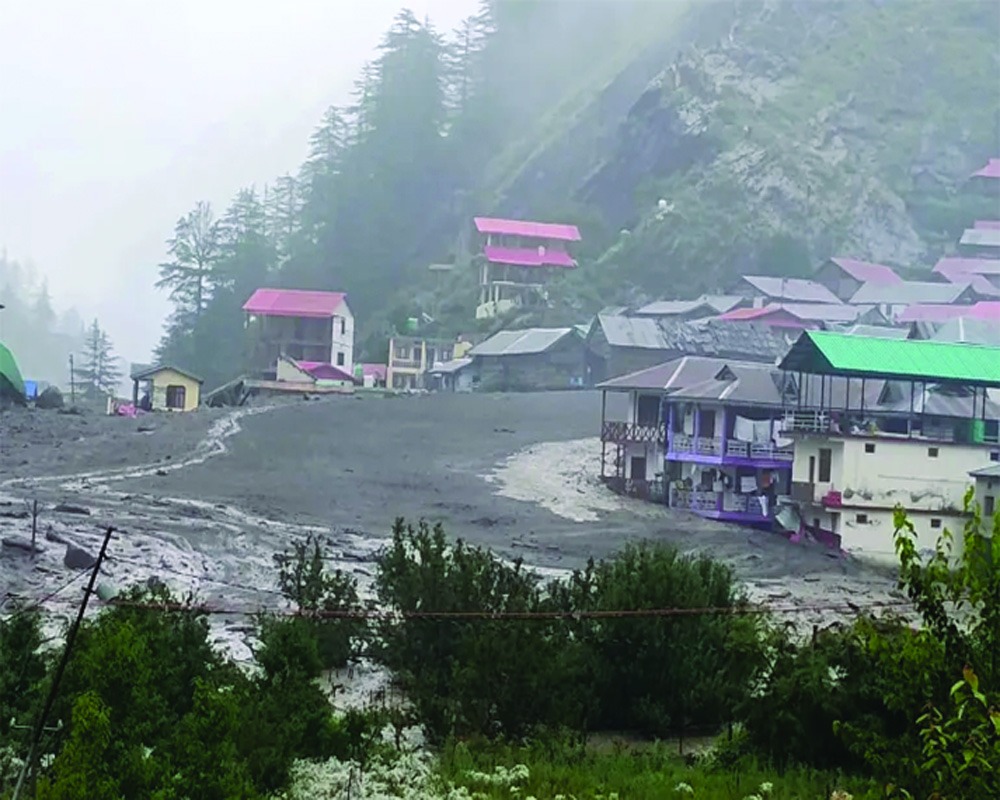
The Dharali and Kishtwar tragedies must not fade into another chapter of ignored warnings. A dedicated climate and disaster-resilience policy for the Himalayan states is an urgent necessity. Inaction will result in loss of lives in the hills, and water insecurity, energy disruptions, and ecological collapse across the plains
The monsoon, once a season of renewal for India’s farms and forests, has become a season of dread in the Himalayas. On August 5, 2025, a catastrophic cloudburst struck Dharali village in Uttarkashi, Uttarakhand, unleashing flash floods and landslides that swept away homes, roads, and lives. Before the region could recover, Kishtwar, Jammu & Kashmir, was struck by another tragedy, as a cloudburst claimed several lives, left over 200 missing, and crippled vital bridges and highways.
These disasters were not isolated. In just one intense weekend this monsoon, Himachal Pradesh recorded 19 cloudbursts, 23 flash floods, and 16 major landslides, displacing thousands. From Kinnaur and Kullu to Chamoli and Rudraprayag, the pattern is clear: Intense rainfall events, cloudbursts, river overflows, and glacial lake outburst floods (GLOFs) are no longer rare shocks — they are becoming seasonal certainties.
A Fragile Region Under Siege
The Himalayas have always been geologically young and fragile, prone to landslides, earthquakes, and floods. But in recent decades, the frequency, intensity, and destructiveness of these hazards have risen sharply. Warmer temperatures, shifting monsoon patterns, and rapid glacier melt are amplifying the risks.
The 2013 Kedarnath disaster was a grim warning. As Executive Director of the National Institute of Disaster Management (NIDM), I led the post-disaster field assessment that identified both natural and human-induced drivers of the tragedy.
Why disasters in the Himalayas are becoming more deadly?
While heavy rainfall and sudden cloudbursts are natural to mountainous regions, the calamities we see today are progressively shaped by human choices. Climate change is accelerating the melting of glaciers, destabilising terrain, and raising the risk of glacial lake outburst floods. Simultaneously, spontaneous urbanisation has replaced conventional buildings with concrete on fragile slopes, often lacking sufficient geological assessments, while poor drainage systems and intrusions on riverbanks disrupt the natural watercourse. Infrastructure expansion has intensified the issue, as hydropower projects, roads, and tunnels are built in vulnerable regions, with blasting and deforestation further weakening hillsides and increasing hazards across whole river basins. Poor governance worsens these problems, as building codes, risk zoning, and environmental safeguards are inadequately enforced, and disaster risk mitigation initiatives are fragmented among different departments rather than being mainstreamed across all sectors.
Ignored Warnings, Repeated Mistakes
The outcomes of the 2013 and 2021 disasters were clear, highlighting the pressing requirement for enhanced protection in the Himalayan area. They advocated for stringent hazard zoning and enhanced regulation of high-risk regions, along with the implementation of compulsory Disaster Impact Assessments (DIA) in addition to Environmental Impact Assessments (EIA). Also significant was the advice to limit hydropower projects in ecologically sensitive areas and implement ecosystem-based planning emphasising slope stabilisation. The reports emphasised the importance of improving early warning systems and boosting community preparedness to enhance resilience in the face of future disasters
Yet most of these recommendations remain unimplemented. Development continues to prioritise short-term economic gains over long-term safety. In many towns, the same risky construction patterns persist, as if the disasters of the past decade never happened.
Human, Economic, and Ecological
Every season of inaction carries a devastating cost. Entire families are buried in landslides, children orphaned, livelihoods lost. Economic damages — destroyed roads, bridges, power projects, and farmland — run into thousands of crores annually. Recovery is slow, especially in remote villages, where losses are often permanent. Ecologically, the damage is silent but profound. Forests are lost to landslides and debris flows. River courses are altered, glacial retreat accelerates, and biodiversity is threatened.
Why the Existing Framework Falls Short?
India’s national disaster management framework, although strong in many aspects, is not specifically tailored for the unique hazards of the Himalayas. The region’s terrain, weather unpredictability, and logistical challenges require a specialised approach.
Response times are often too slow due to difficult terrain and broken transport routes, which hinder rescue efforts during the critical “golden hour.” Moreover, institutional responsibilities are fragmented. Scientific research exists in isolation, often disconnected from operational planning. Local governments lack resources, and community engagement in preparedness remains limited.
Development in the Himalayas
A focused framework for the Himalayas will only thrive if there is a significant change in planning and governance. This means development in hilly terrains must be planned with risks in mind — by enforcing eco-friendly zoning, incorporating rainwater harvesting, and guaranteeing slope stabilisation in all hilly regions. Infrastructure growth needs to be resistant to disasters, requiring mandatory Disaster Impact Assessments, banning construction in landslide-prone zones, and implementing resilient building designs as a standard.
Equally important is viewing nature as the primary defence by rejuvenating degraded slopes through the planting of native species, restoring historic water management systems, and protecting wetlands as natural barriers.
Technology should also be utilised for readiness by enhancing satellite surveillance, implementing AI-driven risk assessment, and guaranteeing that last-mile mobile notifications reach at-risk populations.
Ultimately, strategies focused on the community must stay central, incorporating local insights into risk management and enabling villages to act as the primary and most efficient line of defence.
Need for a Dedicated Himalayan Disaster Resilience Framework
To genuinely transform the planning and governance of the fragile Himalayan region — and to break the endless cycle of devastation and reconstruction — India needs to establish a Himalayan Climate and Disaster Monitoring and Response Centre (HCDMRC). This apex authority would function as the nerve centre for strengthening disaster preparedness and climate resilience across all Himalayan states. Importantly, it cannot remain confined to research functions alone; it must be endowed with clear operational authority to ensure preparedness, coordinate timely response, and oversee effective recovery. Its mission can have a focused seven-point action plan:
1. Safeguarding the Himalayas: Implement eco-friendly regulations and thoroughly oversee the surroundings to prevent reckless development.
2. Safer Development: Synchronize infrastructure initiatives with ecological realities, avoiding areas of high risk.
3. Identifying the Risks: Utilise scientific research to pinpoint regions most susceptible to cloud bursts, floods, landslides, earthquakes, and glacial lake floods.
4. Smart Solutions: Integrate engineering techniques with nature-inspired methods like slope reinforcement, flood management, and ecosystem restoration.
5. Empower Communities: Prepare and supply local authorities, panchayats, and volunteers to ensure neighbourhoods serve as the initial line of defence.
6. Rapid Response: Create specialised, highly-trained high-altitude rescue and recovery units to respond quickly during emergencies.
7. Science in Action: Collaborate with leading research organisations — such as the Wadia Institute, GB Pant Institute, IIT Roorkee, National Institute of Hydrology, ICFRE, and the Forest Survey of India — to guarantee that policies are based on the highest scientific expertise.
The Last Chance to Act
The Himalayas are not just mountains-they are the water towers of India, the birthplace of its great rivers, and the custodians of its biodiversity. The Dharali and Kishtwar tragedies must not fade into another chapter of ignored warnings.
A dedicated climate and disaster resilience policy for the Himalayan states is no longer a matter of debate — it is an urgent necessity. We have the science. We have the lessons from past disasters. What remains is the political will to act. The time to protect the Himalayas is slipping away — if we wait any longer, we will be left with mountains of regret where once stood mountains of hope.
The writer is a former Executive Director of the National Institute of Disaster Management



