










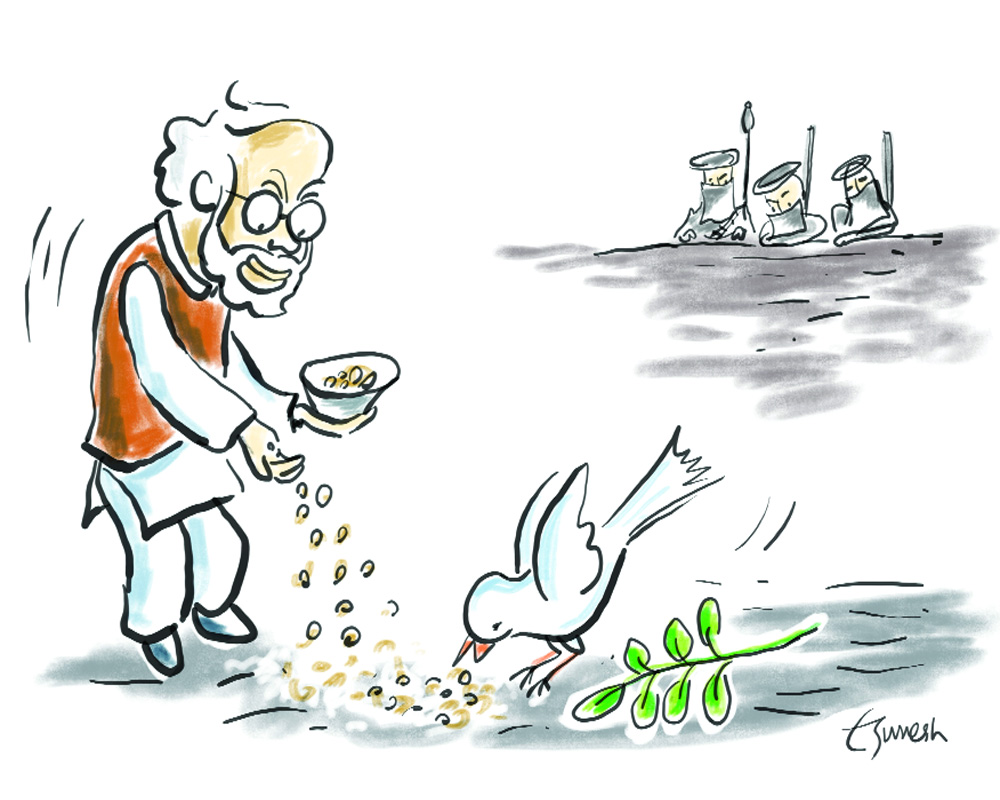
Amid this global unrest, where diplomatic declarations are often drowned out by the din of war, India emerges as a steadfast advocate for peace — not through passive neutrality, but through principled strength
In a world bristling with tension — from the razed streets of Gaza to the blood-soaked fields of Ukraine, from the persistent unrest in Kashmir to the volatile Taiwan Strait — peace is increasingly becoming an endangered ideal. Every diplomatic forum today rings with commitments to non-violence, yet the deafening sounds of war and terror often drown them out.
At this crossroads, India finds herself emerging not just as a stakeholder but as a conscience-keeper, calling for peace with accountability, dialogue with dignity and action with principle. As Prime Minister Narendra Modi said during the G20 Summit, “This is not an era of war.†These words, resonating beyond India’s borders, have become emblematic of India’s foreign policy posture, peace-oriented, yet unwilling to sacrifice justice and sovereignty at the altar of terrorism wherever it breeds.
In the contemporary international order, the line between terror and political resistance is often blurred, frequently shaped by geopolitical interests rather than universal principles. Professor Harsh V Pant, Vice President — Studies and Foreign Policy, at Observer Research Foundation (ORF), argues, “There can be no moral equivalence between a state that fights terror and those who use it as an instrument of policy.†India’s call to the world is both simple and urgent — ‘peace cannot be built on platforms that provide impunity to terrorism’. The 2008 Mumbai attacks, the 2016 Uri assault, the 2019 Pulwama bombing, and the very recent mayhem at Pahalgam on April 22, 2025, are seared into India’s national consciousness and raised by India across several national and international platforms, going beyond the realm of strategic silence.
Dr K Subrahmanyam, widely regarded as the father of India’s strategic culture, once warned, “If you do not define terrorism objectively, you become complicit in its perpetuation.†India’s insistence on a ‘Comprehensive Convention on International Terrorism’ at the United Nations has long been blocked by nations unwilling to alienate their proxies or strategic partners.
Many discussions on terrorism per se and the inability of the global community to arrive at a unified definition of terrorism have concluded, not because of the failure of language, but as scholars and analysts of foreign policy, such as Professor C Raja Mohan, have validated it as a ‘failure of will’. Further, India’s former envoy and permanent representative at the UN, Syed Akbaruddin, once remarked that “States have a duty to protect their citizens, and that cannot be held hostage to the veto power of transnational terror.†He was alluding to the UN’s patchy record in addressing terrorism (here, Pakistan-supported) that directly affects India, especially when state sponsors of terror receive cover under larger strategic alliances.
A September 24, 2024, statement released by the United Nations regarding its 79th session, clearly declares the hardest truth, yet it looks like merely a paper document. United Nations Secretary-General António Guterres on impunity warned, “We are in a purgatory of polarity,†and said that more and more countries feel they can trample international law, violate the UN Charter, invade another country, lay waste to whole societies, or utterly disregard the welfare of their people. “We see this age of impunity everywhere — in the Middle East, in the heart of Europe, in the Horn of Africaâ€, he said. The statement further read that Gaza is a non-stop nightmare that threatens to take the entire region with it. The war in Ukraine is spreading with no signs of letting up, and civilians are paying the price. In Sudan, a brutal power struggle has unleashed horrific violence. The situation is growing increasingly dire even for those who do not live in war zones, he emphasised. Of the world’s poorest 75 countries, one-third are worse off today than they were five years ago.
(https://press.un.org/en/2024/ga12633.doc.htm). It is also pertinent to note what Luiz Inácio Lula Da Silva, President of Brazil, had to say in his statement. He said “The right to defence has become the right to vengeance.†India’s approach to international relations is increasingly being shaped by a nuanced doctrine — balancing hard power with Gandhian values of peace and dialogue. But this is not the pacifism of naivety; it is a peace rooted in strength.
The response of India to Pakistani terrorist outfits after the Pahalgam attack or the Balakot airstrike in 2019 was not just a military operation. It was a message to the world that India would not remain passive in the face of terror. This balance of assertiveness and moral grounding distinguishes India’s diplomacy in an increasingly fractured world. India has supported the territorial integrity of Ukraine while maintaining communication with Russia. It has called for humanitarian aid to Gaza while opposing terrorism emanating from its soil.International peace mechanisms, from the UN Security Council to the Human Rights Council, often suffer from inertia or politicisation.
As history shows, from Rwanda to Syria to Afghanistan, delayed justice breeds deeper conflict. Justice must accompany peace, or peace becomes fragile and fleeting. India’s warning to the world is not apocalyptic — it is pragmatic. As External Affairs Minister Dr S Jaishankar has reiterated, “Terrorism cannot be one state’s strategic tool while another state’s humanitarian concern. The world must develop a unified response.†This is not just about India’s security but about the precedent the global order sets. “Terror and talks cannot go together†is the new forceful strategy.
India does not claim to be perfect. But its stance on terrorism and peace is rooted in its lived experience and its democratic ethos. In a world where great powers often prioritise expediency over ethics, India offers an alternative — principled realism. Ronald Reagan, the 40th president of the United States, once said, “Peace is not absence of conflict, it is the ability to handle conflict by peaceful means.â€
That ability must come from courage, not cowardice; from justice, not just dialogue; from unity, not uniformity. The global search for peace is urgent. Terrorism must be called out, not explained away. Dialogue must be sincere, not strategic. And nations must stop treating terror as an instrument of foreign policy.
Nelson Mandela rightly summarised, “If you want to make peace with your enemy, you have to work with your enemy. Then he becomes your partner.†But if your enemy refuses peace and chooses terror, principle must speak louder than platitude. Unmistakably, if peace is the goal, justice must be the path.
(The writer is a programme executive of Gandhi Smriti Sansthan. Views are personal)



