











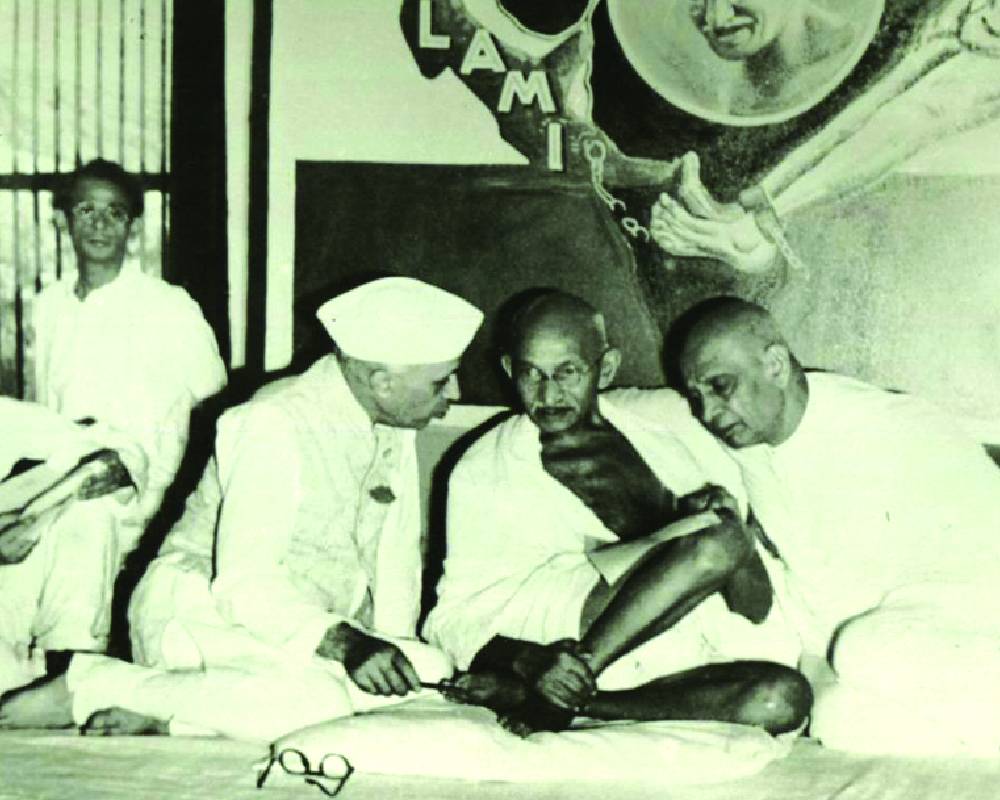
On October 31, India marked a momentous milestone-celebrating the 150th birth anniversary of Sardar Vallabhbhai Patel, the nation’s first Deputy Prime Minister and Home Minister. Yet, even today, a lingering question captivates minds: How might India have looked if Mahatma Gandhi had not exercised his ‘veto’ in 1946 during the selection of the Interim Prime Minister?
Prominent journalist Durga Das, a credible witness to those eventful years, best captures the entire interim government process of that time. In his book India - From Curzon to Nehru and After, he vividly recalls: “Patel was the head of the Congress Parliamentary Board, and the provincial Congress committees had expressed their preference for him as Azad’s successor. But Gandhi felt Nehru would be a better instrument to deal with Englishmen as they would talk in a ‘common idiom’.”
It was the first instance of a ‘vote chori’ in India’s political history, which declared Nehru the victor, despite the majority of Congress’s provincial committees nominating Patel. Interestingly, Nehru’s 136th birth anniversary is just around the corner on November 14, prompting us to reflect on how India would have been shaped with the legendary Sardar at the helm.
Sardar Patel’s political philosophy was passionately anchored in India’s rich civilisational heritage and cultural nationalism. If the young Republic had adopted his vision of secularism, the long-standing Ayodhya dispute, much like the Somnath case, might have been settled many decades earlier.
The pending disputes over the temple and mosque in Kashi and Mathura, which have caused tension both inside and outside the courts for centuries, might have been resolved long ago.
On the night of December 22-23, 1949, when the idol of Ram Lalla miraculously appeared inside the disputed structure at Ayodhya, the first eyewitness was not a Hindu but a Muslim policeman named Abdul Barkat.
Moreover, over a dozen local Muslims submitted affidavits before the city magistrate, willingly acknowledging Hindu ownership of the Ram Janmabhoomi site. Even the then United Province (now Uttar Pradesh) Chief Minister Govind Ballabh Pant, the then Home Minister Lal Bahadur Shastri, senior bureaucrat KK Nayar, City Magistrate Gurudutt Singh, Chief Secretary Bhagwan Sahay, and local Congress leader Baba Raghavdas-along with both the administrative and social leadership-favoured rebuilding the Ram temple. Still, the issue was hanging fire for seven decades, mainly due to
Pandit Nehru’s distorted interpretation of secularism. Nehru was also known to be uncomfortable with the reconstruction of the Somnath temple; however, as long as Gandhi and Patel were alive, he could not bring himself to stop it. Once these towering figures faded into the background, Nehru’s bias against Hindu culture began to surface. He went so far as to dismiss Hindu temples as mere “oppressive” structures, revealing his colonised mindset.
This ideological stance reached a shocking low in 2007, when the Congress-led UPA Government submitted an affidavit to the Supreme Court, claiming that there was no evidence to support Lord Ram’s existence. Patel’s approach-combining persuasion, accommodation, firmness, and strategic force-was instrumental in unifying over 550 princely states. Meanwhile, Nehru, for some inexplicable reasons, kept personal control over the volatile Jammu and Kashmir.
Patel regarded Jammu and Kashmir as merely one among many princely states that were integrating into the Indian Union. However, Nehru perceived it as a unique case for two reasons. Firstly, Jammu and Kashmir was the only Muslim-majority state to accede to India, which led Nehru to grant it particular consideration, arguably a communal approach.
Secondly, Sheikh Abdullah, who clandestinely aspired to become its ‘Sheikh’, a sovereign ruler, held substantial influence over Nehru and succeeded in misleading him. The result was disastrous: Kashmir was subjected to a plebiscite proposal; Articles 370 and 35A granted it special status; the issue was internationalised at the United Nations; and a premature ceasefire was declared even before the Pakistani invaders were fully expelled.
One can only imagine — if Nehru had similarly approached Junagadh or Hyderabad, they might also have become Pakistani territories, turning into festering wounds that would have kept bleeding, causing India to remain fractured for decades.
The truth is plain: had Patel dealt with the Kashmir issue, peace would have prevailed there, as in the rest of India. There would have been no stone-pelting on Indian soldiers, no communal killings based on religious identity, and Pakistan would have thought twice before interfering in the Valley. The genocidal exodus of Kashmiri Hindus during 1989-90 might never have taken place.
Imagine a world where the Indus Waters Treaty of 1960 never came into existence — its disadvantages to India’s long-term prospects seemingly erased.
Instead of clinging to the outdated hope of ‘Hindi-Chini bhai-bhai’ diplomacy or bestowing China with a permanent seat on the UN Security Council, a more strategic and determined approach could have been employed to check China’s aggressive expansion. Such a shift in strategy might have significantly impacted history and the outcome of the 1962 war.
Had India been under Patel’s leadership, the nation’s economic destiny might have taken a different path-one driven by innovation and self-reliance rather than sluggish, crony socialism. With his unwavering vision, Patel would have inspired Indians to unlock their full creative potential and would have taken a strong stance against foreign-funded protests, often masquerading as environmental and human rights campaigns, that threaten national progress.
India’s inherited Marx-Macaulay brand of secularism, shaped by Nehru, has deeply skewed the nation’s social fabric. It often paints the Hindu community-long-standing victims of religious intolerance and persecution aggressors rather than the enduring victims they truly are.
The origins of this inversion can be traced to Nehru’s letter to the Chief Ministers dated May 18, 1959. In it, he unilaterally shifted the burden of maintaining “communal peace” onto the “majority Hindus”, while confidently asserting that “Muslims in India cannot, by their very nature, adopt aggressive attitudes.”
For over a millennium, Hindus, Buddhists, Sikhs, and Jains have suffered relentless assaults-facing invasions, forced conversions, and the destruction of their sacred temples-all fuelled by bigoted monotheistic zeal. Can anyone truly claim that Islam in the subcontinent has fundamentally transformed or shed its historically iconoclastic tendencies?
Patel saw the menace of fanaticism with striking clarity. In 1939, in Bhavnagar, Gujarat, he narrowly escaped death when jihadists hiding within a mosque attacked him with swords. While these terrifying episodes were often left out of the mainstream narrative, Patel had already seen the deadly consequences of neglecting Islamist extremism-an oversight that still threatens to undermine the very unity and integrity of the nation. On January 3, 1948, addressing a gathering in Calcutta, Patel candidly said: “Among the Muslims who remain in India, many, perhaps most, had supported the creation of Pakistan. It is beyond my understanding how their hearts could have changed overnight.”
Three days later (January 6, 1948), in Lucknow, he asked, “Why do Indian Muslims not condemn Pakistan’s aggression upon Indian soil?” Sardar Patel consistently put the country’s interests above his personal or family concerns. More than just a historical figure, Patel remains a guiding force that continues to shape India’s future.
It might not be an overstatement to assert that Prime Minister Modi, for more than a decade, has been endeavouring to rectify the errors made by Nehru and to guide India back onto the trajectory that Patel would have pursued.
The writer is the author of ‘Tryst with Ayodhya: Decolonisation of India’ and ‘Narrative ka Mayajaal’



