











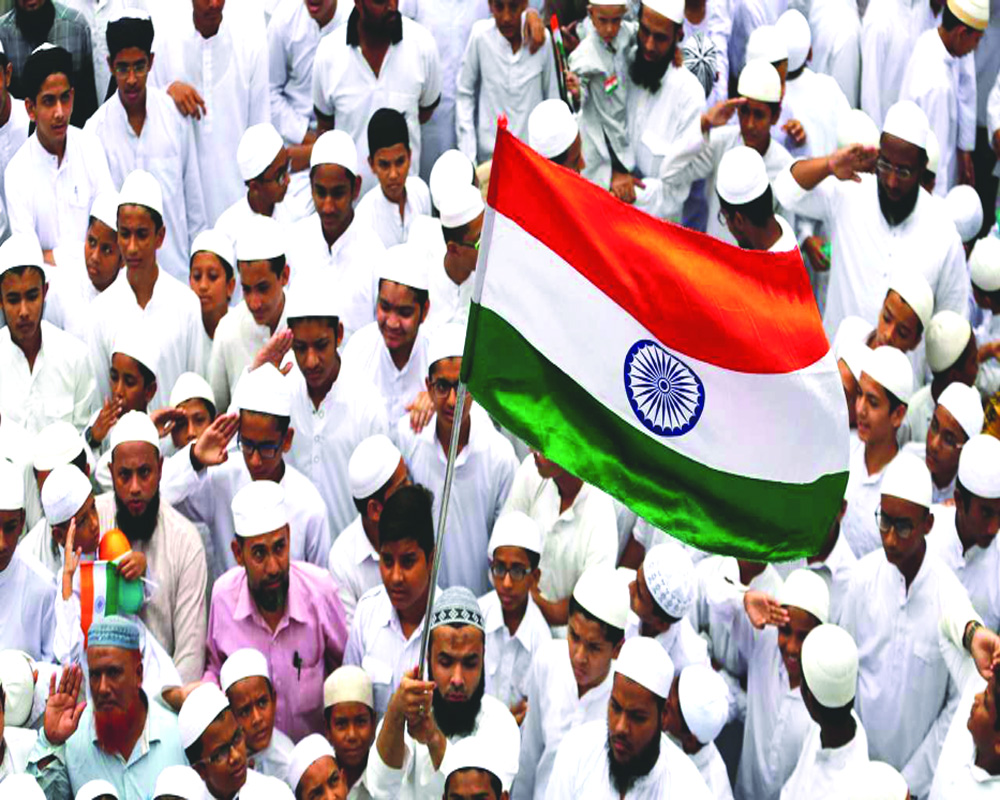
Drawing lessons from global experiences and India’s own past, introspection and reform within the Muslim community are imperative to strengthen national unity and align with the constitutional vision of equality and integration
Shaukat Ali Quadri, in his article in this esteemed publication on July 31, has made wise and moderate suggestions, so that Muslims can retain their identity and yet be an integral part of the Indian populace. In this regard, it would be useful to first enumerate the compulsions that loyal Hindu citizens apprehend about their country.
The country is vast, with a correspondingly large population. The population speaks a variety of languages, not to mention the numerous dialects. There is a variety of castes; besides these, India also has religious diversities to take care of, not to speak of the racial differences that go with the largeness of the country, with its long and often contentious history.
India obtained its independence from Imperial Britain in August 1947, but before relinquishing the reins of power, several observers, mostly British, had predicted that if Indians were not careful, their country could be threatened with secessions and breakups. In short, having given Muslims the Pakistan the latter wanted, it was now for the Hindus to be cautious, if not also careful.
To that extent, India is not a typical nation of the kind the Western world is used to. Such a typical country should ideally have all or most of its citizens’ souls breathing together.
These are points that have never been driven into the minds of Muslim citizens who remained in India after August 15, 1947; Pakistan having been born the previous day. Each political party has propagated its own ideology, which generally has been music to the Muslim ear but not necessarily to the integrity of the country.
Islam has, from its beginnings, been a transnational religion, rather like Judaism and Communism. In these beliefs, the coming together of several peoples or groups is no big thing, nor is the break-up of a country a calamity to be mourned. Take the example of Egypt and Syria during the time of the presidency of Col. Nasser.
These two countries briefly formed a union called the United Arab Republic (UAR) in 1958, which dissolved in 1961. Again, a significant number of people in the western wing of Pakistan did not mind their eastern wing seceding. The Soviet Union comprised sixteen republics.
Moscow spontaneously let secede fifteen of these republics and go their way one day in 1991. In fact, the Soviet constitution provided for secession if any republic felt like seceding. This provision in the Soviet constitution reflects the transnational outlook of the communist ideology. Chaim Weizman, the first prophet of modern Israel, had said that there were no Polish Jews, Hungarian Jews, Russian Jews, British Jews, etc, but Jews in France, Jews in Britain, Jews in Russia and so on. Chaim Weizman was also the president of the Zionist Organisation and later first president of Israel. “Workers of the world, unite” was the exhortation in the Communist Manifesto of Karl Marx and Friedrich Engels in 1848.
Indian Muslims, therefore, in today’s times, have to find a way to rise above these transnational impulses. There can be no denying that separatism, and the feeling of being ‘distinct’ or different from other communities, has been a particular feature of this community’s consciousness as well as conduct.
In India, this feeling of separateness and being distinct has existed vis-à-vis the Hindus of the country ever since the Muslims first came as invaders to settle in parts of the country — their rule over it and subsequent Hindu resurgence leading to the collapse of Islamic rule and the partition of the country after the departure of British colonial rule in 1947.
It is reasonable to expect that the members of all religions who expect personal laws to be retained would be of a similar bent of mind. In the Constitution of India, Article 14 insists on equality of all citizens. But by the time we reach Article 25, different communities are allowed different personal laws. There is a Directive Principle of State Policy which expresses a desire of the Constitution to have a Uniform Civil Code, but after 75 years of the Constitution being in force, one community continues to enjoy its personal laws, which have been imported from abroad.
Hindus are allowed to have family trusts, while Muslims have the privilege that are called waqf, which is entirely different, and increasingly a matter of contention.
With so many variations, it is difficult to be assured that India is a united and well-integrated nation. The question of all the souls of the country breathing together could be a tall order. Everyone needs to be reminded that there are two nations in the neighbourhood that were once parts of the British Empire.
This makes the Hindu heart harbour fears that one minority or the other might be harbouring extra-territorial or transnational loyalties in its heart. It would be much preferable if the scope for such fears did not exist. We must also not forget that for decades together, the communist parties have been operating with weapons in the hands of many of their armed cadres. Transnational ideologies and the demands of loyalties they impose negate the very notion of national integration and oneness. Therefore, for the Muslim citizens of the country, the path of reform beckons, in their own interest.
The writer is a well-known columnist, an author and a former member of the Rajya Sabha



