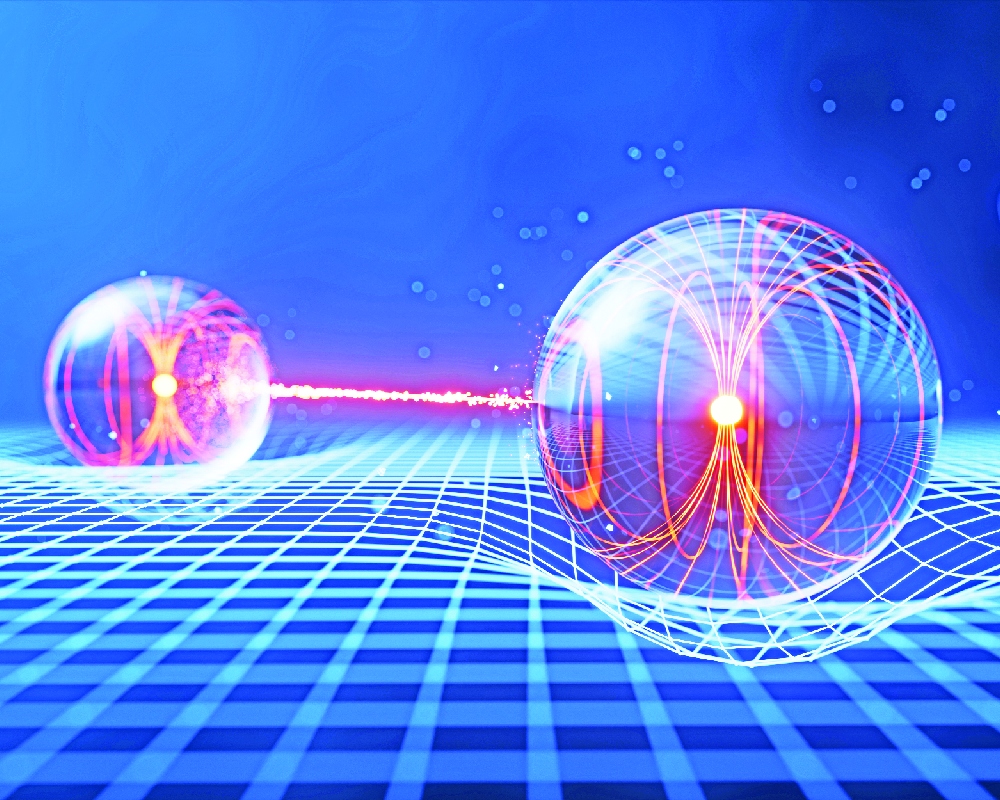
Century-old quantum mechanics can explain how a single sub-atomic particle cross the energy barrier through tunnelling, be located at multiple places simultaneously, occupies discrete energy levels and emits energy in quanta as it moves from higher energy level to lower energy level.
Three US Physics Professors; namely John Clarke, University of California Berkeley, Michel H Devoret Yale University, New Haven CT and University of California, Santa Barbara and John M Martinis University of California, Santa Barabara, were awarded this year’s Physics Nobel Prize. Quantum mechanics has advanced from single particle to macroscopic level, and during 1984 and 1985 these Professors have conducted experiments wherein quantum behavior has been observed at the macroscopic level, where billions and trillions of Cooper particles (two-electron closed system) are involved.
The Professors had discovered macroscopic mechanical tunneling and quantized energy level in a system large enough to be kept in hand. When they made this discovery in 1984 and 1985, Martinis was a PhD candidate, Devoret was a postdoctoral fellow, and Clarke was their professor and supervisor. Two of the three Laureates have links with Google. Besides his professorship Devoret, is Chief Scientist of Google Quantum AI, while Martinis headed Google’s Quantum AI lab till 2020.
How Quantum Mechanics is different from Classical Mechanics? We have seen in our day today life that when a ball is thrown against a wall, it rebounds on the same side and never crosses to the other side of the wall. In sharp contrast to this, atomic particles under quantum mechanical principles cross the barrier through tunneling, located at multiple positions simultaneously and can occupy discrete energy levels.
In 1973 Physics Nobel Prize was won by Brian Josephson for discovering the flow of electric current between two superconductors separated by an insulator. This has been a very useful finding and superconductor-insulator-superconductor junction has been used in various experiments like measurement of fundamental physical constants and magnetic field etc. and is commonly called as Josephson junction. This set-up was utilized by Nobel Laureates in the series of experiments they conducted in 1984 and 1985 meticulously isolated the set-up from its environment and ensured that the quantum effects are not destroyed by interference. They were successful in demonstrating the flow of electron through the set-up and also found the electrons exhibiting quantum mechanical behavior.
The superconducting chip separating another superconductor by an insulator had electric current flowing without any resistance. The electrons coordinate and move together in a single wave. The voltmeter reading showing zero initially starts showing value corresponding to a discrete energy level confirming that the particle has crossed the wall (the insulator) through tunneling. Though the scientists have not been able to conclude the maximum size of the system exhibiting the quantum behavior, but the experiments conducted in 1984 and 1985 by the Nobel Laureates have confirmed that the system as large as the set-up chosen by them did show quantum behavior. The discovery led to the building of quantum-bits (qubits) — unit of information in quantum computers.
The discovery has been extensively used in mobiles, cameras, transistors in computer microchips and optic cables etc. that are part of our lives these days. The next generation quantum technology such as quantum cryptography, quantum computers and quantum sensors are the way forward from these inventions.
These discoveries have far reaching consequences and have been providing breakthroughs in many fields of medicine, chemistry and environment etc. The quantum behavior in superconducting circuits has led to the creation of superconducting qubits, the building blocks of quantum computers and can perform intricate calculations far beyond the reach of a classical computer, marking the dawn of a new computational era. Google Sycamore processor, co-developed by martinis has already demonstrated quantum supremacy by solving problems faster than any existing supercomputer.
The implications extend far beyond computing. In cybersecurity, quantum technology challenges current encryption models, driving innovation in post-quantum cryptography to safeguard credentials, financial data, and national digital infrastructures. If appropriate innovations are not done, our personal data, bank accounts etc. can be hacked using quantum computers. Quantum key distribution (QKD) further enhances data privacy, allowing secure communications based on unbreakable principles of Quantum Physics.
In industrial applications, quantum enhanced sensors can detect minute changes in temperature, magnetic fields or vibrations, revolutionising areas like predictive maintenance, manufacturing quality control and energy management. These sensors could form the backbone of quantum secure industrial networks, protecting critical systems from cyber threats while improving performance and efficiency. We are aware that information is stored in any normal computer as bits, which are either 0 or 1. Quantum computer uses qubits that can be understood to be behaving like a spinning coin in air with 0 and 1 at the same time. Group of qubits can become linked indicating that when we learn about the one we get to know something about the other too.
The two traits are utilised in a quantum machine and bring out several possibilities in parallel.
Google’s quantum AI team has recenly reported that its ‘Willow Superconducting chip’ has run a new test and obtained 13,000 times faster result as compared to the result from top supercomputer. This test is called Quantum Echoes and can be repeated and checked using other quantum machines. Google calls it as ‘verifiable quantum advantage’. Earlier quantum advantage demos produced one off random results and thus, were not verifiable. Quantum Echoes, however, measure the number called ‘out of time order correlator’ (OTOC), which would again emerge when another quantum computer follows the same step. Thus the number is specific irrespective of the quantum computer used. The similar output can be obtained after redoing/ rechecking and hence it is ‘verifiable’.
We encounter chaos in natural processes, which is generally characterized by the high sensitivity of a system towards small perturbations. The notable examples being weather patterns, wherein a small change in initial conditions leads to different outcomes over time and population dynamics where a small shift in local population can affect the entire ecosystem. Chaos is also found in quantum systems, like dynamics of magnetisation in atomic nuclei subjected under magnetic field varying with time and flow of electrons on high temperature superconductors. Quantum computers are ideal for simulating such chaotic systems.
A quantum computer simulating OTOC signals from a physical system in nature such as molecules, whose system parameters are not fully known can be compared with OTOC signals against the real world data about the physical system and observe when they best agree. A more precise estimation of system parameter can be made as compared to any other technique. The echo number thus, can track any small disturbance spreading through the material and has tremendous scope in guiding the design of alloys, cleaner catalysts and zero-in on a chemical battery that can last longer.
The physics of Nuclear Magnetic Resonance is being extensively used in Medical Science especially in MRI. Google has shown that how Echoes paired with NMR data can act like a molecular ruler. Structural features of real molecule can be compared to find how a drug might bind to a protein making a clear scope for quick discovery of drugs. It opens the way for examining the complex quantum behavior and possibilities of breakthrough in climate technology, environment, electronics and Chemistry. Quantum precision measurement is advancing medical imaging, environmental monitoring, and even space exploration, opening new frontiers in scientific discoveries.
The writer is a retired Head of Forest Force, Karnataka, and a postgraduate in Physics; views are personal