











India’s growing ties with Israel amid Middle Eastern sectarian tensions are forcing New Delhi to carefully balance its foreign policy with the sensitivities of its Shia minority at home
Battle ground in the Middle East, be it earlier with the likes of Al Qaida or Islamic State of the Levant (ISIL), Assad’s Syria, Lebanese Hezbollah, Yemeni Houthis or most recently entailing the Israeli war on Iran are less about individual sovereignty or even Palestine, but about sectarianism.
The collective cause of Ummah (Pan-Islamic world) or even the supposed cause of Palestine, are fronted just as props and sideshows — the real battle is for supremacy between the broadly divided camp of Sunni Muslims, i.e., Arab ‘Sheikhdoms’, versus the Shia-led Iran and its proxies in other Muslim countries.
In Shiite literature, Palestine has little relevance and it is the holy Shia sites in Iraq, Syria, Jordan, Egypt and Saudi Arabia that have decidedly more imagination.
In Shiism, the nightly journey to the “furthest mosque” as mentioned in the Holy Qu’ran was made in the mosque of Al-Kufah in southern Iraq and not from Al-Aqsa, as the Sunni tradition has it. Yet the mantle of defending the predominantly-Sunni populated Palestine is championed by Iran, whilst the Arab Sheikhdoms have quietly normalised their relations with Israel overtly through Abraham Accords, etc., or even covertly, e.g., Saudi-Israel secret talks — the worst-kept secret of the Middle East!
As Iran was pummelled in the “12-day war” with Israeli and American planes and munitions flying over Arab territories before raining into Iran, a stunned silence from the Arab capitals almost suggested complicity in the attack on Iran.
Last year, during the Israeli attack on the Gaza Strip, when Iranian drones had taken off to hit targets in Israel, they were targeted and shot down by Arab Jordanian forces and not Israel. All the while, Arab countries were courting Donald Trump, and the likes of Qatar had gone as far as gifting Donald Trump a $400 million Boeing 747 when the Gaza Strip was getting flattened and over sixty thousand Palestinians had been killed. During this time, it wasn’t just Israel that was attacking the Yemeni Shiite militia of Houthis or the regime of Alawite (Shia sub-sect) Bashar al-Assad, but also the Arab militaries of Saudi Arabia, United Arab Emirates, Jordan, and their affiliates. Given that Shias are roughly 20 per cent of the total Muslim population, they are typically persecuted and discriminated against in countries where they are in minorities. In India too, the Shias only constitute roughly 15-20 per cent of the Muslim population. Iran has emerged as the spiritual guardian, protector, and advocate of Shias globally, and that has shaped its political and diplomatic identity, purpose, and actions as a sovereign.
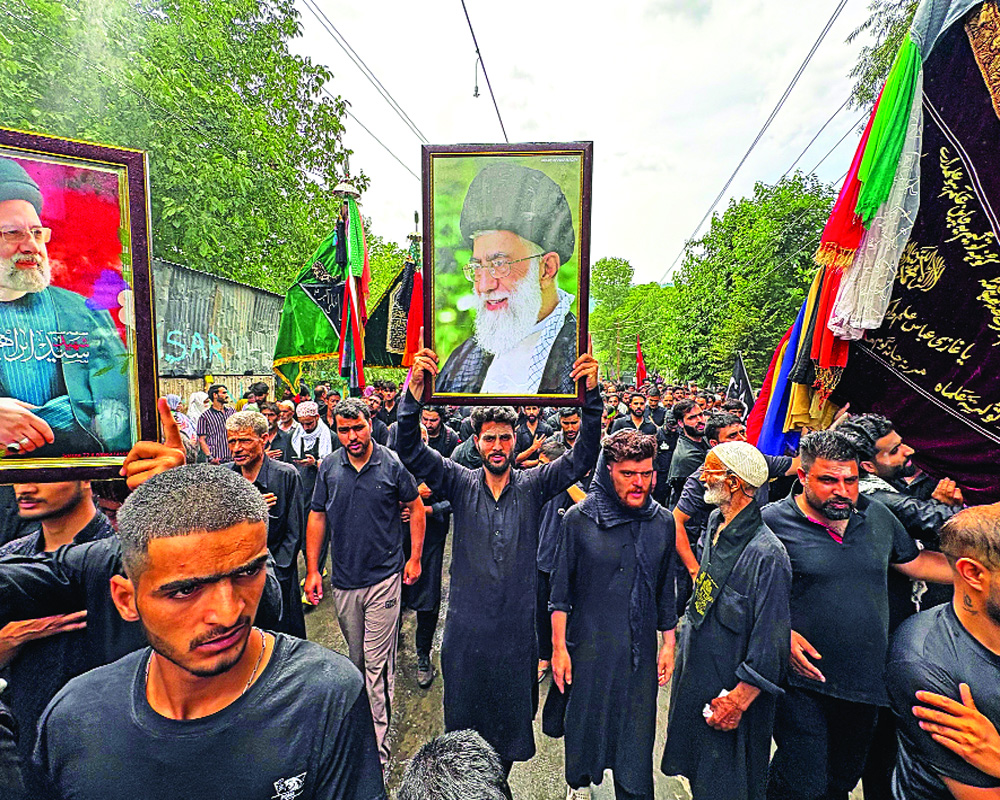
An affront or attack on Iran is perceived as a direct attack on Shiite sensibilities from Lebanon, Yemen, Pakistan, to Lucknow or Kargil, in India! Because Iran is the only country to declare itself a “Shia Muslim” country (even though Shias are in majority in Azerbaijan and Bahrain), it actively supports, finances, and arms Shiite militias in countries where they are in minority, e.g., Hezbollah (in Lebanon), Houthis (in Yemen) or Liwa Zainebiyoun (in Pakistan) to ensure their protection. In the Shiite quarters like Budgam in Kashmir (otherwise Sunni-dominated J&K), it is not unusual to see posters of Ayatollah Khomeini, General Qasem Soleimani or Ayatollah Khamenei on the streets, as the locals emotionally connect and empathise with Iran.
Therefore, the recent dissonance in the Middle Eastern theatre, e.g., Saudi-led forces attacking Yemeni Houthis, Sunni militia overrunning Bashar Al Assad’s Alawite regime, or the recent attack on Iran by Israel (with almost all Arab-Sunni nations watching silently or even allowing their airspace for Israeli attack) has infuriated Shiite sensibilities, in India too.
Recent times have also seen Delhi warm up to Tel Aviv to such a level that the usual support that it afforded Iran too was compromised by mealy-mouthed statements that brought no succour to Tehran. All this would not go unnoticed amongst the minority-within-a-minority populace of Shias in India who have always lived under the subliminal sectarian tensions.
A piquant situation arose during the recent Muharram procession in J&K, where Shiite mourners were seen carrying flags and posters of Iran and Lebanese Shiite militia Hezbollah (including its late leader, Nasir Hassan Nasrallah), and chanting anti-Israel slogans. The consequential undercurrents, passions, and fears of the India Shias is reflective. It is a particularly disconcerting situation for Shias in India as they were generally seen as more pro-the current dispensation.
Many senior Shiite leadership (especially in Avadh region) had openly given a call to support the ruling government, whereas the majority Sunni leadership has had a more fractious relationship.
Even in Kashmir, as it was the Sunni-Wahabi-Salafi instincts of the main militant organisations and its principal benefactor, i.e., the predominantly Sunni-Pakistan, the Shias were generally averse to making common cause with the Pakistani handlers and agencies. But the recent developments that have led to the ganging-up of Israeli-US forces onto Iran and the virtual silencing of Shiite militias like Hezbollah and Houthis — the play of the global sectarian ‘divide’ has made the Shias in India, vulnerable and wary.
Delhi has to make deliberate and reassuring outreach to its Shia population by delinking geopolitical and diplomatic actions from connecting with internal politics. Even steps to build back trust, trade, and strategic investments, e.g., Chabahar port, with an increasingly isolated Iran (by de-hyphenating Israel from the equation) will repair trust.
(The writer, a military veteran, is a former Lieutenant Governor of the Andaman and Nicobar Islands and Puducherry)



