











As artificial intelligence reshapes education, the challenge lies in building a culture of self-learning-one that goes beyond classrooms to create lifelong learners capable of adapting, innovating, and thriving in a rapidly changing world
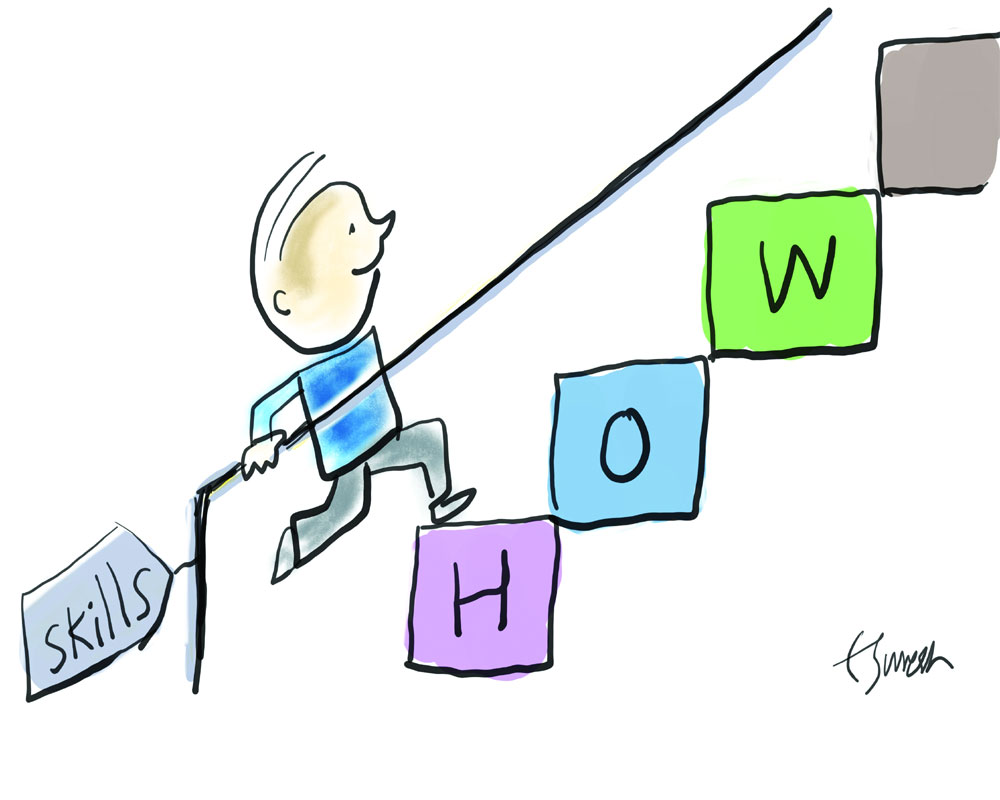
Anyone dealing with management learns the ‘how’ of a process. This is important because the ‘how’ explains the steps that have to be undertaken for the completion of tasks. It focuses on the skills. It focuses on the sequencing of the acts. It focuses on the resources needed to discharge the action. All this, and more, is a foundation of skills to accomplish a task. There can be no two opinions about that.
Whereas this is useful, it is not enough, because the timing of the intervention is very often the fulcrum of the successful reaction. This is judgement. This is not an operational skill. Similarly, every skill and action has an intensity, and that intensity has to be acceptable to the group for the individuals of the group to be galvanised into action. Likewise, there are other gentler and subtler inputs required to take the action from inception to conclusion. Some of them cannot be learnt without practice and without an internal, innate aptitude for self-development and the ability to relate to people.
Ultimately, successful completion of an act is a subtle process involving many attributes beyond the gross skills of the steps in doing the job. Management theorists have no ready-made answers to this but believe the process of training and development is complete only when taken to its logical conclusion through practice. It can be said that, ultimately, of the many inputs needed for the successful completion of a task, the most critical is self-development and the instinct to grow. The parameters of this have yet to be worked out to elevate it to a level of teachability and skill sharpening.
The net conclusion is that all components of learning are important, but perhaps among the more significant ones is the linking of one ability with another, one skill with another, and above all, having the auto-motor ability of the mind sharpened enough to put it all together in a holistic perspective.
Thus, it is the learning that requires an openness of the mind to receive inputs without judgement and without any additions in the free flow of receiving, doing “trades”. This last phrase is not yet common in management literature and, inter alia, will cover knowledge, skills, insights, instincts, and above all, practices for getting on with the tasks. The list elaborated has no claim to be exhaustive and needs to be a continuous process. This will be a differentiating factor in the level of skills that people have in being successful or otherwise.
There is a clear need to further strengthen the theory of learning, not only with gross skills but also with subtler predilections, as well as with the positioning of the mind to keep inventing as one goes along, meeting the challenges.
This is based on the need to encourage organic talent and grow one’s skills alongside the growth of the mind, not to overlook the knowledge components. It would be useful to recognise that an enumeration would have its own classification and its own sub-narratives, depending upon the nature of the action at stake.
Consider the mechanical action of an engineering variety, where the nature of the material and the ultimate nature of the outcome determine the distance which has to be covered between the two to lead to the crux of action. On the other side of the spectrum would be abstractions that are rooted in ideas and require a cognitive approach, which is far more cerebral than operational situations that need skills in the fingers, the hand, and indeed the body parts themselves.
It would be useful to recognise that learning theory is a continuation of levels of fulfilment of the task from A to Z in all areas of action, and that a useful way of segmenting skills to be taught is to see what is presently termed as ‘learning’ at the school level, the collegiate level, and the postgraduate level. Indeed, the postgraduate level is merely one level of learning, as indicated earlier in the text. It has to become self-generating with the parallel stream of learning through one’s own life. This would raise the question of the formalisation of the teaching-learning process, and it may be a good idea to have a parallel stream of teaching for each operational content, along with the knowledge inputs.
Put simply, each course may require clarity on what the knowledge content is and what the operational content of both these streams is. There should be facilitation for the learner to be able to teach himself and keep the learning alive. This raises the subtler question of self-learning beyond classroom learning.
For this, it would be necessary to generate literature which can be acquired by an adult to train himself independently, even when formal learning has ended. But what one is hoping to focus on is the whole third leg of learning, which is self-learning, to keep the torch of learning alive throughout one’s career.
This itself is a challenge and calls for the creation of literature which needs attention from the ab initio level to levels that can encompass all types of challenges. It is about time human resources specialists started the creation of a talent pool, faculty-wise and domain-wise, to respond to this need.
Whereas some thought has been given to learning on the job, more attention needs to be paid to learning beyond the classroom at the self-orientation level to keep in touch with the requirements of problem-solving.
Artificial intelligence is adding a new dimension to education as it permeates the curriculum, the learning process, and curricular planning. There is a basic revolution waiting in the paradigm of teaching and learning. The future appears exciting and challenging to a point where only time will tell how it is going to take shape and affect the life processes of those in the learning and teaching profession.
The writer is a well-known management consultant of international repute



