











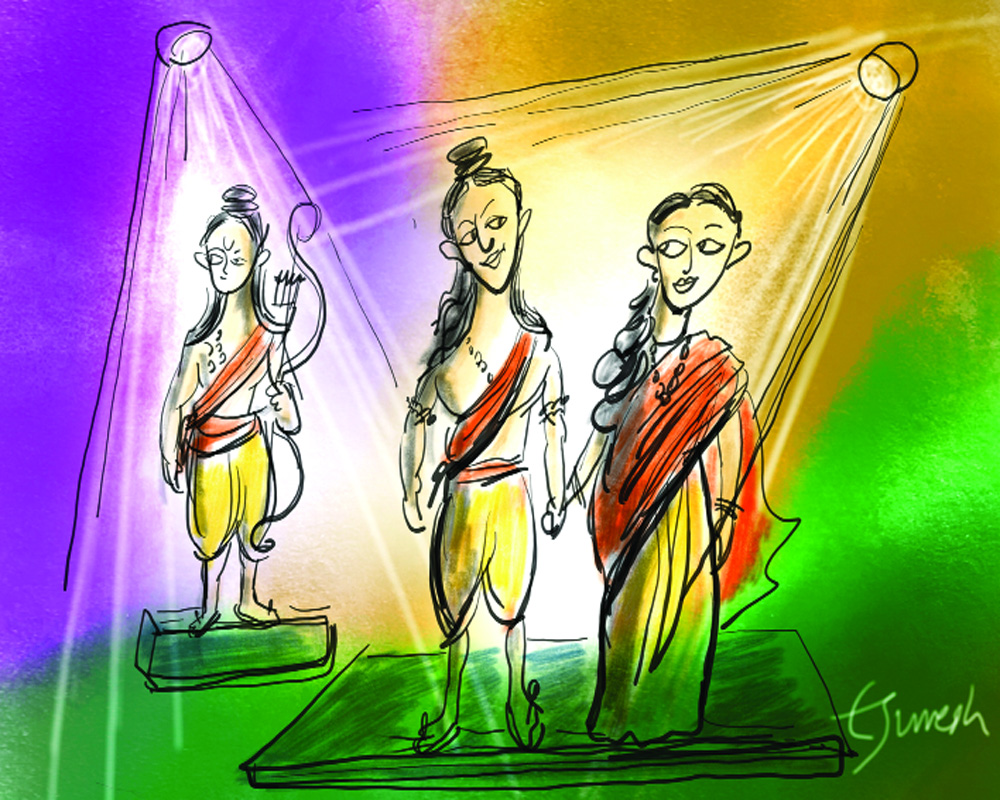
In a surprising gesture of cultural resonance and artistic courage, a Pakistani theatre group named Mauj staged the Hindu epic Ramayana at the Arts Council of Pakistan in Karachi, despite the ongoing India–Pakistan tensions
It was recently reported in the media that a theatre group called Mauj had collectively staged the play Ramayana in a theatre, the Arts Council of Pakistan at Karachi.
Despite the environment of enmity because of the gruesome killing of 26 Hindus in Pahalgam by Pakistani terrorists, drawing a devastating military response by India in the form of Operation Sindoor, and the events preceding and following, the Ramayana’s staging sold approximately a thousand tickets, as reported, and the show was enjoyed by the entire audience. Incidentally, a hitch was that a part of the audience did not understand the word ‘Mundrika’; the Pakistanis are more familiar with ‘Anguthi’, meaning ring, which was presented by Hanuman to Sita when he reached Lanka in search of her.
All the actors in this play were local Muslims; the director, Yogeshwar Karera, was the only Hindu, and the producer’s name is Rana Kazmi. Perhaps the Ramayana epic has not been staged as a theatre performance earlier, but both our epics did command a large audience when they were screened on Doordarshan in 1987 and 1988.
For one hour, every Sunday morning during those two years, the traffic in the cities of Pakistan would disappear as citizens were busy indoors watching the teleserials Ramayan, produced and directed by Ramanand Sagar, and Mahabharat, made by BR Chopra, both well-known filmmakers of their day. In India as well, the Muslim populace too used to watch the epics being brought alive in their television avatar with equal zeal.
Research into the phenomenon of why both of India’s timeless epics have attracted so much interest in Pakistan has so far been insufficient. Is this only a case of great narratives being delivered masterfully? Is it because the Islamic tradition does not have comparable literature?
Is it because the Muslim common folk, whether in India or Pakistan, do not suffer from communal prejudice as their leaders might? Or is it because of the social memory of most Muslims, who were once Hindus? It is pertinent to remember and reiterate here that although cut from the same cloth, Pakistan’s sharp turn away from whatever common it culturally had with India began in 1951, the year its first Prime Minister, Liaquat Ali Khan, was murdered. The need for a national mythology became particularly urgent after the country’s humiliating defeat in the 1971 war at the hands of its hated enemy India, and the subsequent secession of the eastern wing, ie, East Pakistan, which broke away from West Pakistan to become Bangladesh. Pakistan was now equated to Islam itself, became more of a deal, and then the Zia era made that turn complete. For those born during the Zia era or after, Hinduism itself was a very powerful sense of the Other, indoctrinated since their infancy.
But social memory, as psychology explains it, or the memory embedded deeply in the psyche of individuals and communities regarding their history and ancestry of bygone eras, is difficult and near-impossible to eradicate by ideological indoctrination. History has been witness to this across continents and cultures.
What we are witnessing is just another instance of this human phenomenon, for which no neat and convenient explanation exists. Take, for instance, the views of Rana Kazmi, producer of the recently staged Karachi theatre’s Ramayana: “I don’t know if something particularly good ever came out of banning anything. My view is that putting something down or stopping something from happening is never the solution. I think there is so much that we have to offer as a part of the world and we are so much stronger together. I don’t know why we don’t see that strength, realise it and actually leverage it. Imagine what we would do as one group. I am a champion of us doing things together. We watch content from each other’s countries. We relate to it and enjoy it. No bans have ever stopped that from happening.”
Similar views have been expressed by Samhan Ghazi, who played Ravana in the drama, and Sana Toaha, who played Kaikeyi. Several places and the events occurring in them mentioned in both the Ramayana and Mahabharata are today located in the geography of Pakistan. Kekaya (Kaikeyi’s native kingdom), Takshashila (Taxila), Sindhu, and Peshawar are some of them; Gandhara, the native land of Gandhari, mother of Duryodhana and the Kaurava brothers, is in Afghanistan, but adjacent to Pakistan’s Peshawar district.
We have mentioned social memory to be the most likely cause of the Ramayana and Mahabharata still resonating in many Pakistanis’ hearts and minds. In historical context, social memory can be said to be the shared recollections and interpretations of the past that are held by a group or society, shaping their understanding of themselves and their place in the world.
It encompasses the collective knowledge, beliefs, and narratives about past events, experiences, and cultural traditions that are passed down through generations. Viewed through this perspective, social memory can be glimpsed at its most expressive in the active remembrance of the Hindu epics in some pockets of Pakistani society.
(The writer is a well-known columnist, author, and former member of the Rajya Sabha)



