











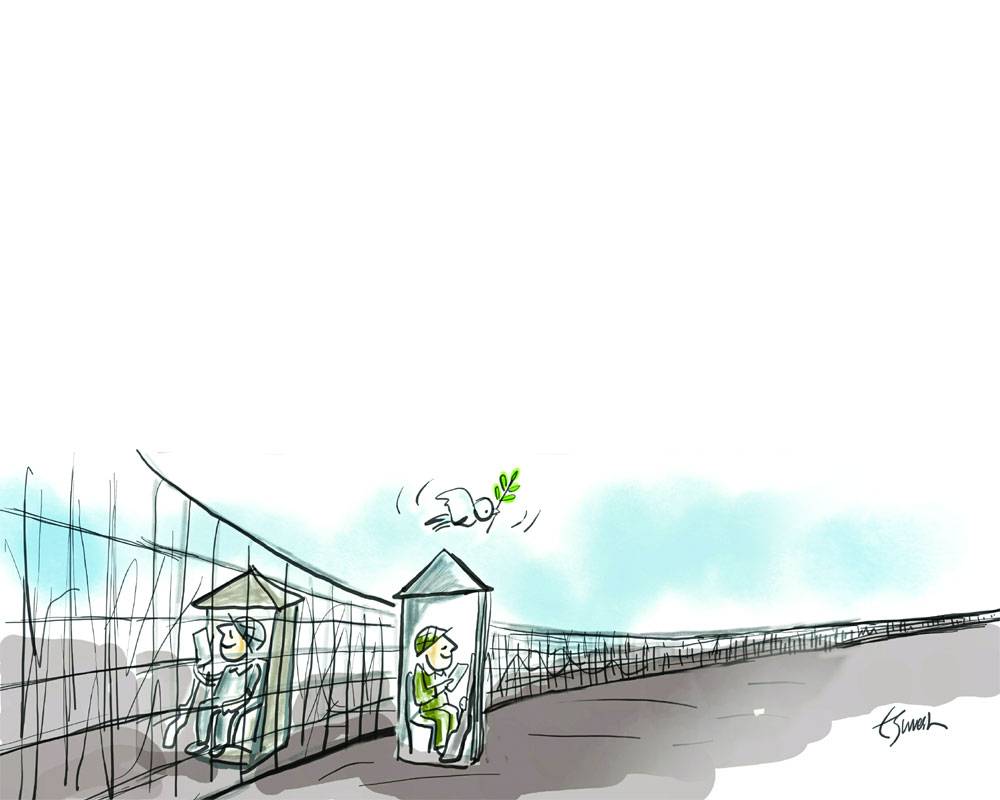
The upheaval in Thailand not only underscores the cycle of judicial interventions and political instability but also carries lessons for India as it confronts its own unsettled borders
I arrived in Thailand last Friday just as Bangkok was rocked by the Constitutional Court’s expected ruling of dismissal of Paetongtarn Shinawatra, who became PM last year after an election in which democratic parties like her Pheu Thai and the Move Forward Party swept the vote.
Only the previous Friday, her father, a long-time critic of the military-monarchy and former PM Thaksin Shinawatra, was acquitted by a court of a royal defamation charge. His daughter, sister, brother-in-law, and two others connected to him, five elected PMs were sacked since 2008. The super-judicial Constitutional Court was formed in 1997 by members handpicked by the Monarch and the Army. The CC’s latest intervention followed a four-day border clash (July 24–28) between Cambodia and Thailand in which President Trump had claimed credit for the ceasefire using the tariff weapon.
During PM Shinawatra’s confidential phone conversation with former Cambodian PM Hun Sen, whom she calls “uncle”, she agreed to “handle the border situation” while criticising the Royal Thai Army, naming Army Commander Lt Gen Boonsin Padklang. The classified conversation leaked by Sen was called a betrayal by Thailand, given the longstanding family ties between the Shinawatras and the Sens. Further, Sen warned in a public speech: “The neighbourly betrayal disguised as friendship” and accused the Shinawatras of disrespect to the Thai military and monarchy, the ultimate badge of honour in Thailand. The outcome of the ethical probe ordered by the CC end of July was triggered by Sen.
A quick study of the war is instructive. Thailand and Cambodia have an 817 km border. There are a number of border crossings, and border trade in 2024 was USD 4.4 bn. Casinos recently legalised in Thailand are popular among Cambodians and are one source of friction. The crown jewel of the dispute is the Preah Vihear temple claimed by both; four other temples and a 12 sq km Emerald Triangle, which sits at the junction of Laos, Cambodia, and Thailand, are also disputed. In 1907, during French colonial rule, the area was mapped, but the border was not properly demarcated, leaving several disputed pockets.
All colonial rulers marked borders for “rule longevity and convenience,” which is most vivid on the map of Africa. Thailand was uniquely not colonised. The most violent border incident was in 2008, triggered by Cambodia by designation of Preah Vihear as a World Heritage Site. In 2011, Cambodia took the dispute again to the ICJ whose 1962 verdict ruled Preah Vihear was on Cambodian territory but left out other disputed pockets. The latest incident on 24 July clearly establishes linkages to feuds between the Sen-Shinawatra clans and the dismissal of PM Shinawatra. Gen Srey Duk, Deputy Commander of the Royal Cambodian Army and Commander of the 3rd Support Division, was killed in the fighting. Before the clashes, Duk was engaged in negotiating with Maj Gen Sompop Parang of the RTA near Chongbuk, a disputed site. Duk had been involved in border talks since the 2011 clashes. Another Cambodian General was reportedly killed in the Thai counterattack. Duk was accused of starting the fighting; his wife had organised a music festival in the disputed Emerald Triangle. This was seen as a sign of escalation. Thailand employed four Gripen Swedish fighters recently acquired as a right to defend sovereignty. Sweden was accused of selling lethal equipment to conflict zones, but both countries elevated bilateral relations to ‘strategic’.
The clash was intense on July 24, when Cambodia fired BM-21 rockets and artillery, destroying a Thai hospital, a 7-Eleven store, and killing eight civilians. Eleven Thai soldiers were killed in the clashes. Uneasy calm prevails on the border as Thailand has suffered heavily due to mine incidents while its soldiers patrolled the disputed borders after the ceasefire. Six mine injuries occurred since the ceasefire on July 28 – August 9, August 12, and August 27 (two earlier on 16 and 23 July).
Thailand has accused Cambodia of violating the Ottawa Convention, which bars the use of plastic mines. Malaysian Prime Minister and Chair of ASEAN Anwar Ibrahim, along with Vietnam and Singapore, brokered the ceasefire; the US pushed for a peaceful resolution of the dispute though Thailand wanted to settle the dispute bilaterally. On August 1, Thailand took out a foreign delegation representing 23 countries to the disputed sites. Among the observers was the Indian Naval Attaché. On August 2, Thailand commemorated the martyrs of the fighting near the border. India has many disputed pockets with China on the LAC. The ones most recently numbered were in East Ladakh, where qualified disengagement has occurred, but there is little sign of de-escalation and de-induction. With Pakistan, the LoC remains unstable, and cross-border terrorism continues despite the new Modi normal. Our Chiefs of Armed Forces are rushing into lesson-learning and drawing benchmarks after Op Sindoor on the theatrisation, nature of future wars and politico-military decision-making, forgetting that Op Sindoor was a four-day clash (like Thailand-Cambodia). It was untypically non-contact, beyond visual range, where manned systems did not cross the international border/LoC. It involved the IAF in the lead and its air defence systems and other land-based rockets and missiles, virtually leaving out of the battle the Army and Navy. No casualties were officially announced, though civilian casualties were higher than the military casualties.
The 127 gallantry awards included Vir Chakras, Mahavir Chakras, and Sarvottam Yudh Seva Medal, 40 distinguished service medals. For the first time in the history of Indian military operations, no citations were recorded and gallantry awards were given for non-contact conflict. Gallantry awards are traditionally given for extraordinary acts of bravery and personal courage demonstrated in the face of the enemy with serious risk to the recipient. This could have been only marginal in the beyond-visual-range 88-hour exchange of fire.
The profusion of awards, lack of transparency about citations, casualties, and equipment losses are unprecedented and could tell another story. The major political lesson for India from the Thai-Cambodia border clash is to settle borders with China and, more urgently, with Pakistan. But this can only be done if Delhi agrees to negotiate with Islamabad. The Thai-Cambodia border clashes have led to the killing of a General and regime change in Bangkok — another Shinawatra casualty and continued political instability paving the way for possibly another Army PM.
The writer, a retired Major General, was the Commander of IPKF South, Sri Lanka, and a founder member of the Defence Planning Staff, which is currently the Integrated Defence Staff



