











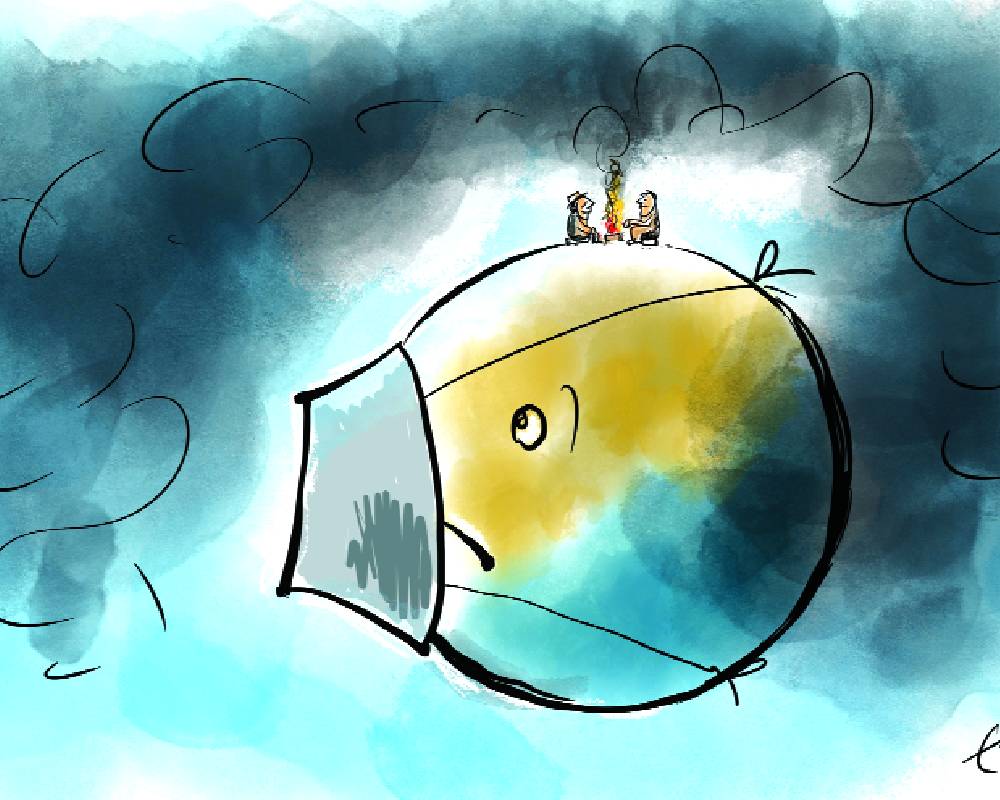
Every year, as winter arrives in Delhi, so does the inevitable reality of toxic haze, so does the discussion to prioritise healthy air. After huffing and puffing, literally and figuratively, for a few days, it is work as usual till the next Diwali/farm fire season.
The great Indian apathy to demand better governance continues. However, this is no more a seasonal nuisance but a major public health and policy crisis unfolding. For the crores of residents, breathing has become an act of endurance. The norm of pollution has disillusioned the citizens about the need for immediate action by their chosen representatives. While most cities would shut down at an AQI of over 500, Delhi continues to function as if the choking air were normal, with the Government even hosting fitness events amid it all.
Worse still, the Government’s response only further enhances its wilful apathy, as rather than fighting pollution, it chooses to manipulate the data measuring it. The remarkable “triple-engine government” in Delhi has been accused of taking cosmetic measures, such as allegedly spraying water near AQI sensors, rather than tackling pollution at its source.
According to the data submitted to the Supreme Court, on Diwali, only 9 out of 37 sensors were functioning, even as authorities claimed to be monitoring air quality closely. Various examples will tell you that a call for a ban on anything seldom works, rather makes the proposition more interesting. Similar was the case of the firecracker ban, and once that was lifted by the highest court of the land under the label of ‘green crackers’, welcomed by the Government, the NCR saw the return of the firecrackers with a vengeance.
Yes, of course, this isn’t the only cause but one of the major causes of what makes the capital of the country choke with poisonous air. Then there is the elephant in the room-the stubble burning by farmers. Punjab alone has already recorded over 1,200 farm fires since September.
To add salt to the wound, when India’s AQI scale has been capped at 500, international apps have shown readings over 1,000. While this is not new, it remains unaddressed by the Government, and much of the population remains unaware. Around such conditions, many parts of the city will adopt work-from-home policies, yet what about the citizens who cannot afford to work from home, nor afford to buy a purifier like the Chief Minister?
The new-age capitalism has brought along the need to buy clean air for survival. This is no more a seasonal problem. According to the 2025 Lancet Countdown on Health and Climate Change, India now accounts for 26 per cent of global deaths caused by air pollution-over 17 lakh deaths annually, 38 per cent rise since 2010. The very air that every single citizen of the country breathes is also what is slowly killing them.
Even still, the Environment and Health Ministries continue to deny any direct correlation between air pollution and mortality. This silence should itself be a clarion call for decisive and coordinated action. Delhi’s smog is a symptom of a deeper policy vacuum on pollution. On one hand, cities like Mumbai get away thanks to the sea winds, which also blow away accountability, against unchecked construction and industrial activity. On the other hand, northern cities dominate global pollution rankings in the top 50 of the world’s most polluted cities.
This inaction is not India’s alone; it mirrors a wider failure of global leadership. Even as India ranks 10th in the Climate Change Performance Index, global leadership continues to falter.
The United States’ renewed withdrawal from the Paris Agreement under Trump, the rollback of climate grants, and the retreat of major corporations and banks from climate alliances reflect a dangerous trend of wilful denial by those most responsible. The developed world is not yet seeing the worst consequences of climate change, now endured by the Global South. Addressing this crisis requires not just short-term measures but systemic reform. That is why, in 2021, I introduced the Climate Change Council Bill-a Private Member’s Bill-to establish a comprehensive legal framework to guide India’s response to climate change; a framework we currently lack. The absence of a unified climate law in India limits effective action, with the background of it being among the most vulnerable nations facing compound climate extremes such as landslides, floods, and heatwaves. By integrating environmental, ecological, and developmental aspects, the Bill seeks to ensure focused mechanisms for the assessment, adaptation, and mitigation of climate change impacts.
Still, policy cannot succeed without public will. These persisting conditions across various North Indian states will drive the majority of the public health emergencies not only for the present but for future generations as well. Every citizen, regardless of occupation or income, deserves the right to breathe clean air.
We must expand public transport; prioritise walking and cycling through safer streets; enforce vehicle and construction emission standards; and embed air quality goals into urban planning. Clean air must be a collective national guarantee. It is not a woke agenda, as many dismiss it, but an urgent health hazard agenda that needs to be tackled on a war footing. The citizens of India deserve better. When fate comes knocking, it will not distinguish between wealth and geography. By then, no nation will be immune to the consequences of its own and our collective inaction.
The writer is a Member of the Rajya Sabha



