











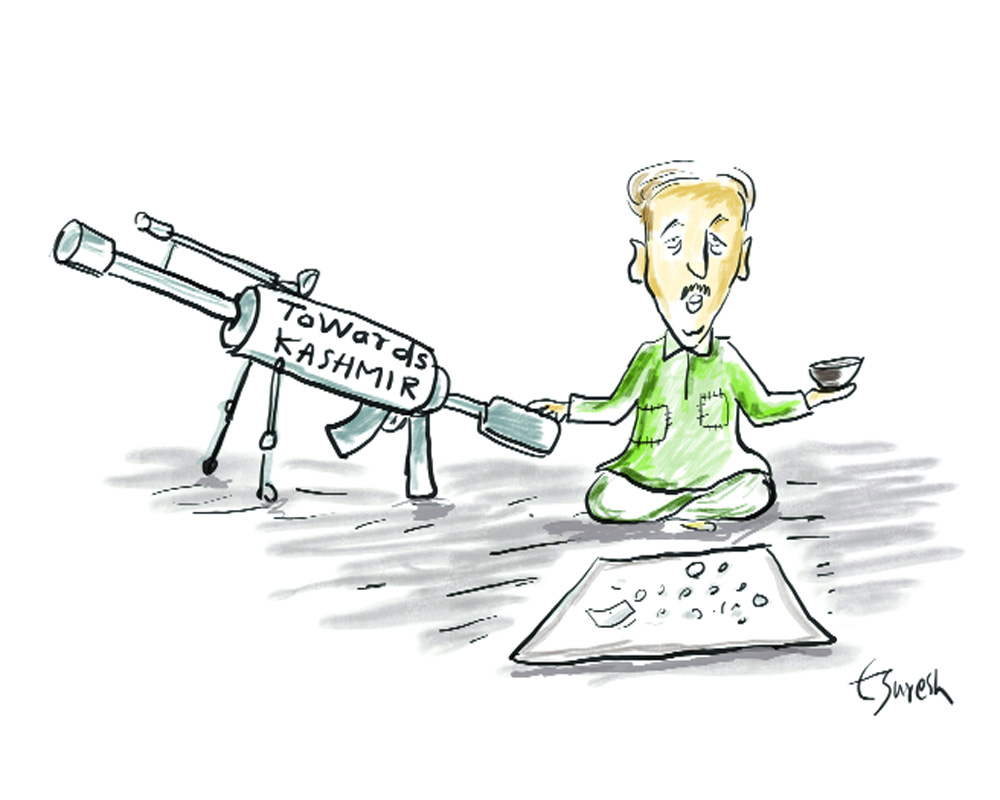
The latest civilian attack in Pahalgam by Pakistan-backed terrorists not only shattered a long-standing unspoken pact against targeting tourists but also reignited calls for retribution, hinting at a dangerous new phase
The latest civilian attack in Pahalgam by Pakistan-backed terrorists not only shattered a long — standing unspoken pact against targeting tourists but also reignited calls for retribution, hinting at a dangerous new phase. The war over J&K is unending. It started in 1947 and has not ceased since the Partition and the birth of Pakistan. It is unlikely to stop even after three full-fledged wars, several skirmishes and many ‘brink of war’ situations.
The doyen of India-Pakistan relations, late Stephen Cohen, said, ‘They will fight a hundred years.’ Add the numerous terrorist attacks by Pakistan (mainly against BJP Governments) and India’s retaliatory covert actions across LoC/IB and the cost is staggering — a setback to the economic progress of the region, countless loss in human lives and deepening roots of hate and violence. During this time, dialogue has not been given a proper chance, thanks to spoilers. Post-Pahalgam, it is déjà vu. The most consequential terrorist attack was on December 13, 2001 against India’s Parliament, the citadel of democracy, by Pakistan’s Jaish-e-Mohammad. The failed encounter near the entrance to Parliament was over in 12 and a half minutes — less time than terrorists took to kill 26 innocent Hindu tourists. Security forces were slovenly in acting to make up for the intelligence and security void in Pahalgam. In 2001, the BJP-led NDA Government took the unprecedented step of mounting the unsuccessful Operation Parakram within 24 hours, which brought India and Pakistan twice to the brink of war. Pakistan’s proxy war then was at its zenith.
Twenty soldiers, 0.5 JCOs and 1.7 officers were being killed in counter-terrorism operations every month — akin to fighting one Kargil every 16 months. By strengthening deterrence — though deterrence is not effective against terrorists — and kinetic operations following terrorist attacks in Uri and Pulwama (as well as political measures like revocation of Article 370), levels of terrorism were significantly lowered from the peak of 4,000 to 5,000 terrorists in 2001 to around 100 terrorists today, of whom 75 are foreigners.
But Pahalgam has punched a hole in the Government’s claim that J&K is free of terrorism and Kashmiris have joined the mainstream. Many have not — due to continuing alienation resulting in considerable local support for terrorists. Otherwise, hundreds upon thousands of overground workers and administration officials would not have been rounded up, with reprisals against families which would rebound and affect J&K’s statehood. Pahalgam was qualitatively different from the previous choice of targets. Earlier, mainly military targets — like Pathankot air base, Uri brigade headquarters and Pulwama CRPF convoy — were chosen. Pahalgam was a civilian target. In the Pentagon’s book, an attack against civilian targets is terrorism.
The cardinal sin of terrorists was breaking the compact with Kashmiri awaam: not to attack tourists. This was the first time they did so; this would hurt the local economy and livelihoods badly.
There was yet another difference. One of the terrorists told the wife of a victim that they were sparing her so that she could tell Modi about the attack. Targeting women and children is taboo for terrorists and insurgents, who also spare doctors.
Terrorists have made Pahalgam personal for Modi. After every major attack, Pakistan has denied its involvement, even after Mumbai 2008 where Kasab was captured. It has always demanded ‘credible evidence’ and invariably suggested a joint probe, though this time a ‘neutral probe’ endorsed by China.
During Parakram, India’s biggest and longest military mobilisation, its initial demands on December 14, 2001 were the termination of activities of Jaish and Lashkar terrorists, detention of leaders and sealing of their offices. These demands were later expanded to Pakistan stopping cross-border terrorism and full renunciation of terrorism in all its manifestations. Pahalgam terrorists chose their targets deep in the hinterland with the advantage of quick escape into high-altitude pine forests. Prime Minister Modi has directed terrorists to be hunted down till the ends of the earth. A bounty of `20 lakh has been offered. India’s retribution so far has been chiefly diplomatic, economic and people-to-people. The already truncated Indian embassy in Islamabad has been scaled down to virtually nothing.
Unprecedented and unknown in effect, the Indus Water Treaty, which had survived all previous conflicts, has been held in abeyance. The war of words has begun: “Not a drop of water from the Indus River will flow into Pakistanâ€; “will bring Pakistan to its knees†are ministerial threats from India. Pakistan has responded with “Indian blood will flow if water is stoppedâ€. Modi has famously said, “blood and water can’t flow togetherâ€.
The long-threatened water wars could start. Usual war cries are also being issued from TV studios. Oft-repeated kinetic plans are being rebranded. Indians are crying out for revenge. A Pakistani minister has said its 130 nuclear missiles are not for show. Nuclear signalling has also begun.
But surprise — surprise: Ceasefire 2021 along the LoC is still breathing. Patriotism and nationalism should not blindside Indians to ground reality — though Pakistan’s signature on terrorist attacks is well known. But a study of Pakistan’s National Security Committee statement in response to the release of India’s CCS decisions post-Pahalgam could balance the debate about victimhood. While Pakistan is the acclaimed epicentre of terrorism, Indian agencies are no longer papal and pristine. Pakistan’s NSC statement mentions Kulbhushan Jadhav and Indian covert activities in Balochistan and Afghanistan. NSA Ajit Doval’s expressed threats on Balochistan are historic. After the serial attacks by BLA in Balochistan recently, including Jaffar Express, Pakistan’s DG ISPR Lt Gen Ahmand Sharif Chaudhary said: “the rules of the game have changedâ€, hinting at Indian involvement. The interview of the Editors of Friday Times, Najam Sethi to Karan Thapar, also helps to clear the fog. Terrorists chose a target that ensured unqualified success and quick exit. Nearly a week has come to pass.
There is no news of contact with terrorists. Their exfiltration will nail the blame on the Pakistan complex. India’s inevitable kinetic response must be measured — not driven by public sentiment and emotion and below the escalation threshold. In Balakot, high risk of escalation was underwritten by Trump and high domestic electoral reward. Trump 2.0 is unpredictable, though Bihar elections are approaching. For Pakistan, no risk is too high to keep the Kashmir masalacentre stage.
(The writer, a retired Major General, was Commander, IPKF South, Sri Lanka, and founder member of the Defence Planning Staff, currently the Integrated Defence Staff. Views are personal)



