











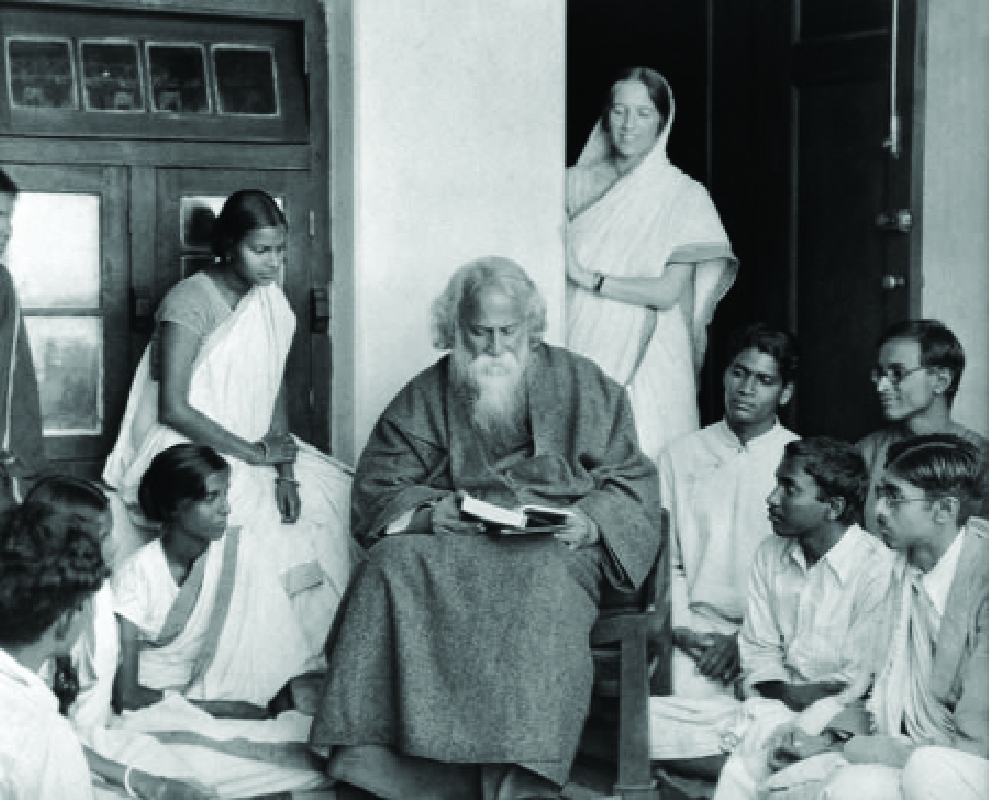
When Rabindranath Tagore founded Visva-Bharati University, he envisioned it as a place “where the world makes a home in a single nest”. His dream was not to Westernise Indian education, but to universalise it — to let the winds of the world blow freely through India’s corridors of learning without uprooting the Indian tree. A century later, that vision appears to be taking root once again. The decision to allow foreign universities to establish campuses in India marks a defining moment in the nation’s educational journey. India’s civilisation has always been broad, inclusive, and intellectually open.
The ancient universities of Takshashila and Nalanda remind us of our rich tradition of cosmopolitan scholarship. History is replete with accounts of scholars from China, Greece, and Central Asia travelling to India in search of wisdom and dialogue.
Today, the arrival of foreign universities is often viewed through economic or competitive lenses. Yet its deeper significance lies in something more profound — the revival of India’s ancient spirit of dialogue between seekers of truth across cultures. It signals India’s readiness to engage with the global education ecosystem on its own terms. Diversity, excellence, and affordability will soon stand at our doorstep. For thousands of Indian students, the dream of an international degree no longer demands the crushing expense of studying abroad. The world, quite literally, is coming home.
This exchange, however, will not be one-way. The partnership between Indian and foreign institutions promises to be both cooperative and competitive. Indian students will benefit from exposure to global pedagogies, research methods, and multidisciplinary learning environments. In return, foreign universities will gain unique insights into the opportunities and challenges of one of the world’s fastest-growing knowledge economies. The “global classroom” is already taking shape — where a student from Jaipur debates a peer from Japan, and a professor in Delhi co-guides a thesis with a mentor in Melbourne.
Yet the road ahead is not without challenges. The internationalisation of education, if left unchecked, could become a luxury reserved for the privileged. Many global programmes still cater primarily to affluent learners. India must therefore establish strong frameworks for scholarships, flexible credit transfers, and “earn while you learn” opportunities. Equity and access must remain at the heart of this transformation. The true spirit of Indian education lies in balancing public good with private growth. The nation must ensure that education does not become a commodity, but continues to serve as a catalyst for character and creativity.
Importantly, India is no longer merely a recipient of global influence; it is also emerging as a contributor. Several premier Indian institutions, including the IITs and IIMs, are now setting up campuses abroad. This represents not just the export of curriculum, but the sharing of an Indian educational philosophy — one rooted in moral reasoning, inclusivity, and holistic growth.
Among the most promising innovations in this evolving landscape is the Academic Bank of Credits (ABC). This initiative allows students to accumulate and combine credits from both Indian and foreign universities, paving the way for dual or joint degrees. It recognises that learning is a lifelong, borderless pursuit.
A student might begin her degree in India, complete a semester in Singapore, and finish her research in London — all within a single academic framework. The result is not only greater mobility, but a deeper intellectual maturity born of diversity.
Meanwhile, the classroom itself is transforming. The rise of Artificial Intelligence (AI), virtual laboratories, and hybrid learning models has made education more interactive and cost-effective. Students can now attend lectures by global faculty, collaborate with peers across continents, and simulate experiments in real time. Yet technology cannot replace the human touch. The teacher’s role as a mentor, guide, and moral compass has never been more vital. We must ensure that machines do not erode the spark of curiosity and the depth of reflection that define true learning. This transformation calls for introspection. What do we truly value in education? As India opens its universities to global influences, it must also nurture critical thinking, empathy, and ethical awareness. The test of education lies not merely in employability, but in enlightenment. The challenge is to engage with global diversity without losing one’s distinct identity.
The global winds, then, need not uproot the Indian tree — they can help it bloom. India’s entry into the global education marketplace is not merely a policy shift, but a cultural evolution. It signals a confident assertion that Indian education can stand shoulder to shoulder with the best in the world while retaining its moral centre.
If pursued with vision and vigilance, this initiative will allow India’s universities not only to absorb global knowledge but also to radiate their own light outward. The Tagorian nest, it seems, is ready once again — for the world to make its home.
Prof Prem Kumar Kalra is the Senior Director of the Dayalbagh Educational Institute, Agra, and a former Director of IIT Jodhpur. Prof JK Verma is the Head of the Department of English at the Dayalbagh Educational Institute; views are personal



