




“The United Nations was not created to take mankind to heaven, but to save humanity from hell.” Dag Hammarskjöld’s words ring with renewed urgency as the UN marks its 80th anniversary this year. Born in 1945 from the ashes of the Second World War, the institution was meant to embody a pledge of “never again” — a promise of peace, dialogue, and cooperation among nations. Eight decades later, however, the UN stands at a fragile crossroads. It is weakened by rivalries among major powers, pressured by nationalism and isolationism, and tested by crises that often move faster than its machinery can respond. The latest diplomatic storm — Israel’s declaration of Secretary-General António Guterres as persona non grata — illustrates this precarious moment. The move followed Guterres’s comments highlighting civilian suffering in Gaza and calling for urgent humanitarian relief.
Israel dismissed those words as biased, interpreting them as undermining its right to self-defence. By barring entry to the UN’s top diplomat, Israel delivered not just a personal rebuke but a broader statement: even the Secretary-General, custodian of the UN Charter, is not beyond rejection. This unprecedented step cast a long shadow over United Nations Day, observed globally on October 24.
A day meant to celebrate multilateralism instead became a stark reminder of the scepticism that increasingly surrounds global institutions. The term persona non grata has long been a sharp instrument in international diplomacy, most often used against foreign ambassadors to signal rejection. When deployed against the UN Secretary-General, however, the symbolism is extraordinary. It is not merely António Guterres being told he is unwelcome; it is the very idea of the UN as an impartial mediator being
pushed aside. The episode forces deeper reflection: Is the UN still capable of serving as the one global table where adversaries meet? Or has it been reduced to another arena where national grievances overwhelm the ideals of cooperation? The answer depends largely on how the world’s most powerful nations choose to treat the institution. Unfortunately, the outlook is troubling.
In Washington, former President Donald Trump’s return to power has brought a more forceful scepticism of the UN. During his first term (2017–21), Trump dismissed the body as ineffective and wasteful. Many hoped that stance would remain an anomaly. But in his second term, he appears more emboldened, intent on sidelining the UN from global decision-making. His “America First” message portrays the UN as a globalist bureaucracy draining US resources. In his speeches, Trump boasts of “ending seven wars” in the early months of his new term — claims aimed at thrilling his domestic base while subtly undermining the UN Security Council, the body mandated to safeguard peace and security. If America, the UN’s most powerful member and principal financial backer, treats it with disdain, the institution’s legitimacy inevitably weakens.
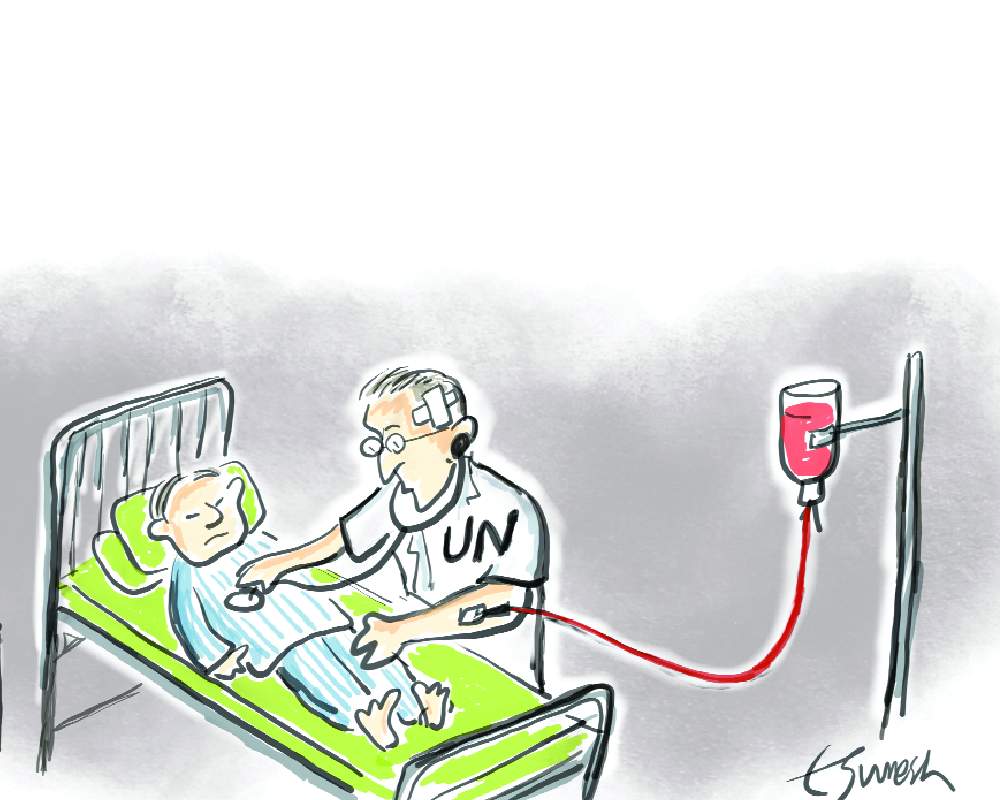
Beijing, meanwhile, treats the UN as a stage for influence. Through its contributions to peacekeeping operations, partnerships along the Belt and Road Initiative, and leadership bids within UN agencies, China utilises multilateralism to expand its soft power. Russia, under pressure from sanctions and diplomatic isolation, wields its Security Council veto to blunt criticism and protect its interests. The result: paralysis, mistrust, and an institution caught in the grip of great-power rivalry. And yet, dismissing the UN as irrelevant would be wrong. Its humanitarian work in war zones, refugee assistance, climate negotiations, and public health campaigns remains vital. During the pandemic, the World Health Organisation — despite criticism — coordinated a global response. UN agencies still deliver food, shelter, and protection to millions trapped in conflicts. The problem, therefore, is not the UN’s utility but the political will of member states to empower it.
The Israel-Guterres episode demonstrates what is at stake. If humanitarian concerns can be silenced by threats of exclusion, diplomacy risks becoming hollow — an echo chamber of national interests rather than a platform for compromise. The growing rise of nationalism and isolationism deepens this risk, making governments less willing to accept scrutiny from international institutions. Reform or Decline?
At 80, the UN faces not only a survival test but also an opportunity for renewal. Calls for reform are hardly new — expanding the Security Council, ensuring accountability in peacekeeping, and strengthening conflict-prevention mechanisms have long been on the agenda. What has been lacking is genuine political will. Middle powers such as India, Brazil, and South Africa can play a decisive role here. India, in particular, has argued that its population size, democratic record, and economic strength warrant a permanent Security Council seat.
But beyond the question of membership, the real opportunity lies in shaping a multilateralism that reflects today’s fractured world — one not dominated solely by Washington, Beijing, or Moscow, but sustained by broader coalitions of states committed to problem-solving.
A Mission That Endures Hammarskjöld’s reminder — that the UN was designed not to bring heaven to earth but to save humanity from hell — remains the guiding compass. The task of preventing catastrophic wars and fostering dialogue is as urgent today as it was in 1945. From Gaza to Ukraine, from forgotten conflicts in Africa to looming climate disasters, the need for international cooperation has never been
more obvious.
The UN’s future is uncertain. Its authority is under attack, its leaders challenged, and its structures weighed down by rivalry. But history shows the organisation’s resilience. It survived Cold War paralysis, adapted to new global challenges, and expanded its scope from peacekeeping to sustainable development. Its survival today will depend not on lofty speeches but on whether nations, large and small, can rediscover the value of working together in an age of division. United Nations Day should not be a mere commemoration. It must serve as a call to action. At 80, the UN’s fate rests less on the hostility it faces and more on the resolve of its members to make multilateralism meaningful again.
In a world bristling with conflict, mistrust, and populist rhetoric, the UN remains humanity’s imperfect but indispensable safeguard. The challenge now is to ensure it can still fulfil its most basic mission: not to deliver paradise, but to prevent the descent into chaos.
The writer is a Professor at the Centre for South Asian Studies, School of International Studies and Social Sciences, Pondicherry Central University