











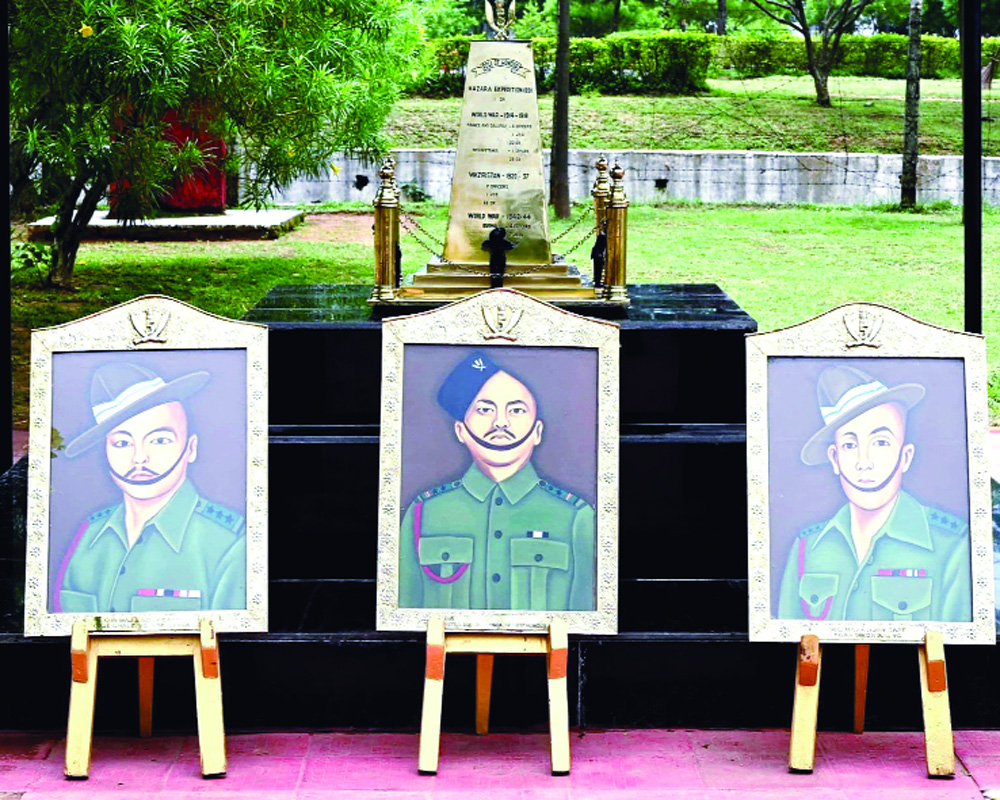
On 26 June 2025, the legendary Second Battalion of the Fifth Gorkha Rifles (Frontier Force), fondly called the “VC Paltan,” marks the 81st anniversary of Victoria Cross Day — a stirring tribute to unparalleled courage, sacrifice and tradition. The Battalion’s story is etched in both history and legend
The Victoria Cross (VC) For Valour was the highest award for gallantry between 1856 and 1947 when the British Indian Army won 153 of the 1340 VCs, 25 VC winners being Gorkhas. The first VC was won on 26 June 1857. Till 1911, Indians were not eligible for VC. Instead, they were entitled to its equivalent Indian Order of Merit. The first Gorkha winner of IOM was Kishanbir Nagarkoti of 1/5 GR (FF). He bagged it four times earning a Gold Clasp. The highest number of VCs awarded in a single action over a protracted period was 11 VCs at Rorke’s Drift in 1879 during the Boer War. The Sikh Regiment earned a maximum number of 14 VCs as a regiment. The Indian battalion that won the maximum number of VCs — Three — is the Second Battalion Fifth Gorkha Rifles( Frontier Force), all between 1943-44, uniquely two in a single action within 24 hours at Bishanpur near Imphal which along with the Battle of Kohima, prevented the Japanese from invading India.
Today, 26 June 2025 is the 81st anniversary of VC Day being commemorated by the VC Paltan. Winning the For Valour medal is a mix of opportunity, luck and courage. On 26 May 1943, Havildar Gaje Ghale led the assault on Basha Hill for the third time; though severely wounded, he charged with his platoon against murderous crossfire, refusing to be evacuated to earn the VC. One year later heavily outnumbered by the enemy Subedar Netra Bahadur Thapa defended Mortar Bluff, BP and Water Piquets with his platoon unsuccessfully against repeated Japanese assaults for eight hours and was killed, earning VC posthumously. Naik Agan Sing Rai led the counter-attack; silencing a 37mm gun and later a bunker full of Japanese.
His indomitable courage and ferocity forced the remaining Japanese to flee and the platoon to recapture the post within 24 hours. Rai won the third VC protecting the pivotal post to Imphal. Destiny would take the Battalion back to Mortar Bluff area 65 years later on a routine tour.
The British did not permit Indian officers to command Gorkha soldiers which happened only after Partition 1947. Joining the Gorkhas on commission became very popular; also to travel to Nepal to learn about them, their land, language and culture. In 1959 I visited Barpak where Gaje Ghale was born. I met his father and others in the village which in 2015 was the epicentre of Nepal’s horrendous earthquake. This May, VC Paltan’s ex-servicemen in Nepal endearingly called Budhos, visited Barpak for the inauguration of a Gaje Ghale monument. In 1985, I met Agan Sing Rai again in his village Apswara, Okhaldhunga. He was popular as ‘VC Baje’. Rai re-enacted the Mortar Bluff battle for me with every bit of battle craft laced with shock and awe but aided by Hercules’s rum. He said his recently promoted Brigade Commander Brig Hedley, who was his former Commanding Officer, was breathing down his neck. He was mortally scared but retook Mortar Bluff. In 1978, I went looking for the late Subedar Netra Bahadur Thapa’s village but probably had the wrong address. In 2022, 2/5 GR Budhos found the village — Raghugaon — in Tanhau where Netra’s elder brother’s children were staying. They found a plaque by the British 5 RGR Association which had built a Middle school in his name.
The Ranchi reunion was no different from previous ones: a Sainik Sammelan followed by a wreath laying at the mobile VC memorial built in Trivandrum after the 1971 war. A Bada Khana was the high point of the VC Day where the Gorkha spirit was unleashed. The Madal or its improvised equivalent a jerry can provide the right rhythms for traditional Gorkha dances.
The British used to call it ‘nautch’ and male Gorkhas would impersonate females — ‘marunis’ becoming ‘tarunis’. There are stories of happy men falling for Taranis. In a vintage era, Budhos used to the Kodo elixir made from millet would cheerfully yield to Old Monk rum while calling one another with the last two digits of their erstwhile Army numbers — Pachees (25), Sattavan (57) and Pachasi (85). The Gorkha magic is in full play.
The VC Paltan has its famed institutions and personalities to whom besides the winners of gallantry awards and the martyrs, the Remembrance Day is dedicated. Bachelor Mess Waiter Tek Bahadur fell in love after being superannuated and returned as he was indispensable to the history of every piece of silver and memento in the Officer’s Mess though he also ensured young officers were kept on leash in the Mess. Barman Pritam Singh was the solitary sardar in the Paltan. He kept liquor cards and ensured adequate levels of alcohol in the bloodstream.
He kept inventory of any rakhi abuse. Mohammad Yahya, the Tailor Master, was the Battalion’s Wikipedia. He went into battle mustered as the Mess Cook. He could never keep his overbooked Order Book on schedule. His reply to the ever-delayed delivery of clothing invariably was Bholi (tomorrow) which never came. The Brits could not pronounce his name so they called him Charly, the Paltan called him Bholi Charly. His son as the Paltan’s tailor is Mannu. The Battalion has fought all the wars — the recent actions in Ladakh including Op Snow Leopard —and earned several gallantry awards. The aim is to replicate the triple VCs with Param Vir Chakras. It is getting there through bold and courageous counter-insurgency operations like Rato Khukuri in J&K and other operations in the northeast. Lt Gen ZC Bakshi MVC, VrC, VSM, MacGregor Medal was the hero of his time. Later came Lt Gen Faridoon Bilimoria PVSM, ADC who rose to be Army Commander. Maj Gen Deepak Mehra KC, AVSM, VSM and Col KK Sharma Shaurya Chakra, Sena Medal and Bar are gallant Gorkhas.
The Battalion’s most recent achievement was winning the COAS citation for outstanding performance in Galwan. When not in battle, and in peace station, the battalion excels in sports, adventure and professional competitions. Subedar Krishna Bahadur Kunwar scaled new heights by climbing Mount Everest for a second time last month as part of the Indian Army’s expedition. Naib Sub Ros Kumar Gurung represented the Indian Army paragliding team at the Telomoyo Cup 2024 in Indonesia.
The Battalion was selected as the only Infantry unit from Eastern Command to lead the Republic Day marching column in 2024 and 2025.
Hav Bhabindra Malla Thakuri captained the Indian Army football team during the Durand Cup 2024 while two other Paltan players were selected for the Army team 2025-26.
The equally memorable Gorkhas are one’s buddies, the radio operator and the driver. Tularam Pun was great at the wheel. In 1957 in Srinagar on a shopping errand for the Officer’s Mess, I asked him to park the 1-ton truck behind a black Fiat outside the Nedou’s Hotel. I spent the rest of the day looking for Tularam. Late in the evening, I found the 1-ton glued to the black Fiat outside Badami Bagh.
There was also the religious teacher, Subedar Maniram Pokhrel who belonged to Arghakhanchi from where his tribe comes. Just before the 1971 war, he developed an unstoppable and loud hiccup. Although the Baman baje is required to go into battle, he had to be made LOB (Left Out of Battle) as he became EW for the enemy. The grand old man of the Paltan is the Subedar Major, many of whom rose to Everest heights in Nepal.
To name a few, Hony Capt Giriprasad Burathoki, Sardar Bahadur, OBI, MC, MBE became Governor of a province, Member of Parliament and Defence Minister of Nepal. Hony Captain Indrabir Thapa, Sardar Bahadur, OBI, IOM, MC was also Governor and Member of Parliament. The list of the brave and famous is unending. To the likes of them, the VCs, the martyrs and the Unknown Soldier, the Paltan makes a grand salute from Ranchi pledging to keep the flag flying high.
(The writer is an Army Veteran. He writes extensively on defence matters and anchors Defence Watch on Doordarshan. Views expressed are personal)



