










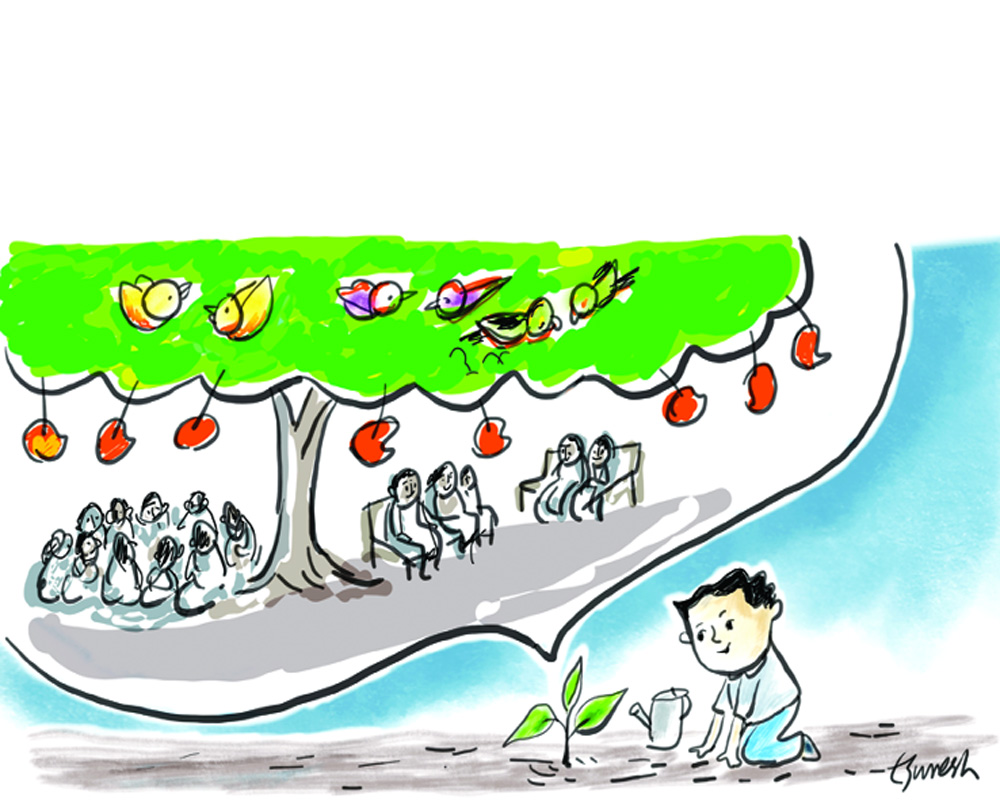
As India marks Van Mahotsav 2025, the “Festival of Trees” carries more urgency than ever. What began in 1950 as a tree- planting initiative by KM Munshi has since evolved into one of the nation’s most vital environmental movements
Every year, from July 1st to 7th, India celebrates Van Mahotsav, the “Festival of Trees.” Initiated in 1950 by Shri KM Munshi, the then Union Minister for Agriculture, this national tree-planting drive was envisioned to encourage forest conservation and environmental stewardship. Over the decades, it has grown into one of India’s most impactful ecological campaigns, raising awareness about the vital role trees play in sustaining life.
In 2025, as India and the world face intensifying climate challenges, this celebration takes on renewed urgency. The theme for this year, “Planting Trees for Resilience,” underscores the reality that trees are not just green adornments of nature — they are our protectors. They safeguard our homes, farmlands, water sources, urban landscapes, and, ultimately, our lives.
The monsoon season has once again brought severe devastation — floods, landslides, cloudbursts, and flash floods across regions like Himachal Pradesh, Uttarakhand, Sikkim, and the Northeast. Hills have collapsed, rivers have overflowed, and entire communities have been swept away.
At the same time, parts of central, western, and southern India are battling delayed or inadequate rainfall, resulting in droughts, plunging water levels, failing crops, and depleting groundwater. This simultaneous crisis — flooding in some regions and drought in others — is becoming more frequent each year.
A major contributor to this imbalance is environmental degradation, especially deforestation due to development, mining, road-building, and unregulated urbanisation. Trees play a critical role in managing rainfall by absorbing water, reducing surface runoff, and binding soil. When forests are cleared, rainwater rushes unchecked over barren land, causing erosion, landslides, and flooding.
In cities, the loss of tree cover leads to clogged drains, flash floods, and higher temperatures. In villages, it exacerbates droughts and depletes soil fertility.
Experts warn that over 60 per cent of India’s land is vulnerable to natural disasters. According to the Swiss Re Catastrophe Report, India suffered economic losses of over $12 billion (`1 lakh crore) in 2023 alone due to natural calamities — a significant jump from the decade’s annual average of $8 billion.
In this context, tree planting is more than an environmental activity — it is a life-saving strategy. Trees act as natural infrastructure. Their roots stabilise soil, absorb rainwater, reduce landslide risks, purify air, lower temperatures, and recharge groundwater.
They are among the most effective defences against climate-induced disasters, especially in a geographically diverse country like India. Consider Odisha’s mangrove forests. During the devastating 1999 super cyclone, villages shielded by mangroves suffered far less damage than those without.
Since then, Odisha has restored large tracts of mangroves, offering effective protection during cyclones like Phailin (2013) and Fani (2019). Research shows that just one hectare of mangroves can reduce wave energy by up to 60 per cent, shielding communities from tidal surges and storm winds.
In hilly states like Himachal Pradesh and Uttarakhand, deforestation on slopes has intensified landslides. Yet reforestation efforts, especially those led by Eco Task Forces supported by the Army, have helped reclaim barren hills. Indigenous trees like oak, pine, and bamboo are being planted to stabilise slopes and prevent erosion. Studies confirm that tree-covered villages endure less monsoon-related damage.
In drought-prone regions like Marathwada and parts of Rajasthan, agroforestry is proving transformative. Farmers who integrate trees such as neem, moringa, or amaltas with crops report improved soil moisture, more stable yields, and better drought resistance. These trees also provide fruit, fodder, and shade while supporting groundwater recharge. In some cases, farmers have recorded yield increases of up to 30 per cent due to agroforestry practices.
Urban India, too, is reeling from rising temperatures and air pollution. In 2024, several cities hit scorching highs of 48–49°C, leading to heatstroke-related deaths. Urban trees act as natural air conditioners, cooling their surroundings by up to 10°C. To promote green urban spaces, the Government of India launched the Nagar Van Yojana (NVY) in 2020, aiming to establish 1,000 Nagar Vans or urban forests in cities.
The programme encourages active involvement of communities, local bodies, NGOs, and educational institutions to build cleaner, greener, and healthier cities.India’s broader climate commitments also emphasise forest restoration. Under the Paris Agreement, the country has pledged to create an additional carbon sink of 2.5 to 3 billion tonnes of CO2 by 2030 through increased forest and tree cover.
The India State of Forest Report 2023 indicates that 25.17 per cent of the country’s land is under forest and tree cover, with a carbon stock of 30.43 billion tonnes of CO2 equivalent. Government programmes like the Green India Mission and CAMPA (Compensatory Afforestation Fund Management and Planning Authority) aim to strengthen afforestation efforts nationwide. However, the responsibility of greening India cannot rest with the Government alone — it must become a collective movement. The recent “Ek Ped Maa Ke Naam” campaign, launched by the Prime Minister in 2024, encouraged millions to plant a tree in memory of their mothers, transforming tree planting into a deeply personal and community-centred act.
Educational institutions across India are nurturing eco-conscious students through the School Nursery Yojana and Eco-Clubs. In villages, joint forest management committees, in collaboration with local residents, are reviving degraded forests. For many rural and tribal communities, forests are their lifeline, providing food, herbs, bamboo, and other essentials. Thriving forests enhance water availability, support agriculture, and build disaster resilience.
As we celebrate Van Mahotsav this year, let us move beyond symbolic acts. Tree planting must be thoughtful and context-sensitive — choosing native species, matching local soil and climate conditions, and ensuring sapling care for at least two to three years to ensure survival and growth.
Every sapling planted today is a promise — to the environment, to future generations, and to ourselves. Trees are our shield, our lifeline, and our legacy. This Van Mahotsav, let every school, roadside, farm, and barren hill become a beacon of restoration. For in each tree lies the hope of a greener, safer, and more resilient tomorrow.
(The writer is former Executive Director, National Institute of Disaster Management, Government of India. Views are personal)





