











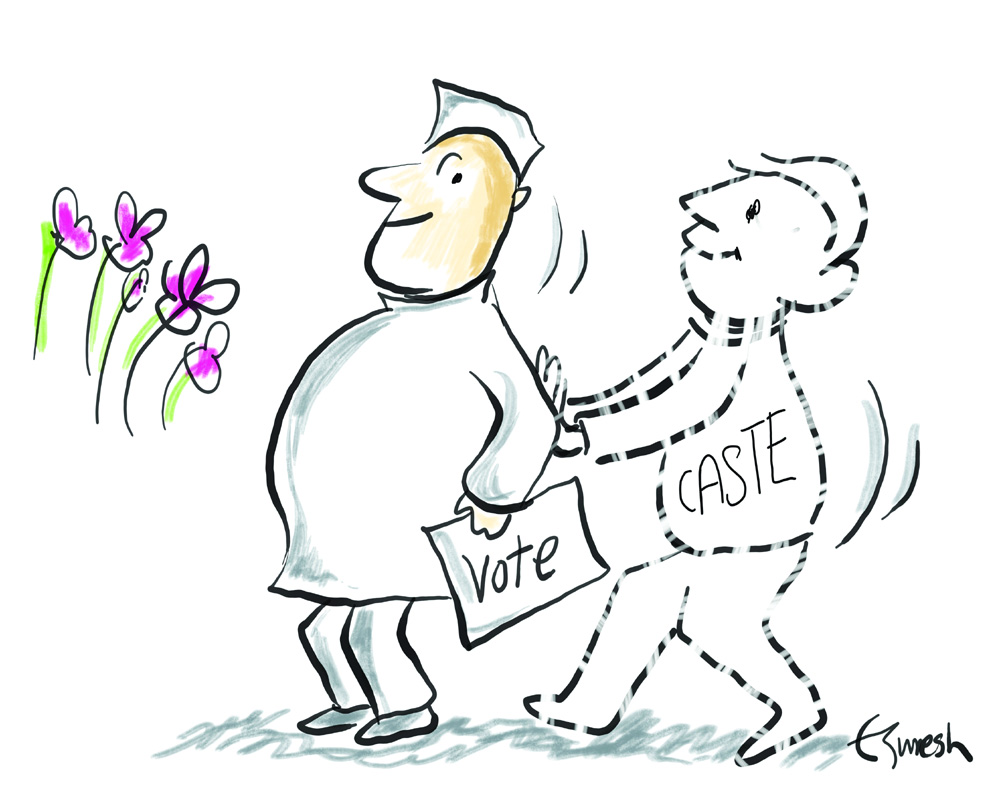
A caste-based headcount could bring long-overdue clarity to the true composition of Indian society. But with clarity comes complexity and a reckoning with uncomfortable truths
While it is chivalrous of the Congress and other opposition parties to welcome the announcement of a caste census in the next round, it is more than likely that the 1931 Census was hitherto the last one where the mention of caste was included. An old gentleman long ago had told me that in 1941, the caste column was withdrawn to ensure that Muslims were not embarrassed. He revealed this to me before he passed away from this world.
Gradually thereafter, the Census went down in importance as a matter of public interest. People were interested in how much the population of India had increased. With the mention of caste, there is likely to be a revival in the interest in details hereafter. To ensure that all communities are treated equally, the Muslims will be asked to declare their caste, as will be Christians, or as before, the Sikhs. The three broad divisions among the Muslims are: the Ashrafs, Ajlafs and Arzals. The last name would be like the Pasmandas.
The Ashrafs would be the uppermost, either those who believe that their origins lie outside India, as well as those who converted to Islam from an upper Hindu caste, say Brahmins or Rajputs. The Ajlafs, such as Dhobis, Darzis and others are the second category. But then, there are many other distinctions, such as the Mughuls, Pathans and others whose origins were in Uzbekistan. Pathans likely originated in Afghanistan.There are the Syeds, Shaikhs, Arab-origin Muslims, Iranian-origin Shia Muslims, Bohras,
Khojas, Ismailis, Sufiyas, Ahmadiyya, Memons (a Khoja subsect), Konkanis, Moplah etc.
The electoral utility of the proposed caste census could be enormous. The contesting candidate could know instantly, the number of voters of the various castes existing in his country, so that he or she can campaign to the local taste. Beyond the electoral utility, the political utility can also be substantial. Who deserves a reservation can be easily ascertained.
According to the courts, reservations are continued to the Dalits and some OBCs. Muslims are excluded from any reservation unless, of course, they switch over to Hinduism or Sikhism. A distinguished sociologist has said that Indian society is best analyzed by a detailed study of caste. Just as Dr Ram Manohar Lohia had said that in India, caste is class. In many ways, this gentleman was correct. For example, many a historian cannot resist the temptation of calling himself a “Brahmin Catholicâ€. There are many Muslims who proudly claim they are “Rajput Muslimsâ€. Uncannily, this writer grew up much beyond his university years to conclude that the Muslim community is one of equals, and certainly free from the scourge of casteism.
It took years thereafter that Muslims also had their sections. First, a Bohra trader told him that all Bohras were converted to Islam from having been Brahmins. In due course, the writer learnt that Khojas had their specific origin; they were Halai Lohanas, whereas Memons were Kutchi Lohanas.
Later, an Urdu teacher made it clear that he was a Mughul and had migrated from Uzbekistan. Afghans usually keep their surnames as Pathan, whereas the Mughals prefer either Mirza or Baig. There is no doubt that reservation is a phenomenon that fascinates the average Indian. The moment caste is declared in the census results, quite a several persons are likely to demand to be given reservation rights, for one or another excuse. The Government’s answer to such people is likely to be a bureaucratic, “No, you are a Muslim and entitled led to be reservationâ€. Do not believe that several Arzals would not mind jumping the fence of religion. In India, particularly especially from the point of religious loyalties, things are undergoing a churn.
In the Nehruvian era, it was advantageous to belong to a minority community. However, at present, some perceive it to be an advantage to belong to the majority. Remember, in the medieval era, many a conversion took place for the temptation of a job or to escape persecution, i.e., to insure oneself against the worst. If the country is gearing itself up into a reform mode, it would be desirable to introduce compulsory voting. The elections would then reflect the true opinion of the entire electorate. Mind you, if some voter has an emergency around the voting time, he or she, within a month of either side of the voting date must explain the problem to obtain an exemption. In the absence of such an application, he or she should run the risk of being struck off the electoral rolls, but with the opportunity of explaining his or her position on the electoral authorities. The intent would be to make them, and indeed everyone, realize that to vote is all-important. To look back at the early days after independence, minorities had a disproportionate influence over the results. The reason was the low voting rates of the majority. With the majority voting more dutifully, look at the dramatic changes in the national policy; not merely a change in the parties getting elected.
In any case, it is in the ultimate nature of democracy that everyone tries to vote. We should note that compulsory voting is the law in 22 of the world’s democracies, including Australia, Belgium and several South American countries plus a couple of African ones.
(The writer is a well-known columnist, an author and a former member of the Rajya Sabha. The views are personal)



