











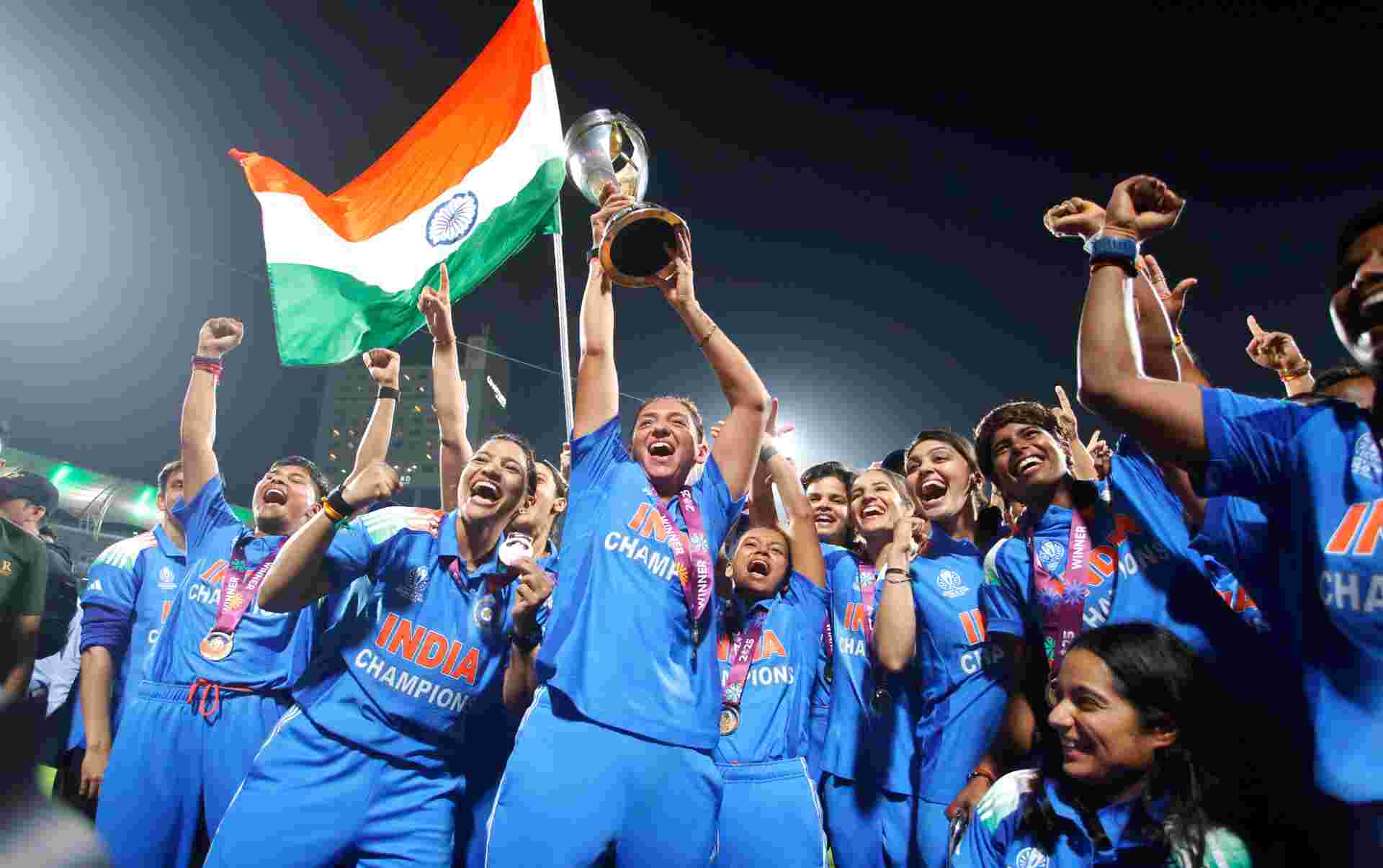
It was never merely a cricket match, nor just another trophy. When the lights dimmed at Navi Mumbai’s DY Patil Stadium on 2 November 2025 and Harmanpreet Kaur lifted the ICC Women’s Cricket World Cup to a sky ablaze with fireworks, it felt as though a nation had exhaled after decades of holding its breath. India had finally conquered the world stage in women’s cricket — a ‘1983 moment’ — defeating South Africa by 52 runs in a performance both poetic and powerful. Smriti Mandhana’s exquisite 134 not out was a masterclass in grace, while Deepti Sharma’s composed half-century and five-wicket haul sealed the triumph. Beyond the roar was something quieter: India’s daughters had rewritten their place in the country’s sporting imagination.
This victory was about courage, conviction, and the invisible labour of those who dreamed when no one was watching. For five decades, Indian women’s cricket has been a story of defiance — of women who played not for fame but for the right to belong. It began in 1973 under pioneers like Shantha Rangaswamy, whose team played on empty fields with borrowed kits. Their debut came against the West Indies in 1976, but progress was slow and underfunded. Milestones came quietly: the first ODI win in 1982, runners-up finishes in 2005 and 2017, and flashes of brilliance that never quite set the nation alight. By 2025, all that had changed. The Women in Blue had turned history on its head. With 168 ODI victories, seven Test wins, and consistent T20I performances, their dominance was undeniable. This World Cup win — the first by a non-Western nation — shattered the duopoly of Australia and England. Mandhana’s century became the highest score in a Women’s World Cup final, while Sharma’s 5/34 made her the first Indian woman to take a five-for in a global decider.
Over 500 million people watched the semi-final against Australia — proof India wasn’t watching women’s cricket out of novelty, but necessity. Behind these numbers lie stories that mirror India’s social mosaic. Harmanpreet Kaur, the captain from Moga, began with a bat her father carved from a willow branch. She faced resistance from those who saw cricket as a man’s game, yet persisted, debuting in 2009 and leading India to Commonwealth gold in 2022. Mandhana’s story is one of resolve — from a wrist fracture at eleven to becoming the first Indian woman to score a double hundred in ODIs. Deepti Sharma’s journey — from being trolled for an overstep in 2022 to hero of 2025 — reads like redemption. Richa Ghosh, from Bengal, became the first Indian to win the U-19 (2023), WPL (2024), and senior World Cup before turning twenty-three — proof that a generation now believes no ceiling is unbreakable.
This diversity is the team’s quiet strength. The 2025 squad represents India’s regions — from Maharashtra’s academies to Bengal’s maidans, Gujarat’s outfields to Himachal’s hilltop pitches. In them, India sees itself: urban and rural, privileged and striving, multilingual yet united by hope.Yet the ascent of women’s cricket has not come without bruises. For decades, players carried not just kits but the weight of inequality. It was only in 2022 that the BCCI announced equal match fees — Rs 15 lakh for Tests, ?6 lakh for ODIs, and Rs 3 lakh for T20Is — a landmark step. Until then, women earned a fraction of men’s pay. Even now, gaps persist: the Women’s World Cup prize money was Rs 51 crore, far below Rs 125 crore for the men’s event. Beyond pay, women’s matches still fight for coverage and legitimacy. Players face online abuse and intrusive questions about “settling down”. Only one in five of BCCI’s 40,000 grounds hosts women’s tournaments. The inequity runs deep, but the resistance runs deeper.
The Women’s Premier League (WPL), launched in 2023, marked a turning point. The first season became the most-watched domestic women’s league, attracting sponsors and global viewers. The professionalisation of the women’s game is now real. Its social impact is profound. In a country where girls’ sports long occupied the margins, the WPL and the national team’s success are rewriting that story. More parents are enrolling daughters in academies, and brands are finally backing female athletes. The question has shifted from whether women can play to how far they can go. As the Women in Blue prepare for the home Ashes in 2026, the challenge moves from conquest to continuity. The BCCI plans to reinvest WPL earnings into grassroots academies.
Yet the revolution remains incomplete until the gender gap in visibility and endorsements — with male cricketers still earning nearly four times more — is narrowed. yIndia’s Women in Blue are not anomalies; they are the nation’s truest reflection — rising from the same soil that births its contradictions, where girls are taught to shrink their dreams yet choose to stand tall. When Harmanpreet lifted the trophy under the Mumbai night sky, she wasn’t merely holding silver; she was carrying the legacy of countless women who were told they couldn’t — and proved they could. For every young girl gripping a bat in a dusty field, this moment is both a mirror and a message: play boldly, live freely, and dream without limits.
The writer is an author, political analyst and columnist; views are personal



