










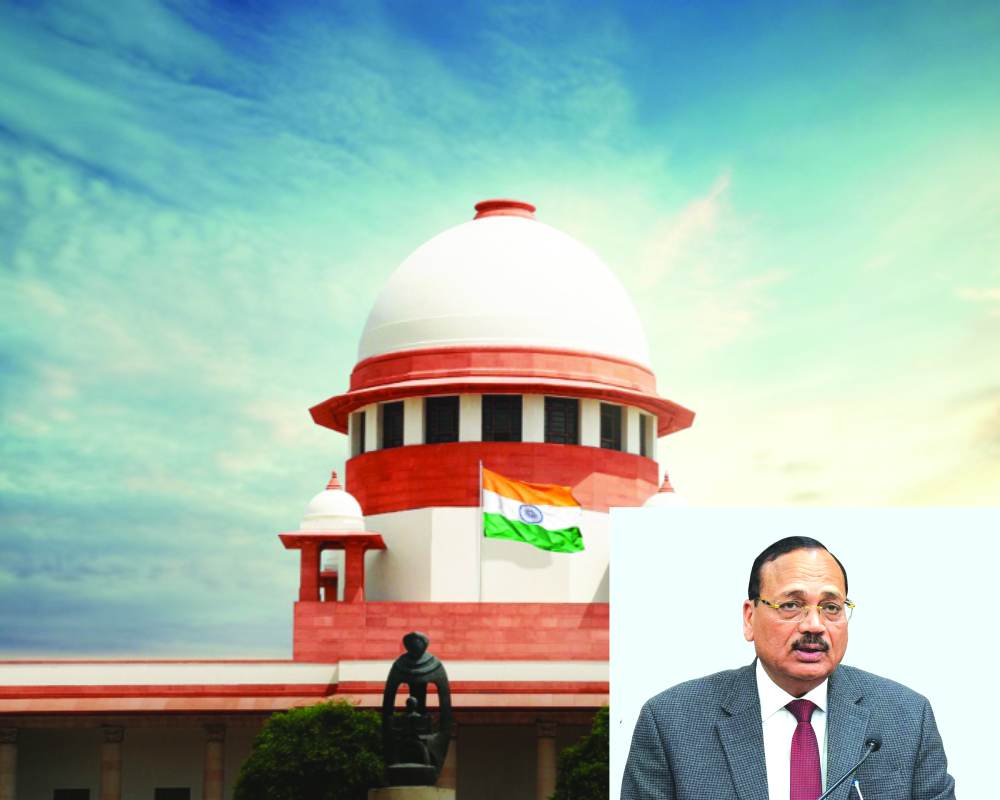
Justice Surya Kant, designated as the 53rd Chief Justice of India (CJI), is set to assume office on November 24, 2025, succeeding Chief Justice BR Gavai. His appointment marks a significant milestone, as he will be the first person from Haryana to hold the country’s highest judicial office.
His journey from a village in Hisar district to the highest echelon of the Indian Judiciary is marked by four decades of persistence, scholarship and extensive service.
Justice Kant commenced his legal career at the District Court, Hisar, in 1984 before shifting his practice to the Punjab and Haryana High Court in Chandigarh the following year, focusing on Constitutional, Service and Civil law.
His sharp legal acumen led to swift recognition, and he was appointed the youngest Advocate General of Haryana in July 2000 at the age of 38. He began his judicial career in 2004, serving as a permanent Judge of the Punjab and Haryana High Court for over 14 years, where his judgments became known for blending legal precision with social awareness (notably in prison reform).
Following a brief but significant tenure as Chief Justice of the Himachal Pradesh High Court, Justice Kant was elevated to the Supreme Court of India on May 24, 2019. He currently serves as the Executive Chairman of NALSA, reflecting his long-term commitment to legal aid, having previously served as a member of NALSA’s Governing Body for two consecutive terms (2007-2011).
Justice Surya Kant’s approximately fourteen-month tenure as Chief Justice of India is expected to be a period of decisive institutional and jurisprudential reform, driven by his career-long emphasis on social justice.
The tenure is anticipated to focus on modernising the institution while steadfastly reaffirming the Supreme Court’s role as an essential instrument of social equity.
Justice Surya Kant assumes the highest judicial office at a time when the impact of social media is acutely felt. Simply put, the digital environment has made the job much harder and riskier for judges, who are constantly under intense public watch and criticism.
The Courts and individual judges frequently bear the brunt of severe scrutiny and backlash for their orders, judgments, and even remarks made during hearings, often resulting in them being personally attacked and trolled for decisions in sensitive cases. This reality seriously threatens judicial independence and the dignity of the court.
Justice Surya Kant will have to find a way to make sure the courts’ authority is not lost to the constant stream of distorted information and targeted online campaigns.
A case to demonstrate here is the shoe-throwing incident on CJI BR Gavai, in which Justice Surya Kant, presiding over a bench, adopted a stance of institutional dignity and strategic restraint rather than immediate punitive action against the concerned advocate. His bench refused to initiate contempt action against the lawyer, despite the Supreme Court Bar Association (SCBA) strongly urging them to do so.
Justice Surya Kant repeatedly cited the “magnanimity” shown by CJI Gavai, who, immediately after the incident, chose to ignore it and proceed with the court session, asking the staff to let the lawyer off with a warning. Justice Surya Kant reasoned that when the affected judge himself chose to pardon the act, it was inappropriate for another bench to revive the issue.
His approach was a restrained and strategic judicial response, choosing to ignore the individual perpetrator to deny him publicity, while simultaneously committing the court to addressing the structural issues of courtroom security and social media interference through the creation of new preventive guidelines.
More recently, Justice Surya Kant’s bench has drawn significant attention over the handling of the controversial Special Intensive Revision (SIR) of electoral rolls, particularly in Bihar, which is a crucial, high-stakes case concerning the integrity of the democratic process.
Petitions challenging the SIR in Bihar are already pending before the Supreme Court, and now the Election Commission of India has announced such an exercise in other States, including Tamil Nadu, which has challenged the constitutional validity of the decision to conduct the SIR. The issues arising out of the SIR are likely to engage the bench headed by Justice Surya Kant for some time to come.
Justice Surya Kant’s rural and regional background came in handy in dealing with the recent farmers’ agitation. Presiding over a bench in 2024, he played a crucial, interventionist, and mediating role in handling the complex issues arising from the agitations, particularly the blockades at the national capital’s borders (like Shambhu and Khanauri). His approach was characterised by upholding the constitutional right to protest while strongly emphasising the need to prevent public inconvenience and maintain institutional neutrality.
Justice Surya Kant authored the lead majority opinion in the landmark 4:1 Constitution Bench judgment that upheld the constitutional validity of Section 6A of the Citizenship Act, 1955. This section, which was incorporated as part of the 1985 Assam Accord, provides the framework for granting Indian citizenship to migrants who entered Assam from Bangladesh before the 1971 cut-off date. He has also dealt with matters relating to the Sexual Harassment of Women at Workplace (Prevention, Prohibition and Redressal) Act, 2013 (POSH Act), and Justice Surya Kant’s approach is marked by strict adherence to the law’s definition and a strong focus on ensuring the integrity of the redressal system.
This year, the Bench headed by him has taken a decisive and highly aggressive stance against the alleged “unholy nexus” between builders, banks/financial institutions, and Government development authority officials. His actions have gone beyond mere judicial observations, leading to mandatory investigative action by the Central Bureau of Investigation (CBI) to protect thousands of defrauded homebuyers. The court passed orders to protect the interests of the homebuyers, directing that no coercive action (like demanding EMIs or executing recovery certificates) be taken against the buyers until further orders, acknowledging that consumers were being “held to ransom.”
Besides, as the judge of the Supreme Court, he had been a part of the bench that dealt with the contentious issues ranging from the Sedition Law (Section 124A, Indian Penal Code), the Abrogation of Article 370, Pegasus Spyware, One Rank One Pension (OROP), and Welfare of Domestic Workers, etc.
Justice Surya Kant is clearly a public-spirited judge, which is reflected in the findings in the Sedition Law (Section 124A, IPC) matter. He was part of the historic bench that, on May 11, 2022, ordered the colonial-era sedition law to be kept in abeyance, effectively stalling its use until the Government completes its re-examination. Further, in the matter of Welfare of Domestic Workers, Justice Surya Kant authored the judgment on January 29, 2025, and directed the Union Government to form an expert committee to devise protective measures and guidelines for the vulnerable workforce of domestic workers.
The directive was issued in the context of appeals related to a criminal case, which brought the issue of systemic exploitation and lack of a comprehensive legal framework for domestic workers to the forefront. The judgment explicitly noted the “legal vacuum” exposing millions of domestic workers to abuse and torture, compelling the court to intervene using the doctrine of parens patriae (the power of the Government to act as a guardian for those unable to care for themselves). Justice Surya Kant, who has a total Supreme Court tenure of approximately 7 years and 8 months (May 24, 2019, to February 9, 2027), has also been involved in several high-profile cases and institutional discussions that have attracted controversy and debate within legal and public spheres.
A significant controversy arose during the period of his elevation, first as Chief Justice of the Himachal Pradesh High Court and subsequently to the Supreme Court (2018-2019). A former Supreme Court judge and a consultee for the Collegium (due to his familiarity with the Punjab and Haryana High Court, which was Justice Surya Kant’s parent High Court), reportedly objected to his elevation. Despite the objection and the seniority debate, the Supreme Court Collegium ultimately stood by its recommendation.
In recent times, a Bench headed by Justice Surya Kant evoked immense attention when it delivered a split verdict on Arvind Kejriwal’s CBI arrest, which was a highly debated case (September 2024). While the bench unanimously granted bail, the judges differed sharply on the legality of the arrest itself.
Justice Surya Kant held that the CBI’s arrest of the former Chief Minister was procedurally sound and did not suffer from any “procedural infirmity.” The other judge, Justice Ujjal Bhuyan, while agreeing to grant bail, strongly questioned the timing and intent behind the arrest. He stated that the belated arrest by the CBI, coming just after Kejriwal had secured bail in a related case, was unjustified and appeared to be motivated to “frustrate the bail” granted by the other court. This differing opinion on the necessity of the arrest highlighted the intense public and legal scrutiny of the case. Justice Surya Kant has also garnered attention for his strong, candid oral observations during court proceedings, which are sometimes debated for their severity, like in the case of then Bharatiya Janata Party Spokesperson Nupur Sharma, who in 2022 faced multiple police complaints (FIRs) across India over controversial remarks she made about Prophet Muhammad during a television debate. Justice Surya Kant made widely reported oral remarks blaming her for being “single-handedly responsible for what is happening in the country.” These remarks were met with both praise and criticism regarding the scope of judicial commentary on freedom of speech and public order.
He has also been noted for strongly reprimanding stand-up comedians Ranveer Allahbadia and Samay Raina for using “disgusting” or “filthy” language in their acts, stressing that popular figures must be cautious about their statements in a diverse society. The judge, who has described the Judiciary as ‘Conscience-Keeper,’ has delivered several key addresses at national and international forums, reflecting his judicial philosophy on democracy, constitutionalism, and access to justice.
At an international stage, he highlighted India’s use of Public Interest Litigation (PIL) to redress collective harm, and at a lecture series in New Delhi, he strongly advocated for legal aid, calling it “constitutional oxygen, essential for democracy’s survival.”
A strong defender of the collegium system of judicial appointments in higher judiciary on the grounds that the mechanism” preserves the Judiciary’s autonomy” and insulates judges from executive pressures, Justice Surya Kant has consistently emphasised the importance of judicial infrastructure to strengthen public confidence.
The great Abraham Lincoln quote always inspires Justice Surya Kant — “Injustice anywhere is a threat to justice everywhere.
The most recent core statement made by Justice Surya Kant concerning the judiciary’s role revolves around gender assurance and reproductive autonomy. Speaking at a sensitisation program on “Removing barriers to reproductive autonomy through legal aid” in Lucknow on November 2, 2025, the CJI-designate emphasised the essential duty of the justice delivery system: “Every woman must have the confidence that the justice system stands firmly with her.”
He further stressed that the system “must offer unwavering assurance to women, regardless of their circumstances.”
During the same event, he also launched the ‘Nyay Marg’ AI chatbot to make legal aid more digitally accessible, underscoring his push for technology to enhance, not replace, human compassion in the law.



