










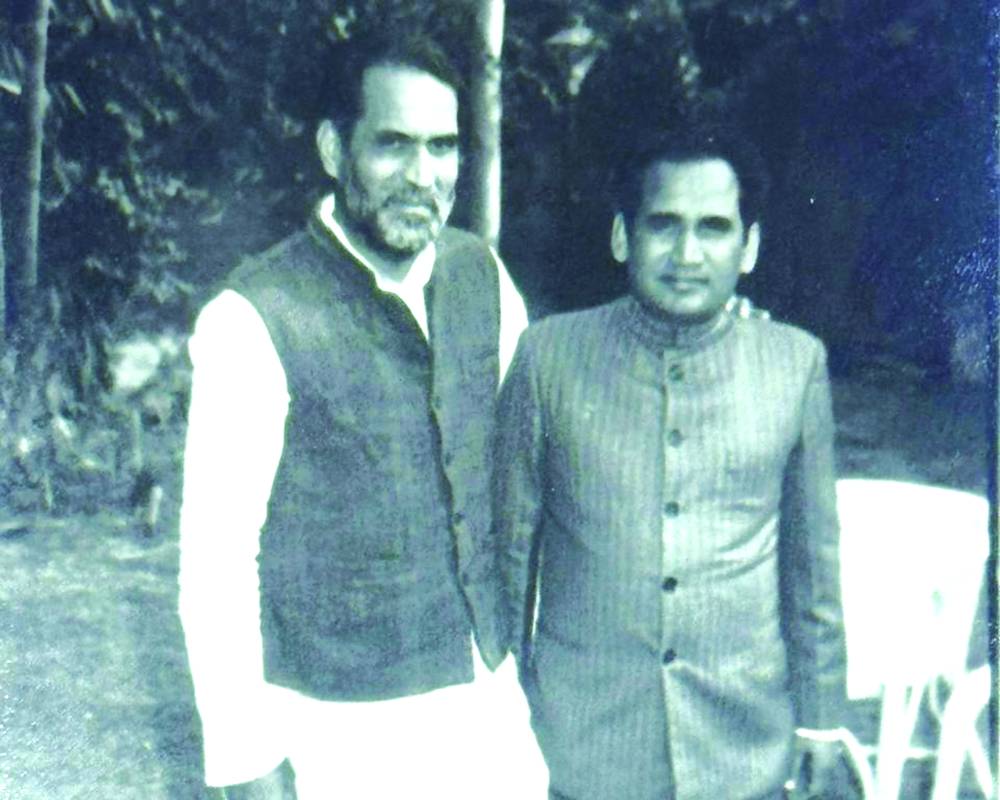
Steering a nation through turbulence
When turbulent times descend, destiny entrusts leadership to those who can navigate with quiet fortitude-revealing their true resilience. It was a moment of profound political upheaval, 35 years ago today, when Chandra Shekhar took the oath of office on November 10, 1990, stepping forward to steer a nation besieged by crisis. These included the Mandal Commission’s reservation upheaval, the economic aftershocks of the Gulf crisis following Iraq’s invasion of Kuwait, a perilous depletion of foreign reserves and escalating tensions surrounding the Ram Temple dispute, among others.
The Chandra Shekhar Government, brief though it was, served as a bandage on a wounded nation — a swift yet vital intervention for an economy bleeding from decades of fiscal mismanagement. For a few decisive months, his administration worked to restore stability and quietly laid the foundation for what would later evolve into India’s Liberalisation, Privatisation, and Globalisation (LPG) reforms. Yet, just as a bandage must remain in place long enough for healing to begin, the Government required time and political steadiness. Instead, Rajiv Gandhi’s abrupt withdrawal of Congress’ support was akin to tearing the bandage away too soon, depriving the administration of the opportunity to confront the nation’s political, economic and administrative emergencies.
Having served as his political advisor, I can say that allegations of his Government spying on Rajiv Gandhi were politically manufactured and lacked credibility. More likely, Gandhi was unsettled by Chandra Shekhar’s independent and secret efforts to mediate a resolution to the Ram Temple dispute, a near breakthrough toward national reconciliation, which, when Gandhi got wind of, prompted the withdrawal of support and the eventual collapse of his Government.
The architect of India’s early economic rescue
While PV Narasimha Rao and Dr Manmohan Singh would go on to institutionalise these reforms and earn their place in history, it was Chandra Shekhar who first initiated the measures that prevented India’s economic collapse and set the stage for its recovery-a story often whispered in Lutyens’ corridors but kept under the carpet, for he wasn’t one to thump his chest.
The lack of credit accorded to him likely reflects political bias and a narrative that downplayed his crisis management to rehabilitate Rajiv Gandhi’s image after the 1989 debacle. Examining the timeline of the LPG reforms, it is difficult to believe that the Narasimha Rao Government could have conceived and implemented such sweeping changes within just 33 days of taking office without the groundwork already being laid-effectively moving India from a closed-door economy to an open one.
Pragmatism over ideology
A steadfast socialist, he understood well that the 1990-91 crisis demanded pragmatic action. His Government’s measures were not a turn toward neoliberalism but a calculated concession to circumstance. Journalist Harivansh Narayan, currently the Deputy Chairman of the Rajya Sabha, described this sacrifice in Chandra Shekhar: The Last Icon as “ideological suicide for national survival.” He often said, “I swallowed poison to save the patient” — a reference to Lord Shiva, whose name he also bore and who drank halahala to protect the universe.
By prioritising the nation over ideology, he sacrificed personal principles for India’s greater good, treating these reforms as emergency surgery rather than a genuine shift in conviction. While the Prime Minister at the time was taking tough measures, the Opposition, in an attempt to tarnish his image, claimed that he had “sold India’s gold.” In reality, the Indian government had pledged 46.91 tonnes of gold with the Bank of England and the Bank of Japan as collateral for short-term funds.
It was a decisive move that secured the balance of payments and bought time for structural reforms. Yet, he never defended the LPG reforms on ideological grounds, seeing them only as an emergency surgery to save the nation.
Leadership, rebellion and public engagement
His ascent was marked by an unwavering commitment to socialist ideals. Born into a modest farming family in Ibrahimpatti, Ballia, early encounters with rural deprivation and inequality forged a lifelong ideological resolve. Initially drawn to academia, having enrolled for a PhD in Political Science, he was persuaded by Acharya Narendra Dev to forgo research and devote himself entirely to public service. His choice to align with the principled and intellectually rigorous Narendra Dev, rather than the charismatic yet theatrical Ram Manohar Lohia, reflected an enduring preference for substance over spectacle.
His rebellious streak became most evident during the Emergency (1975-77). He openly defied Indira Gandhi’s authoritarianism despite being a member of the Working Committee of the Congress. Principled dissent led to his arrest and imprisonment, cementing his reputation as the archetypal ‘Young Turk’ — an uncompromising advocate of dissent who understood that challenging power is not disloyalty but the truest service to democracy. He later famously declared, “We are not against the leader, but against the system that makes leaders infallible.” In contemporary India, where entry into
politics has become increasingly prohibitive for young men and women, his journey serves as both inspiration and instruction. He remains a beacon for emerging leaders seeking the courage to dissent with integrity, as well as for seasoned politicians striving to defend democratic principles with moral conviction.
His courage was not confined to party politics; it resonated most vividly in Parliament. Colleagues and citizens alike would pause to hear him speak, knowing that his words carried clarity, conviction and an unflinching moral compass. He spoke with fearless candor, challenging both authority and complacency. I vividly remember an instance when, after resigning as Prime Minister, someone mockingly remarked on his brief tenure. He responded with characteristic audacity: “Log Mount Everest pe rehne nahi jaate, jhanda gaadne jaate hain, jo main karke aa gaya!” (People do not climb Mount Everest to live there; they go to leave their mark-and that is what I have done!)
Throughout his political life, he remained profoundly connected to the people — a bond most vividly exemplified by his Bharat Yatra of 1983. Over six months, he walked nearly 4,260 kilometres from Kanyakumari to Delhi, not for publicity or spectacle, but to immerse himself in the lived realities of India, village by village, person by person. And unlike today’s leaders who ensure comfort and clearance before going among their own people, his padyatra was entirely reliant on the ordinary villagers; he and his companions accepted whatever they offered-a simple meal, a place to rest-transforming the journey into a living dialogue with the nation itself.
Legacy, challenges and recognition
Across his long and distinguished public life, he established numerous institutions — the Devasthali Vidyapeeth, Jai Prakash Narain Trust, Bharat Yatra Kendra (with centres in Bhondsi, Delhi, Mumbai and beyond), the Yuva Bharti Trust, Shaheed Ismarak Trust and the Institute for Studies in Industrial Development — dedicated to education, rural development, and youth empowerment. He consistently underscored that these trusts were funded through public contributions, not political wealth, and must forever remain in the service of the nation.
Guided by his belief that these assets exist to serve the people rather than individuals, he wrote to then Prime Minister Dr Manmohan Singh in the early 2000s, expressing his wish to dedicate his properties to the nation as transparent public trusts. Tragically, as his health declined and he passed away in 2007, this intent remained unfulfilled. While the nation mourned one of its most principled leaders, a few people close to him seized the opportunity to conspire-using those difficult times as a distraction-and began maneuvering to take control of the very assets he had envisioned for the public good.
It is deeply troubling that these individuals allegedly tampered with trust records — manipulating minutes, documents, and even forging signatures, including those of the late Prime Minister, a few Members of Parliamentand other trustees.
The alleged falsification of the Prime Minister’s signature, in particular, undermines both legal and moral legitimacy. Years of administrative neglect by the authorities have only compounded the problem, leaving several properties entangled in protracted litigation. Barring a handful of committed individuals, few today seem genuinely invested in preserving his ideals and the institutions he created. Yet, as his confidant for over 45 years, I remain resolute in safeguarding these trusts from private appropriation and in upholding his enduring legacy-unwavering service to the people and the nation.
Honouring a life of service
Even today, his life reminds us that politics, at its noblest, is not about power or possession but about service-selfless, steadfast and unshakeable. He was never among those who practised divisive politics of caste or community, and perhaps for that reason, he could not cultivate a vote bank that rewarded symbolism over substance. In recent years, honours such as the Bharat Ratna have sometimes reflected political calculations, as seen in the cases of Karpoori Thakur and Chaudhary Charan Singh.
It is unfortunate that he, who guided India through one of its most challenging political and economic transitions, has neither been adequately celebrated nor given due credit for his resilience and integrity. As the nation approaches his centenary in 2027, it would be fitting for the Government of India to bestow upon him the Bharat Ratna for his lifelong service to the nation.



