










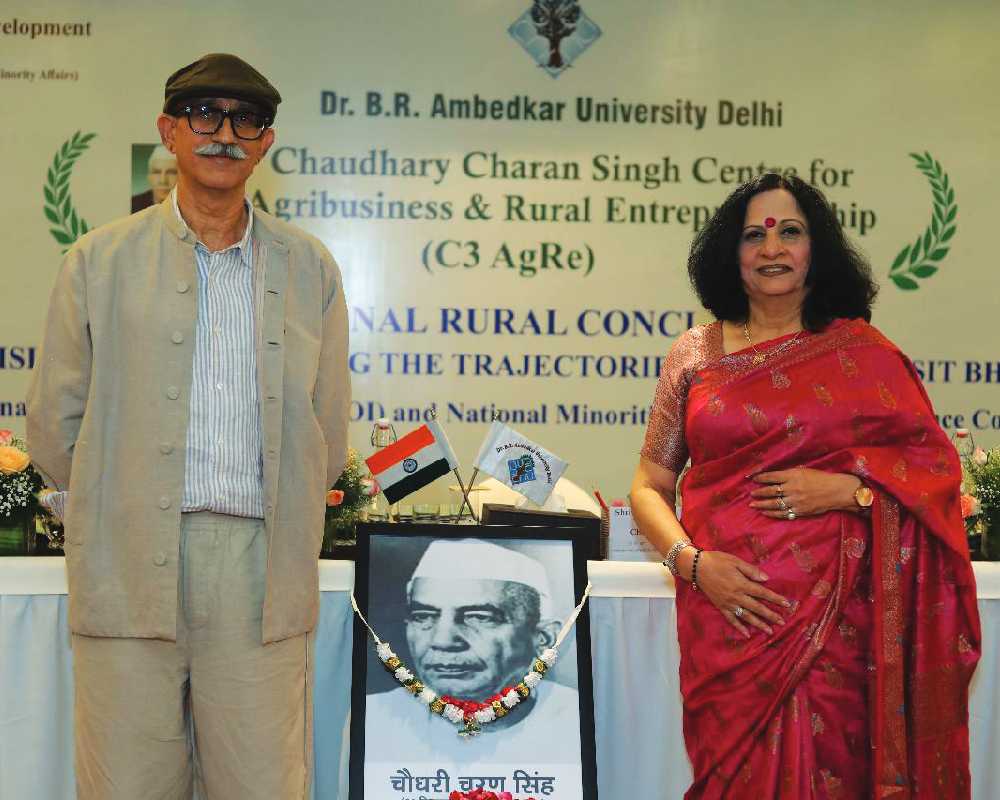
The newly launched Chaudhary Charan Singh Centre for Agribusiness and Rural Entrepreneurship at Dr BR Ambedkar University Delhi is hosting a two-day National Rural Conclave titled “The Rising Rural: Mapping the Trajectories towards Viksit Bharat” on 6–7 November 2025 at the India Habitat Centre, New Delhi. Drawing on the ideas and legacy of Shri Chaudhary Charan Singh, this Conclave seeks to comprehensively engage with the meaning of rural transformation in India— as a process rooted in equity, sustainability and the empowerment of those at the grassroots. As India envisions Viksit Bharat 2047, the discussions will bring together eminent policymakers, academics and development practitioners to reflect on the future of rural livelihoods, agrarian change, entrepreneurship and social inclusion.
On Thursday, the first day of the Conclave, the inaugural session was graced by Chief Guest Professor Anu Singh Lather, the Honorable Vice-Chancellor of Dr BR Ambedkar University Delhi; Dr Abha Rani Singh, IRS and Chairperson, National Minorities Development and Finance Corporation; Dr Archana Verma, IAS, National Water Mission; Dr Santosh K Singh, Director, Chaudhary Charan Singh Centre for Agribusiness and Rural Entrepreneurship and Col. (Retd.) Omkar Singh.
The Keynote address was delivered by Mr Harsh Lohit, Founder and Chairperson, Charan Singh Archives on the enduring intellectual and grassroots contribution of Chaudhary Charan’s Singh’s legacy to rural society and social progress in India. The technical sessions were led by experts and practitioners from organisations such as the World Bank Group, Charan Singh Archive, Water for People India Trust, Welthungerhilfe India, Deutsche Gesellschaft für Internationale Zusammenarbeit (GIZ) India, United Nations Environment Programme to deliberate on critical issues related to water and land.
Discussions at the conclave highlighted the urgent need to move beyond sectoral silos and adopt an integrated vision linking water, land and food-agro systems as the core of rural prosperity. Keynote speakers advocated a holistic and intersectional approach to policymaking, emphasizing community-driven, context-specific and hyperlocal strategies over uniform, top-down models.
The resonant sentiment “bharat ki aatma gaon mein basti hai” (India’s soul resides in its villages) underscored the day’s deliberations. The sessions collectively emphasised that India’s development must rise from its rural roots, blending tradition with transformation. The first day of the Conclave concluded with a collective call to action—to reimagine India’s rural landscape through collaboration, ensuring that rural transformation remains central to the nation’s journey toward Viksit Bharat 2047.
As the National Rural Conclave 2025 progresses, the second day will further bridge research, policy and practice, reaffirming the pivotal role of rural India in shaping an equitable and sustainable national future aligned with the vision of Viksit Bharat 2047.



