










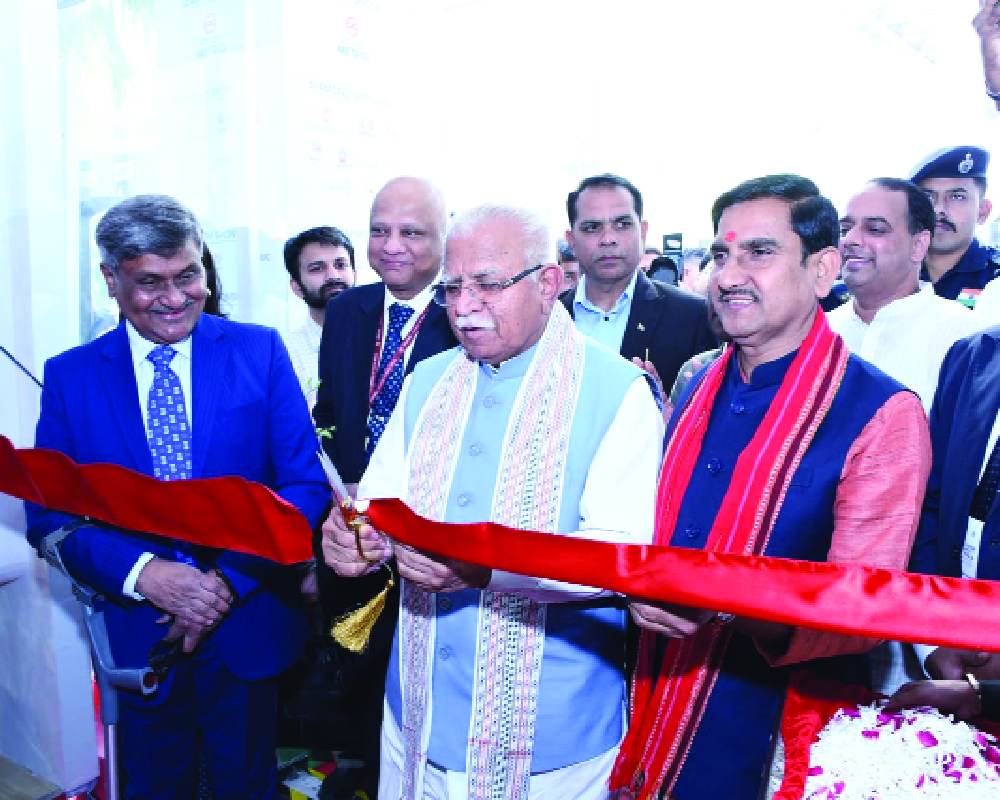
Union Minister for Housing, Urban Affairs, and Energy Manohar Lal said that the primary goal of the 18th Urban Mobility India (UMI) Conference and Exhibition is to enhance urban transportation systems and services to ensure ease of travel for citizens.
The three-day conference, inaugurated in Gurugram on Friday, is being held under the theme “Easy Mode of Travelling” and aims to produce policy-based recommendations that will contribute to sustainable urban development and improved public services.
Speaking at the inaugural session, Manohar Lal also inaugurated the developmental exhibition showcasing advancements in urban development and mobility. The minister announced three major initiatives aimed at strengthening public convenience and developing robust urban infrastructure.
He announced the establishment of Delhi Metro International Limited (DMIL), which will work toward expanding India’s metro expertise to other countries. He also unveiled plans for a Mass Rapid Transit System (MRTS) in collaboration with the Delhi Metro Rail Corporation (DMRC) to enhance interconnectivity and ensure safe, reliable, and cyber-secure transport systems. Additionally, the Delhi Metro Rail Academy will be set up to promote innovation, capacity building, and the establishment of a Centre of Excellence to guide metro services with modern, technology-driven approaches.
The Union Minister said that while Delhi has several large convention centers, Gurugram also deserves a similar state-of-the-art facility. He assured that discussions will be held with Haryana Chief Minister Nayab Singh Saini to develop such a convention center in Gurugram.
Highlighting the vision of Prime Minister Narendra Modi, Manohar Lal said that India is rapidly advancing toward self-reliance. He emphasized that integrated transport networks will play a crucial role in making India a developed nation by 2047, in line with the Make in India initiative. India currently ranks third globally in metro service coverage and is expected to surpass the United States in the next three years, he said.
The government, he added, is committed to adopting new technologies in public services and will continue collaborating with experts to implement future-ready mobility solutions through platforms like UMI.
Union Minister of State for Housing and Urban Affairs Tokhan Sahu said that the UMI Conference represents an important step toward achieving India’s developmental vision for 2047. Under the leadership of Prime Minister Modi, he said, India’s urban future is being shaped with new thinking, new energy, and renewed commitment. The conference, he noted, reflects both India’s cultural heritage and its determination for progress.
Sahu added that urban transport today goes beyond mobility—it acts as a driver of economic growth, environmental sustainability, and social equity. This year’s conference, he said, focuses on the interconnection between urban development and transport, ensuring that citizens have easy access to education, healthcare, and employment.
He also highlighted key initiatives transforming urban mobility, including the Swachh Bharat Mission, Mission AMRUT, Pradhan Mantri Awas Yojana (Urban), metro rail expansion, electric bus services, public bicycle systems, and transit-oriented development.
The objective, he said, is to build an inclusive and sustainable transport system that meets the needs of all citizens.
Addressing the gathering, Haryana Additional Chief Secretary Dr. Raja Shekhar Vundru said that the state is setting a benchmark in urban mobility for others to follow. The conference, he said, serves as a vital platform for collaboration among government bodies, industry, academia, and citizens to exchange ideas and innovations that make cities affordable, accessible, and livable. “The cities we shape today will define the India of tomorrow,” he added.



