










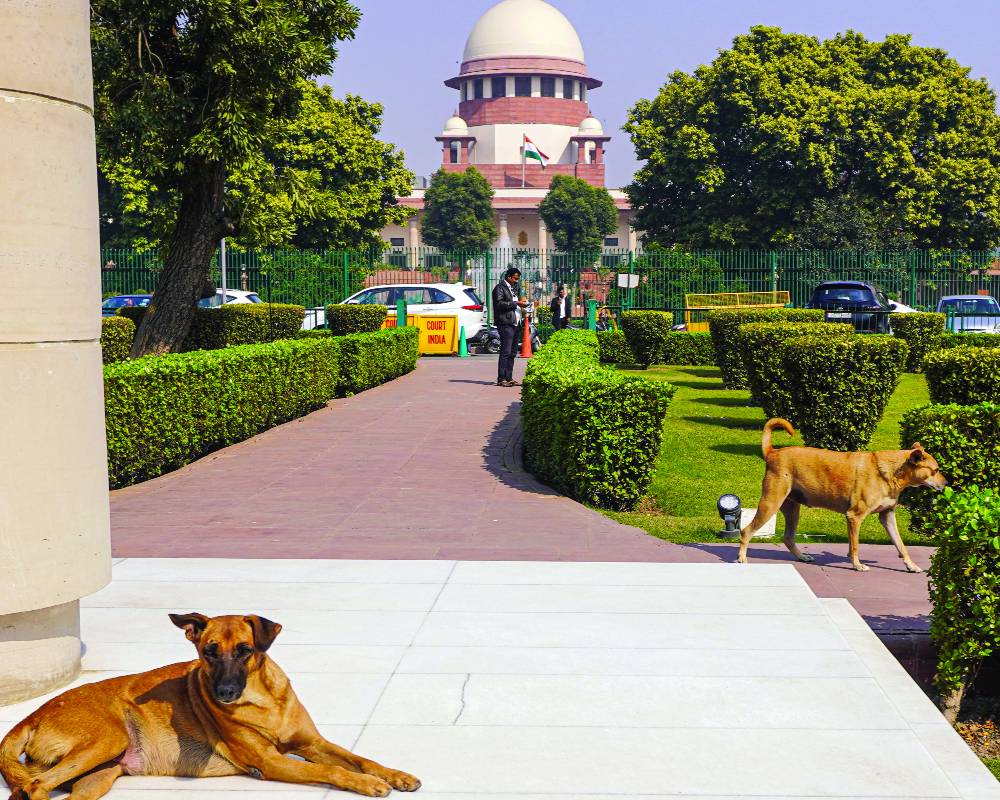
The Supreme Court on Friday issued directions to curb the twin public safety crises of stray dog attacks and cattle-related road accidents, ordering that free-ranging dogs be removed from schools, hospitals, and other institutions, and that highways be cleared of wandering cattle and animals that have caused rising numbers of fatal crashes.
Taking note of the alarming rise in dog-bite cases, the Supreme Court on Friday directed all educational institutions, hospitals, public sports complexes, bus stands, and depots to take immediate steps to fence their premises adequately to prevent the entry of stray dogs. The Court said that they cannot be released back into the same locations after sterilisation.
A bench of Justices Vikram Nath, Sandeep Mehta, and NV Anjaria, which is monitoring stray dog-bite incidents through a suo motu proceeding, directed the authorities to prevent the dogs from entering the premises of government and public institutions.
“(With) regard to the alarming rise in incidents of dog bites within institutional areas, such as educational institutions, hospitals, sports complexes, bus stands and depots, and railway stations, this court deems it appropriate to issue the following directions in the interest of public safety, health, and management of stray dogs,” the bench said.
It also said permitting their return would “frustrate the very purpose” of securing such premises and addressing public safety concerns. The bench directed the local municipal authorities to carry out regular inspections of all premises to ensure no stray dog habitat exists.
It said the recurrence of dog bite incidents within institutional areas, including sports complexes, reflected not only administrative apathy but also a “systemic failure” to secure these premises from preventable hazards. “The situation calls for immediate judicial intervention to safeguard the fundamental right to life and safety of citizens, especially children, patients, and sportspersons, under Article 21 of the Constitution of India,” the bench said. It passed a slew of directions in the suo motu case over the stray dog menace.
The bench directed states and Union territories, through their respective local or municipal authorities, to identify such institutions within two weeks.
The bench asked the administrative heads of such institutions to ensure that the premises are secured by adequate fencing, boundary walls, gates, and such other structural measures as may be necessary to prevent the ingress of stray dogs. The suo motu case was initiated in July following reports of a spike in dog bite incidents, including attacks on children.
It said the primary objective is to safeguard the fundamental right to life and safety of citizens, particularly children, students, patients, and sportspersons, while ensuring compliance with the principles embodied in the Animal Birth Control Rules, 2023, framed under the Prevention of Cruelty to Animals Act, 1960.
It said that after independence, despite significant advances in public health, India continues to report one of the world’s highest statistics of rabies-related mortality. “Scientific assessments, including those conducted by the World Health Organisation (WHO) and the National Centre for Disease Control (NCDC), have estimated that a large ratio of animal-related deaths annually in India were attributable to rabies, with over 90 per cent of human cases resulting from bites inflicted by domestic or stray dogs,” the bench said.
It said the brunt of this menace has been borne by children, the elderly, and economically weaker sections, who, in addition to being vulnerable, lack “timely access to post-exposure prophylaxis”.
The bench further said that it is a matter of grave and continuing public concern that accidents caused by cattle and other stray animals on public roads have become alarmingly frequent.
Reaffirming directions issued by the Rajasthan High Court in an August 11 order, the bench directed the municipal authorities, road and transport department/Public Works Departments of all states and Union Territories, and the National Highways Authority of India (NHAI) to ensure the removal of cattle and other stray animals from the highways.
The bench asked the authorities to undertake a joint, coordinated drive to identify stretches of highways and expressways where stray cattle or animals are frequently found, and take immediate steps for their removal and relocation to designated shelters.
On the “disturbing increase” in dog bite incidents in institutional areas like educational institutions, hospitals, railway stations, and bus stands, the bench directed the authorities to ensure that such premises are secured by adequate fencing, boundary walls, gates, and other such structural or administrative measures as may be necessary to prevent the ingress of stray dogs. The bench directed local municipal authorities and panchayats to carry out regular inspections, at least once every three months, of all such premises to ensure that no stray dog habitats exist within or in the immediate vicinity of these institutions.
It said any lapse in this regard shall be viewed seriously, and the concerned municipal officials/administrative authorities shall be held responsible. “It shall be the responsibility of the jurisdictional municipal body/authority to forthwith remove every stray dog found within the premises of an educational institution, hospital (public or private), sports complex, bus stand/depot (including inter-state bus terminal) or railway station and to shift such animal/s to a designated shelter, after due sterilisation and vaccination...,” the bench said.
It said all Government and private hospitals shall maintain a mandatory stock of anti-rabies vaccines and immunoglobulin at all times. The bench said every educational institution shall be directed by the Ministry of Education to conduct awareness sessions for students and staff on preventive behaviour around animals, first-aid in case of bites, and immediate reporting protocols.
It directed the chief secretaries of all states and Union Territories to file affidavits of compliance within eight weeks, specifically indicating the steps taken to secure institutional premises and availability of anti-rabies vaccines and immunoglobulin in all government medical facilities. The bench directed the states and Union Territories to file comprehensive additional affidavits, specifically indicating the remedial measures undertaken to ensure full compliance with the court’s directions and to rectify the “lapses” highlighted in the report filed by amicus curiae Gaurav Agrawal. It posted the matter for further hearing on January 13.
After the bench pronounced its order in the court, some of the advocates appearing for various parties urged it to hear them before passing the directives. The bench, however, said it has already passed the directions.



