










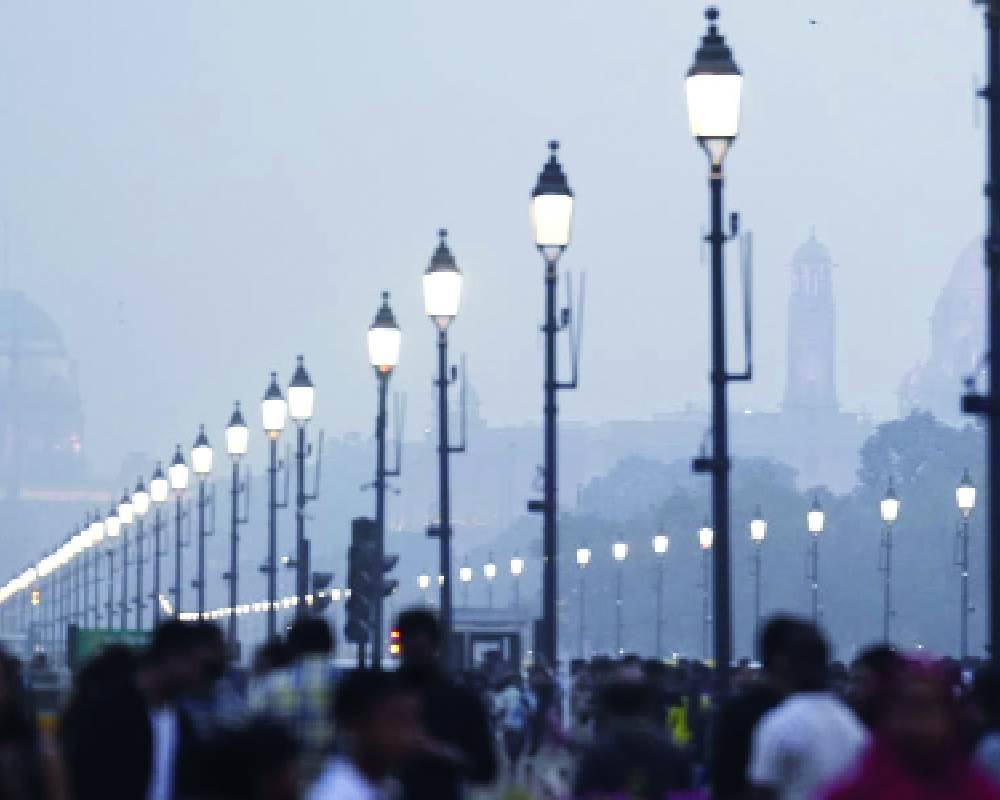
Delhi’s air quality has dropped to its lowest level of the season, with a grey haze hanging heavily over the Capital on Monday — the air thick, the skyline blurred, and temperatures falling sharply below normal. According to the AQI, in website, the national Capital recorded an air quality index of 494, with PM10 at 420 µg/m³ and PM2.5 at 323 µg/m³ at 10.30 am.
Even as the Government claims to be taking steps to control pollution, allegations have surfaced that actual air quality readings are being underreported or manipulated.
On one of the visually worst days of the pollution season, the air quality monitoring system in the national Capital went silent, leaving residents guessing just how bad things were.
The Central Pollution Control Board (CPCB) stopped issuing Air Quality Index (AQI) readings on its Sameer app and website after 12:15 pm, when the AQI stood at 345. Officials blamed a technical glitch for the lapse, assuring that the system would likely be restored by evening.
CPCB data from 8 am show that air quality across most parts of Delhi remained in the “very poor” category, with a few locations slipping into “severe” levels. Bawana recorded the highest AQI at 412, placing it in the “severe” range. Areas such as Anand Vihar (379), Burari Crossing (389), ITO (375), Nehru Nagar (387), and Rohini (390) reported “very poor” air quality. Stations including DTU (286), IHBAS Dilshad Garden (227), Lodhi Road (236), and NSIT Dwarka (218) registered slightly better readings in the “poor” category.
South African cricket great Jonty Rhodes has raised alarm over Delhi’s toxic air, calling the capital’s pollution “hard to digest” while contrasting it with the clean air of his home in coastal Goa.
“Passing through Delhi en route to Ranchi this evening, and as always, it’s hard to digest the low levels of air quality here,” Rhodes posted on X. “I'm grateful to be living in a small fishing village in South Goa.” His message, tagged with #AQI and #whats2Bdone, comes as Delhi records its worst air quality of the season.
As pollution levels continued to deteriorate, parents and children gathered at India Gate on Monday, urging the Government to take immediate action to combat the capital’s toxic air crisis.
Meanwhile, the national Capital recorded its first cold wave of the season on Monday, with temperatures plunging to 9.9 degrees Celsius at the Aya Nagar station. The weather department has predicted that cold wave conditions are likely to persist in isolated parts of the city over the next few days.
Aya Nagar, one of the city’s several weather stations, recorded a minimum temperature of 9.9 degrees Celsius — 5.6 degrees below normal — according to IMD data.
A cold wave is defined by the India Meteorological Department (IMD) as a period when minimum temperatures drop significantly below normal.
For the plains, this means a minimum temperature of 10 degrees Celsius or less, combined with a departure of 4.5 notches to 6.4 notches below normal for two consecutive days. The IMD said, “Cold wave conditions are very likely to prevail in isolated pockets of Delhi during November 10 to 12.”
Meanwhile, the city’s primary weather station at Safdarjung reported the lowest minimum temperature of the season at 10.4 degrees Celsius — 3.9 degrees below normal.
The maximum temperature on Monday settled at 27.5 degrees Celsius, two notches below normal. The season’s last lowest temperature was recorded at 11 degrees Celsius on Saturday.
The minimum temperature dropped below the 15-degree mark for the first time this winter on November 6.
In comparison, Delhi’s lowest minimum temperature in 2024 by November 10 was 9.5 degrees Celsius, while in 2023 it was 9.2 degrees Celsius, and in 2022, 7.3 degrees Celsius, according to IMD records.
The IMD has predicted shallow fog for Tuesday, with the maximum and minimum temperatures expected to settle around 28 and 11 degrees Celsius.



