










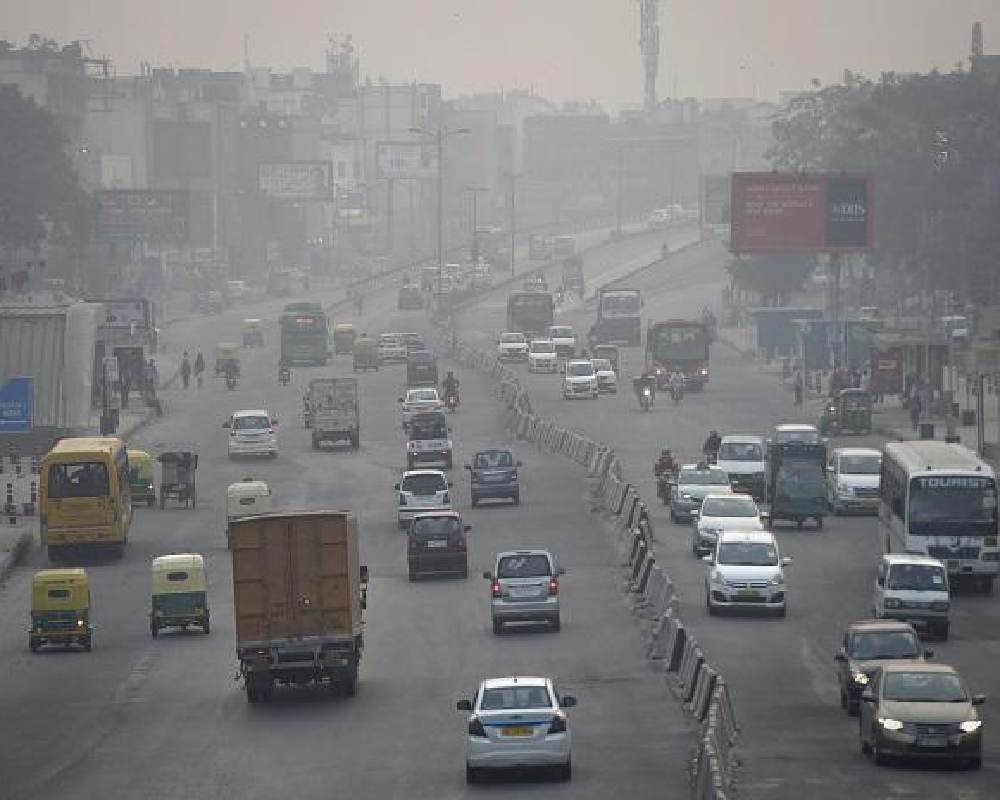
Delhi’s air quality showed further improvement on Wednesday but remained in the “poor” category, with an overall Air Quality Index (AQI) of 202, as favourable wind conditions helped disperse pollutants. The AQI stood at 291 on Tuesday and 309 on Monday, according to data from the Central Pollution Control Board (CPCB).
The levels of PM10 and PM2.5 — the key pollutants — also declined, with PM10 measured at 175.2 micrograms per cubic metre compared with 260 a day earlier, and PM2.5 at 85.5 compared with 128.2 on Tuesday. Of the 38 monitoring stations in the city, 28 reported air quality in the “very poor” category with readings above 300, according to the CPCB’s Sameer app.
Vehicular emissions contributed 16.8 per cent, while other unidentified sources accounted for 44 per cent, as per the daily mean of local and non-local fractional contribution to PM2.5 in Delhi calculated by the Decision Support System (DSS).
Satellite data showed that on Wednesday, 94 stubble-burning cases were detected in Punjab, 13 in Haryana and 74 in Uttar Pradesh.
According to the Air Quality Early Warning System for Delhi, wind speed was expected to decrease to below 10 km/h from the north-west during the evening and night hours on Wednesday.
In a press statement, Delhi’s Environment Minister, Manjinder Singh Sirsa, said that the AQI on Wednesday was 202 compared with 373 in 2024, 454 in 2023, 381 in 2022, 462 in 2021, 450 in 2020, and 324 in 2019 — reflecting a continued improvement trend driven by the strategic, science-based approach of the Delhi Government.
Sirsa stated that over the last 24 hours, more than 500 inspections were carried out across the city by teams from the DPCC, MCD, NDMC, DCB, PWD, DJB, Revenue, DSIIDC, and DMRC, with senior officers from the Chief Minister’s Office, DPCC, DSIIDC, PWD, MCD, and Revenue Departments also joining field inspections in select areas.
“In the last 24 hours, our teams have inspected 387 construction and demolition sites, 79 municipal solid waste locations, 22 DG set installations and 12 hotels and restaurants to check fuel usage and dust control compliance. Action has been taken wherever violations were found.
To tackle road dust and vehicular pollution, 90 MT of road dust was collected through mechanical sweeping, while 1,988 km of roads were cleaned through MRS, 1,797 km were water-sprinkled, and 5,171 km were covered through anti-smog guns using over 1.07 lakh litres of treated water,” he said.
The air quality is expected to remain in the “very poor” category between 6 and 8 November, it stated.
The India Meteorological Department (IMD) said westerly winds with speeds of up to 15 km/h prevailed over the city in the past 24 hours, aiding the dispersal of pollutants. Since Diwali, the national Capital’s air quality has fluctuated between the “poor” and “very poor” categories, occasionally dipping into the “severe” zone.
The maximum temperature on Wednesday was recorded at 30.4 degrees Celsius, 1.6 notches above the seasonal average, while the minimum temperature settled at 18.4 degrees Celsius, the IMD said.



