










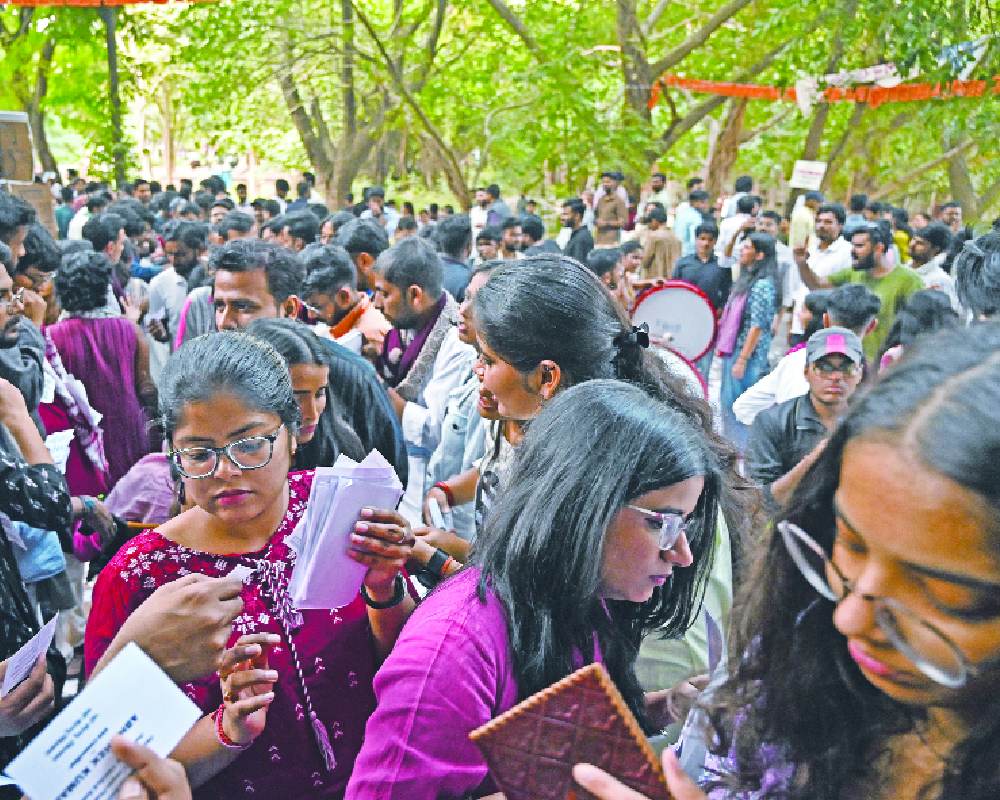
The Jawaharlal Nehru University (JNU) campus on Tuesday turned into a carnival of democracy. The students of the university voted in one of Delhi’s most closely watched student elections, a contest that often mirrors India’s larger political divides.
JNUSU polls recorded a voter turnout of 67 per cent this year, a slight dip from 70 per cent in the previous election. In the 2023-24 polls, the university had witnessed 73 per cent voting — the highest in the past decade.
Polling began at 9 am and continued till evening, with students casting their votes after the 5.30 pm deadline. The JNUSU election committee said counting will start at 9 pm on Tuesday, and final results will come out on November 6.
A total of 9,043 students were eligible to vote this year for the four-member central panel. The president, vice-president, general secretary and joint secretary, along with school councillors, will be elected after the result. A total of 20 candidates are in the fray for the four key central panel posts.
The fight, as always, is ideological. On one side stands the Left Unity, an alliance of the All-India Students’ Association (AISA), Students’ Federation of India (SFI) and Democratic Students’ Federation (DSF).
On the other is the Akhil Bharatiya Vidyarthi Parishad (ABVP), which is hoping to build on its recent gains.
The Left Unity has fielded Aditi Mishra for president, Kizhakoot Gopika Babu for vice-president, Sunil Yadav for general secretary, and Danish Ali for joint secretary.
The ABVP’s panel includes Vikas Patel, Tanya Kumari, Rajeshwar Kant Dubey and Anuj. Both sides have framed the election as a defining moment. The Left bloc campaigned on the promise of “inclusion, accessibility and student welfare.”
The ABVP sought votes on “performance and nationalism”. Outside polling booths, campaigners from both camps shouted slogans and handed out pamphlets. The air was charged but peaceful.
“The Left Unity will win all four seats,” said Aishe Ghosh, former JNUSU president from SFI, as she campaigned near the School of International Studies. “Students know who stands up for their rights when it matters,” she added. However, the ABVP camp is confident that the situation has changed.
Earlier this year, Vaibhav Meena of ABVP won the joint secretary post, the group’s first central panel victory in nine years. Now, the organisation says it is ready for a clean sweep.
“We are winning all four seats this time,” said Meena, who is the current joint secretary. “The Left keeps doing politics of global issues, from Israel-Palestine to Bihar, SIR, that have nothing to do with JNU students. We are working on real problems here.”
Meena cited the reopening of the railway reservation counter and efforts to push for a library extension as examples of ABVP’s focus on student welfare. “The library can seat only 1,000 students, but the university has more than 9,000. We are fighting to get that building sanctioned,” he said. “We also want better health and utility services on campus,” he added.
Through the day, voting picked up steadily. While the morning saw modest queues, crowds thickened after lunch as many first-time voters turned up in groups. “Until now, I had only heard about JNU elections,” said Aakansha, a 20-year-old undergraduate. “Being here feels special. It’s noisy, it’s passionate, but everyone knows this matters,” she added.
Last year, AISA’s Nitish Kumar had won the president’s post, while ABVP’s Vaibhav Meena broke the Left’s decade-long monopoly on the central panel. The outcome of this election will decide whether that was an exception or the beginning of a larger shift.



