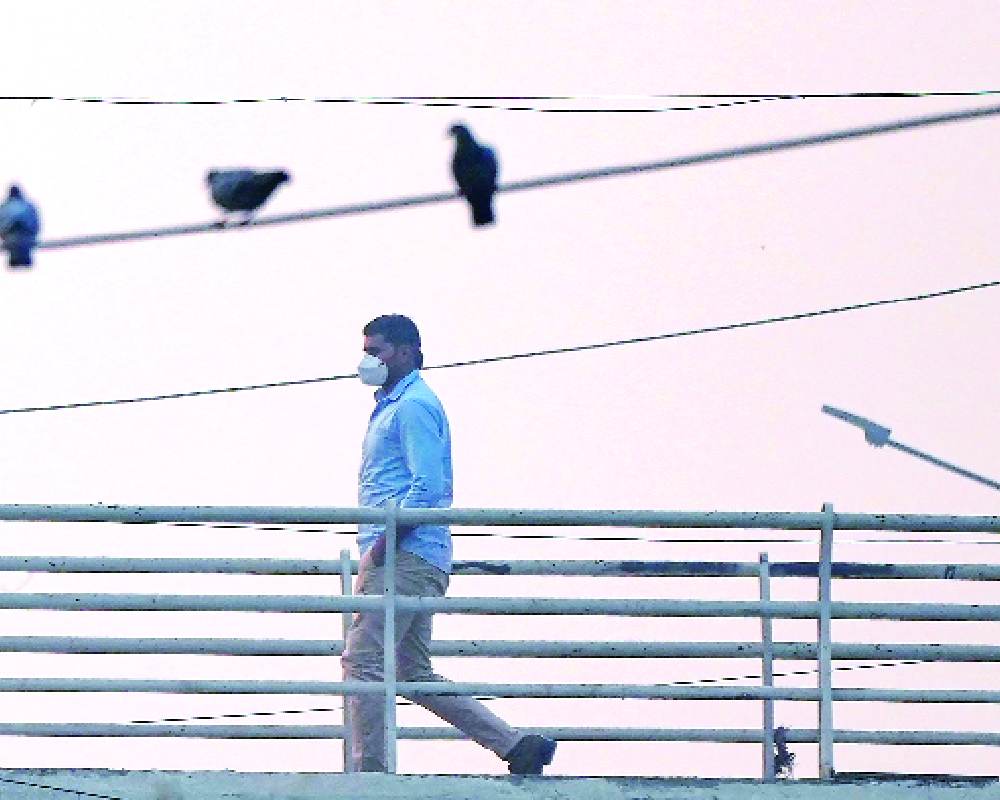
The Commission for Air Quality Management (CAQM) on Saturday decided not to invoke Stage III of the Graded Response Action Plan (GRAP) in Delhi-NCR. The decision was taken after air quality showed signs of improvement through the day.
Officials said Delhi’s average Air Quality Index (AQI) remained in the ‘very poor’ category but recorded a steady decline between morning and evening.
At 10 am, the hourly average AQI stood at 391, which improved to 370 at 4 pm and further to 365 by 5 pm. The decision came after a review meeting of the CAQM Sub-Committee on GRAP, held at 4 pm, which assessed the current pollution levels and forecasts from the India Meteorological Department (IMD) and the Indian Institute of Tropical Meteorology (IITM).
Delhiites woke up to another day of toxic air on Sunday, as pollution levels remained alarmingly high.
Data from the Air Quality Early Warning System on early morning showed an AQI of 392, while multiple areas crossed the 400 marks, ranking the Capital among the worst polluted cities Meanwhile, data from the CPCB’s Sameer app showed that 22 monitoring stations reported air quality in the ‘severe’ range, while 12 stations recorded ‘very poor’ air quality with readings above 300, as on 10:05 am on Sunday.
Other areas in the ‘severe’ category included Nehru Nagar (425), Patparganj (424), RK Puram (423), Vivek Vihar (423), ITO (421), Narela (418), and CRRI Mathura Road (416). Among the localities recording ‘very poor’ air, North Campus (399), Jawaharlal Nehru Stadium (391), Mandir Marg (390), Dwarka Sector-8 (388), Pusa (380), Lodhi Road (IMD) (376), Sri Aurobindo Marg (371), Aya Nagar (366), Shadipur (359), Najafgarh (357), and IGI Airport (360) were among the most affected.
In several other localities such as Punjabi Bagh (415), Ashok Vihar (415), Sonia Vihar (415), Alipur (414), Anand Vihar (410), Dr Karni Singh Shooting Range (406), Chandni Chowk (405), Okhla Phase-2 (404), and Sirifort (403), the AQI remained well above 400.
Across the wider National Capital Region, Noida registered an AQI close to the severe threshold at 392 and Ghaziabad recorded 387; Greater Noida and parts of western Delhi similarly showed dangerously high particulate levels. By contrast, Gurugram was relatively better but still in the ‘poor’ band.
The Air Quality Early Warning System has forecast that conditions are likely to remain stubbornly poor over the coming days.
Officials and weather agencies pointed to a combination of factors: a shallow layer of smog driven by falling night-time temperatures, calm winds and radiational cooling following fresh snowfall in the western Himalayas, which trapped pollutants close to the surface.
Local emissions and regional sources, including ongoing crop-residue burning in adjoining states, continued to keep PM2.5 concentrations high.
The Sub-Committee observed that, while pollution levels remain high, the improving trend and favourable meteorological forecasts suggest that there is no immediate need to impose stricter curbs.
“Given the consistent decline in AQI and the forecast indicating that air quality will continue to stay in the ‘very poor’ category over the next few days, invocation of Stage-III measures is not required at the moment,” the committee noted.
Stage-III restrictions, under the GRAP framework, are imposed when the air quality reaches the ‘severe’ category (AQI 401–450).
These include bans on construction and demolition activities, restrictions on polluting industries and curbs on the use of diesel generators.
For now, measures under Stage I and Stage II will remain in force across the national Capital region. These include road dust control, mechanised sweeping, regulated construction activity and stricter vehicular emission checks.
Officials said the sub-committee will continue to monitor the situation closely. If air quality worsens again, stricter measures could be implemented without delay.
The CAQM has urged citizens to cooperate by reducing private vehicle use and avoiding open waste burning. It also advised Government agencies to ensure strict enforcement of pollution control measures already in place.
According to experts, recent changes in wind speed and a slight improvement in the ventilation index helped disperse pollutants. However, they warned that pollution levels could rise again if weather conditions turn stagnant.
Delhi’s air quality typically deteriorates during November due to a mix of vehicular emissions, industrial activity and stubble burning in neighbouring States.
The Sub-Committee reiterated that all implementing agencies in Delhi and NCR districts remain on high alert.
Regular updates on AQI levels and future actions will continue to be shared publicly, it added.