










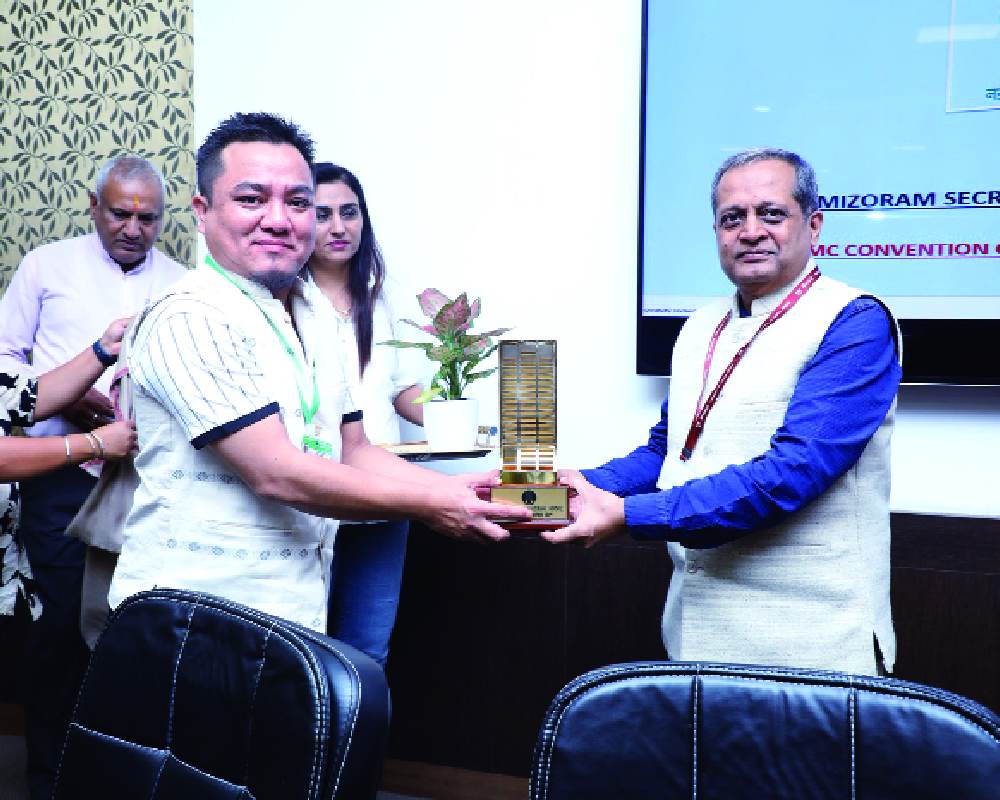
A 25-member delegation of Mizoram Secretariat Services Officers visited the New Delhi Municipal Council (NDMC) on Thursday for a knowledge-sharing session on Smart City initiatives.
The visit was part of a training programme organised by NDMC in collaboration with the Indian Institute of Public Administration (IIPA). During the interaction, NDMC Secretary Rakesh Kumar delivered an insightful presentation, highlighting NDMC’s integrated approach to sustainable urban development and modern civic governance under the Smart City Mission.
He showcased key initiatives that have made NDMC one of the most citizen-friendly capital cities in the country. Senior NDMC officials including the OSD (Personnel/Education), Chief Engineers (Civil and Electrical), Chief Architect, Medical Officer of Health, Director (Horticulture) and Director (Training)-shared sector-specific insights and innovations under Smart City development projects.
Dr Shakuntala Srivastava, Medical Officer of Health, presented NDMC’s smart initiatives. These included the Integrated Command & Control Centre, Smart e-learning, green energy initiatives via solar power projects, smart parking, aesthetic beautification, scientific solid waste management, segregation at source, and the RRR (Reduce, Reuse, Recycle) model. She also briefed the delegation on the development of Anupam Colonies using community-driven best practices, horticulture and green-cover expansion, mist sprayer installations on electric poles to combat air pollution, and e-waste disposal.
During their visit to the Integrated Command & Control Centre (ICCC), Gauri Shankar Aggarwal, In-charge of ICCC, explained its functioning as a state-of-the-art facility at Palika Kendra, acting as the city’s digital brain.
Real-time data streams from across the capital-including CCTV surveillance, air quality sensors, smart streetlights, sanitation systems, and traffic monitoring-converge at the ICCC. The ICCC provides a unified view of the city through a “single pane of glass,” enabling swift, data-driven decisions to enhance public safety, optimise utility usage, and manage emergencies. With GIS mapping, SCADA integration, and GPS-enabled waste management, NDMC has elevated urban management to new heights of precision and efficiency.
More than a technological achievement, the ICCC embodies NDMC’s vision for a resilient, intelligent and citizen-first New Delhi a city that listens, responds, and evolves in real time to the needs of its people.
The Mizoram delegation appreciated NDMC’s exemplary Smart City initiatives for improved service delivery and explored avenues to adopt similar practices in Mizoram’s urban development strategies.
KK Pandey, Coordinator at the Indian Institute of Public Administration, New Delhi, delivered the vote of thanks.
The exchange reinforced NDMC’s commitment to knowledge partnerships and international collaboration in advancing the global agenda for clean, green, and sustainable cities.



