










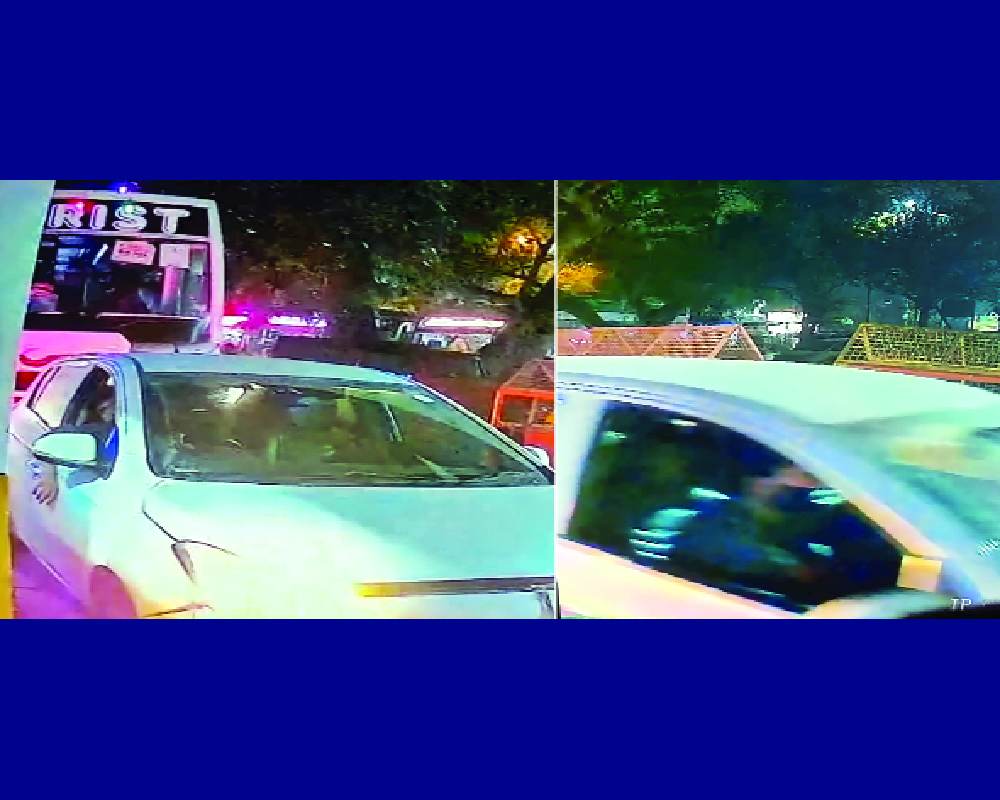
Using footage from more than 50 CCTV cameras, Delhi Police has reconstructed Dr Umar Nabi’s last hours, right from leaving Faridabad the night before the Red Fort blast to driving an explosives-laden car slowly towards the metro station the next evening, seconds before it blew up.
DNA samples collected from near the Hyundai i20 that exploded near the Red Fort on Monday have confirmed that Umar un-Nabi, a suspect in the Faridabad explosive seizure case, was the man behind the deadly attack, and his body was blown apart in the blast, leaving investigators unsure of his identity until now. An arm recovered near the car has been matched with Umar’s relatives, cementing his identity as the bomber.
The DNA samples of Umar’s mother were collected on Tuesday and sent here for examination, the sources said, adding that they were analysed along with the remains gathered from the blast site. “The DNA results confirm that it was indeed Umar who was driving the fateful vehicle,” said a source.
Investigators have also found that the three suspects — Dr Umar un-Nabi, Dr Muzammil Ahmad Ganaie, and Dr Shaheen Shahid —allegedly used a Switzerland-based encrypted messaging app to plan and coordinate their activities related to the terror conspiracy.
Police said the four suspects had pooled more than Rs 26 lakh in cash, which was handed over to Umar for safekeeping and operational use. Using the pooled money, the group had allegedly purchased around 26 quintals of NPK (nitrogen, phosphorus, and potassium) fertiliser, approximately worth Rs 3 lakh, from suppliers in Gurugram, Nuh, and nearby towns. The fertiliser, mixed with other chemicals, is commonly used to manufacture Improvised Explosive Devices (IEDs).
A senior police officer said a large bag — believed to have contained explosives — was placed on the back seat of the car driven by Dr Umar, as he travelled to Delhi ahead of the blast. The chilling hours of his journey from Haryana to the national capital have been pieced together bit by bit in a route-mapping exercise by police, showing how he halted for food at a roadside eatery and spent the night inside his car before entering the national Capital the next morning.
According to police sources, Umar’s movements indicate meticulous planning and deliberate attempts to avoid detection.
A police source said he started on the Delhi-Mumbai Expressway on Sunday and then got off the expressway, reaching Firozpur Jhirka in Haryana’s Nuh district. He reportedly stopped at a roadside dhaba there and spent the night inside his car. “He appeared to be hiding, but not in panic. He avoided major towns, preferring highways and small eateries,” the police source said.
Later, on Monday morning, he was again seen on CCTV cameras installed along the Delhi-Mumbai Expressway, driving slowly toward Delhi. The footage shows him stopping twice, once for tea and once apparently to check his mobile phone.
Police said Umar entered Delhi through the Badarpur border. “He seemed to have planned every step, including his entry and exit routes, to avoid detection,” said the police source. In the footage from the Badarpur toll plaza, Umar can be seen driving a white Hyundai i20 car and stopping at the toll gate around 8:02 am on November 10, the day of the explosion. The car pauses briefly as Umar takes out cash and hands it to the toll operator before proceeding.
Investigators said Umar, who was wearing a mask, repeatedly looked toward the CCTV camera, apparently aware that security agencies were on his trail. The large bag, likely to have contained explosives, can be seen in his car here, the senior police officer said.
The route-mapping also shows that Umar entered Delhi and made multiple loops across the city between 8:00 am and 3:00 pm before finally parking near the Red Fort at 3:19 pm.
“Umar’s car was first seen leaving Faridabad at around 7:30 am near the Asian Hospital. He then crossed the Badarpur toll plaza at around 8:13 am, marking his entry into Delhi. From there, he moved through several parts of southeast Delhi, including Okhla and the industrial belt, crossed Connaught Place, before being spotted in east Delhi and later near central Delhi’s Ring Road,” said the police source.
The reconstruction using the CCTV footage shows that Umar deliberately avoided major arterial roads and instead took a zigzag path through crowded areas, possibly to confuse surveillance or to study crowd movements. He was seen on cameras in multiple districts — starting from Southeast Delhi, then East, New Delhi, Central, and Northwest Delhi’s Ashok Vihar, where he stopped at a roadside eatery around midday. “He appeared calm, ordered food, and stayed for a while before continuing his journey,” the source said.



