











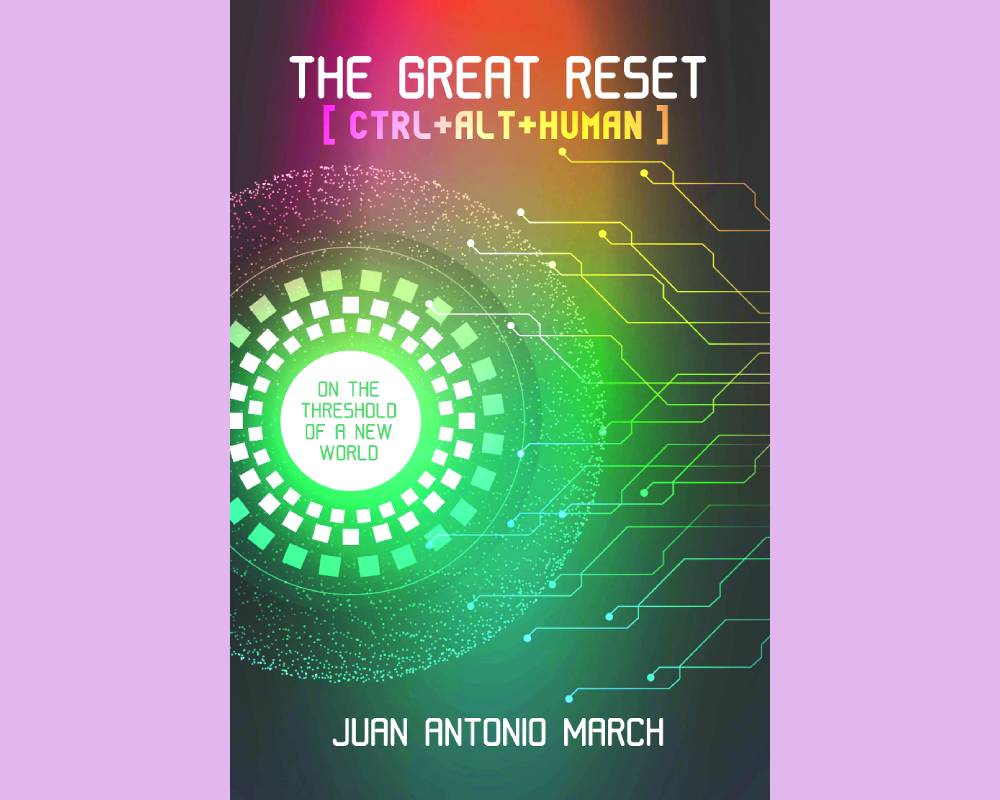
The novel, The Great Reset: Alt+Ctrl+Human by Juan Antonio March Pujol, is a fictionalisation of social idealist possibilities, much like Philip Allott’s Invisible Power duology. Social idealism is not an alternative to existing reality, as it might sound; rather, it is the way of making utopian moments in a dystopian world.
It is a way of discovering and sustaining the hope for a better tomorrow. And for the author of The Great Reset, technology, which he envisions as a soul force, will emerge as the architect of that utopia. And mind you, there is no metaphysical utopia in this book-utopia is in real time and space. It is that immediate future which humanity ought to make.
What is this tale about? It is a story that tells, with an Aristotelian subtext, how humanity can maximise its happiness by forging optimal outcomes. In the plot, we see Nour, a young Syrian-born woman, purposely moving across spaces and times. But occasionally she resembles the author, a career diplomat (leaving the reader to wonder whether this is a case of author surrogate), walking back into the Platonian cave, having seen light, with a mind full of stories to tell the victims of shadows fated to remain chained in the cave—they are stories about their potential liberation. Her (or his?) countenance reflects hope. Her forehead bears the etched lines of quiet determination-her steps confident.
All voices we hear—what Nour speaks and hears in the novel are spatialised, not even missing the characteristics of the topography that gives the voices their character. As we hear the voices, we also hear in the background the sounds of deserts—the wind blowing across the sand dunes and the rhythmic beats of the waves on the shores; smell the aroma of gardens and the petrichor of mountains; and feel the pell-mell of a city, the depth of the seas, and the silence of the caves. Time and space merge into a compelling narrative.
Nour’s journeys also tell us that the social world is a network of human relations-a mind superimposed on the natural habitat, the biological world. It reminds us of the findings of Edmund Jennings, the protagonist in Invisible Power, that the social habitat can be altered, modified, and improved through ideas. Nour—and through her the author—offers us a cornucopia of ideas.
The chapters are arranged in an alternating order-spaces and the experiences they offer, the feel of being in real places. Therein, Nour meets many revolutionaries of mind who educate her. Then she slips into a dream of a redemptive deliberation in the United Nations.
These worlds are far apart—the world of reality and dream—yet for the reader, they are so near, just a page apart. For Nour, too, perhaps, they are not distant worlds-there is just a dimensional divide between them, and, pretty much like Murakami’s “narrator” who moves into the invisible city in The City and Its Uncertain Walls with ease, Nour also moves across these worlds with ease. Whatsoever, for the reader, the alternating builds a rhythm that gets the reading going faster-the faster it gets, the deeper the reading becomes. Then, at some point, the rhythm takes over the reader; pages turn involuntarily, and the reader surfs through emotional and powerful waves produced by the ideas.
The novel is a blue book for a top-down revolution — a revolution in minds that Allott envisioned in Invisible Power. The Great Reset is an action plan for a revolution in minds. In that revolution, technology will be the resourceful comrade, algorithm will be the subconscious to inform and drive action.
All it takes is a will. The novel infuses hope, the master who tries to enslave our inhibitions. The novel has no moments of nihilism or ambivalence. It has sheer sanguinity and determination, coupled with ingenious and imaginative thinking. There is a strong disapproval of violence, killing, and bigotry, and an occasional lament for making history awful that they cannot be recalled without regret.
The author is not a hopeful watcher-as the maker of the story and the transformative schemes unfolding in the novel, but he is a functionary in it. We feel that he walks somewhere in the novel alongside Nour, or perhaps by being Nour himself.
Throughout the novel, there is a profound sense of ownership and accountability—the writer (in the protagonist’s voice) has taken the responsibility to be the harbinger of change. By the end of the novel, the reader feels the author asking, in the words of Khalil Gibran, “Was it I who spoke? Was I not also a listener?” Indeed, dear author, you were with Nour who spoke, and you were also with us—your readers—who listened. We heard you—thanks for speaking!



