











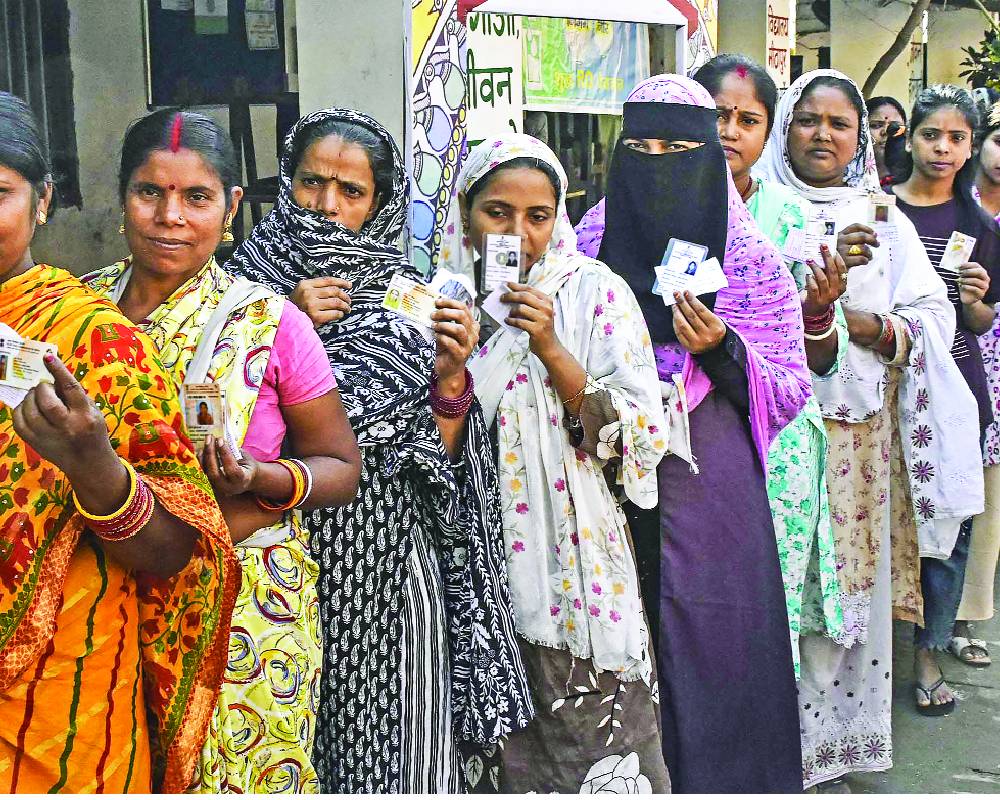
Do women vote as women, or do caste, religion, and class continue to determine their political choices? This question forms the spine of Ruhi Tewari’s What Women Want: Understanding the Female Voter in Modern India, an intelligent and engaging examination of how the Indian woman voter has evolved from the shadows of obedience into the light of agency. Drawing on nearly two decades of political reportage, Tewari weaves fieldwork, data, and conversation into a compelling study of the changing nature of India’s democracy through its most transformative electorate — women.
The book opens with a vignette that feels both distant and familiar. Amsa Amma, a 21-year-old from Hyderabad, cast her first vote during the 1977 general elections, a period clouded by the aftershocks of the Emergency. She was told by her father-in-law and husband whom to vote for.
At the polling station, she followed instructions, unaware of the significance of her action. That quiet compliance reflects the condition of the Indian woman voter in the early decades of democracy — invisible, unconsulted, and politically inconsequential. She existed, but only as an extension of the men in her household. That quiet compliance reflects the condition of the Indian woman voter in the early decades of democracy — invisible, unconsulted, and politically inconsequential. She existed, but only as an extension of the men in her household.
From that scene in 1977, Tewari builds a narrative that travels through villages, cities, and political landscapes, tracing how women have redefined participation. Through layered accounts of women who now stand in polling queues of their own accord, the book portrays how political awareness among women has grown, sometimes out of necessity, often out of choice.
The author observes that this rising participation has made women
central to electoral arithmetic, forcing every political party to rethink its strategy and messaging.
Through her travels, she listens to voices that rarely make it into mainstream political discourse—women who discuss ration cards and gas cylinders alongside aspirations for education, safety, and dignity. These are not abstract ideals; they are lived realities shaping political behavior.
Her examination of welfare politics is particularly incisive. The author questions whether the surge in women-centric schemes—from cash transfers to subsidised cooking gas, has truly empowered women or merely repositioned them as strategic voters in a competitive political market. The author points out that political attention towards women, though often tactical, has nonetheless created tangible shifts in perception. Women have begun to see themselves as stakeholders in governance rather than passive recipients of policy. In this paradox of opportunism and empowerment lies the core of her argument—even when motivated by political self-interest, the system has inadvertently expanded women’s political agency.
The strength of What Women Want lies in its layered understanding of women’s political choices. The author recognises that women voters are not a homogeneous group. Their decisions are influenced by caste, religion, and class, yet connected by a shared history of marginalisation. She shows how women continue to vote within identity boundaries while gradually moving beyond them through awareness and participation.
Tewari’s background as a journalist is evident in her sharp observations and grounded storytelling. Her analysis of how the “Naari voter” has emerged as a distinct political entity is especially engaging. She situates this rise within broader democratic shifts, where social mobility, education, and digital access have changed how women perceive their role as citizens.
Political parties, she notes, have adapted swiftly, recognising women not as a supporting vote bank but as a decisive one.
And as India’s democracy evolves, one can’t help but ask—do women vote as women, or do caste, religion, and identity still shape their choices at the ballot box?



