










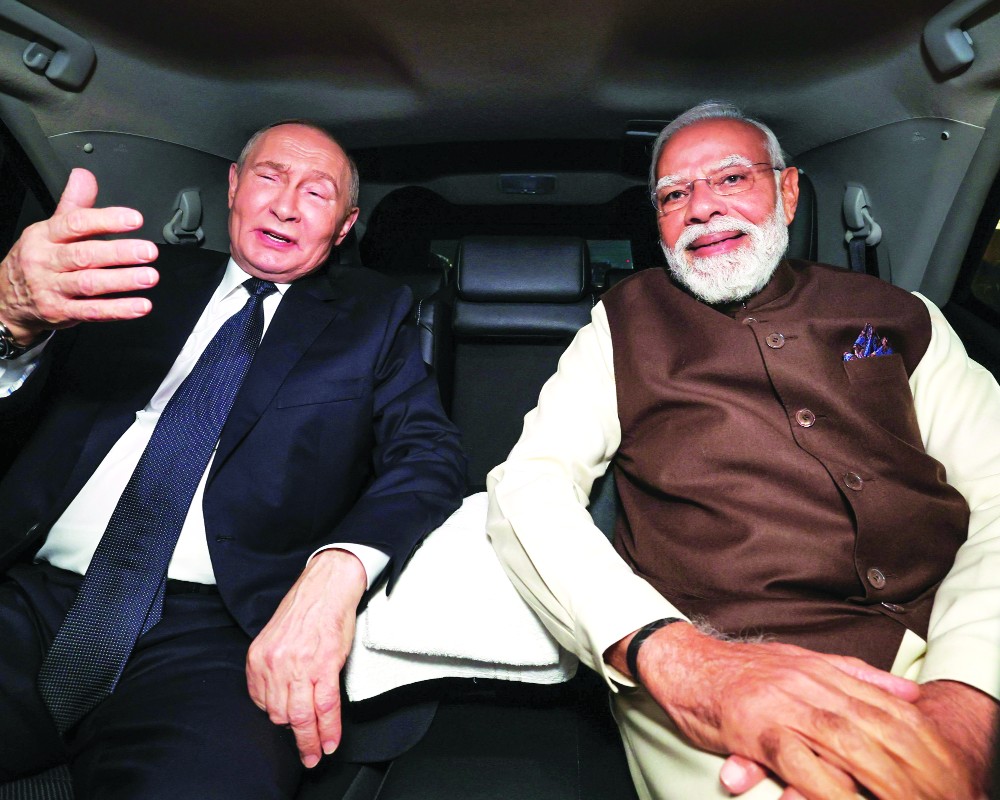
Russian President Vladimir Putin arrived in New Delhi on Thursday — his first trip to India since the Ukraine conflict erupted in February 2022. The visit comes at a moment of global uncertainty, with both nations reassessing their roles amid escalating geopolitical competition and rapidly shifting alliances.
On his arrival, PM received President Putin at the airport and drove together to 7 Lok Kalyan Marg. Later, PM Modi hosted a private dinner for the Russian president. The duo had travelled together last during the SCO meet in China. Sharing his thoughts on social media, PM Modi stated, “Delighted to welcome my friend, President Putin, to India. Looking forward to our interactions later this evening and tomorrow. The India-Russia friendship is a time-tested one that has greatly benefited our people.”
Formal discussions will unfold at Hyderabad House, first in a restricted format and later with their respective delegations. The outcomes of these meetings are expected to shape the trajectory of the India-Russia partnership for years to come.
During his stay, President Putin will participate in the 23rd India-Russia Annual Summit, where he and Prime Minister Narendra Modi are expected to discuss an expansive agenda, which includes trade, defence cooperation, energy security, emerging technologies, scientific collaboration and cultural ties. Regional and global developments-including conflicts, sanctions, and major power realignments-will also feature prominently in their talks.
Putin last visited India on December 6, 2021, when the 21st Annual Summit was held. His return now carries far greater diplomatic weight: Russia is under intensifying Western sanctions and scrutiny, while India is navigating its relationships with major global powers-the United States, the European Union, and Russia-without compromising its strategic autonomy.
Heightened Global Interest
International observers are watching the visit closely for clues on the durability of India-Russia ties at a time of deepening global polarisation. Key questions revolve around the future of defence cooperation, India’s energy engagement with Moscow, and how the two nations intend to position themselves on evolving security challenges across Europe and Asia.
Against this backdrop, the Kremlin has adopted an unusually warm tone towards New Delhi. With Russia increasingly reliant on dependable partners, Moscow is emphasising its long-standing ties with India. Kremlin spokesperson Dmitry Peskov described India as a “historic partner” and thanked New Delhi for its “friendly position” on Ukraine, signalling Moscow’s desire to solidify one of its last major energy and strategic relationships outside China. “We are proud to stand shoulder to shoulder with India,” Peskov said, framing the summit as proof of the “deep trust and mutual respect” between the two countries.
A Diplomatic Balancing Act
For India, the visit highlights one of the most complex diplomatic balancing acts in its modern history. While New Delhi’s legacy ties with Moscow remain strong-especially in defence and energy-its economic and strategic engagement with the United States and Europe has expanded rapidly. India must continue this dual engagement without alienating either side.
Putin’s presence in New Delhi is therefore more than symbolic. It will test India’s ability to maintain strategic autonomy in an increasingly divided global landscape. For Russia, the visit offers an opportunity to reaffirm its relevance, diversify partnerships, and reinforce its ties with a major Asian power as Western pressure deepens.
As Modi and Putin prepare for substantive discussions, the outcomes of this summit will likely echo far beyond bilateral ties-shaping regional dynamics across Asia, influencing global strategic alignments, and offering insight into how both nations plan to navigate a rapidly changing world order.



