











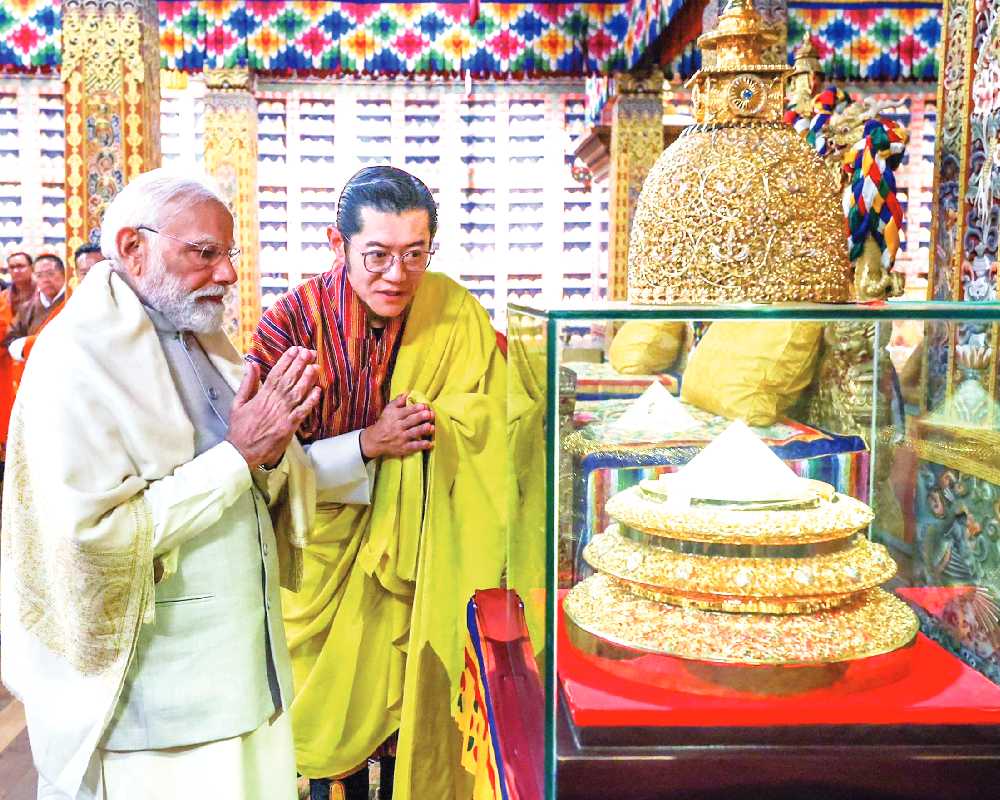
Prime Minister Narendra Modi on Tuesday reaffirmed India’s commitment to deepening its partnership with Bhutan through improved connectivity, enhanced border infrastructure, and expanded clean energy collaboration. His two-day visit to Thimphu highlights the growing synergy between the two Himalayan neighbours, particularly in the fields of transport, trade, and renewable energy. During the visit, Prime Minister Modi, welcomed by Bhutanese Prime Minister Tshering Tobgay, attended a special event commemorating the 70th birth anniversary of former King Jigme Singye Wangchuck.
Modi praised the former monarch for his vision in promoting democracy, peace, and sustainable development in Bhutan, and for laying the foundation of the two nations’ enduring friendship. A key highlight of the visit is the inauguration of a 1,020-megawatt hydroelectric power plant, a major milestone expected to boost Bhutan’s hydropower capacity by about 40 per cent. The project is part of the broader Indo-Bhutan energy partnership that has made Bhutan a leader in renewable energy and the world’s first carbon-negative country.
Modi also confirmed that work would soon resume on another long-pending hydro project and announced new joint efforts in solar energy. Emphasising the role of connectivity in economic growth, Modi said the new rail links between Gelephu and Samtse in Bhutan and India’s rail network would open new trade opportunities for Bhutanese industries and farmers. “Improved connectivity creates new pathways for prosperity,” he noted. India will also assist in developing infrastructure for Bhutan’s ambitious Gelephu Mindfulness City, an economic and cultural hub envisioned by King Jigme Khesar Namgyel Wangchuck.
To facilitate smoother cross-border travel and investment, Modi announced that India would set up an immigration checkpoint near Gelephu. New Delhi has allocated `10,000 crore for Bhutan’s current five-year development plan, supporting initiatives in roads, healthcare, agriculture, and financial services. Modi reiterated that the prosperity of Bhutan and India is “intertwined through geography, culture, and shared progress.” Digital and youth collaboration also featured prominently in the discussions.
The two sides are expanding India’s Unified Payments Interface (UPI) services in Bhutan, while young innovators from both countries continue to collaborate in space technology, education, and entrepreneurship — including the development of a joint satellite.Modi also underscored the importance of cultural bonds, citing the opening of the Royal Bhutanese Temple in Rajgir, India, and announcing that land has been provided in Varanasi for a Bhutanese temple and guesthouse. Closing his address, Modi lauded Bhutan’s guiding philosophy of Gross National Happiness, saying it continues to inspire nations worldwide to measure progress through well-being, not just wealth. “Our friendship stands on the solid foundation of trust, respect, and shared values,” he said.



