











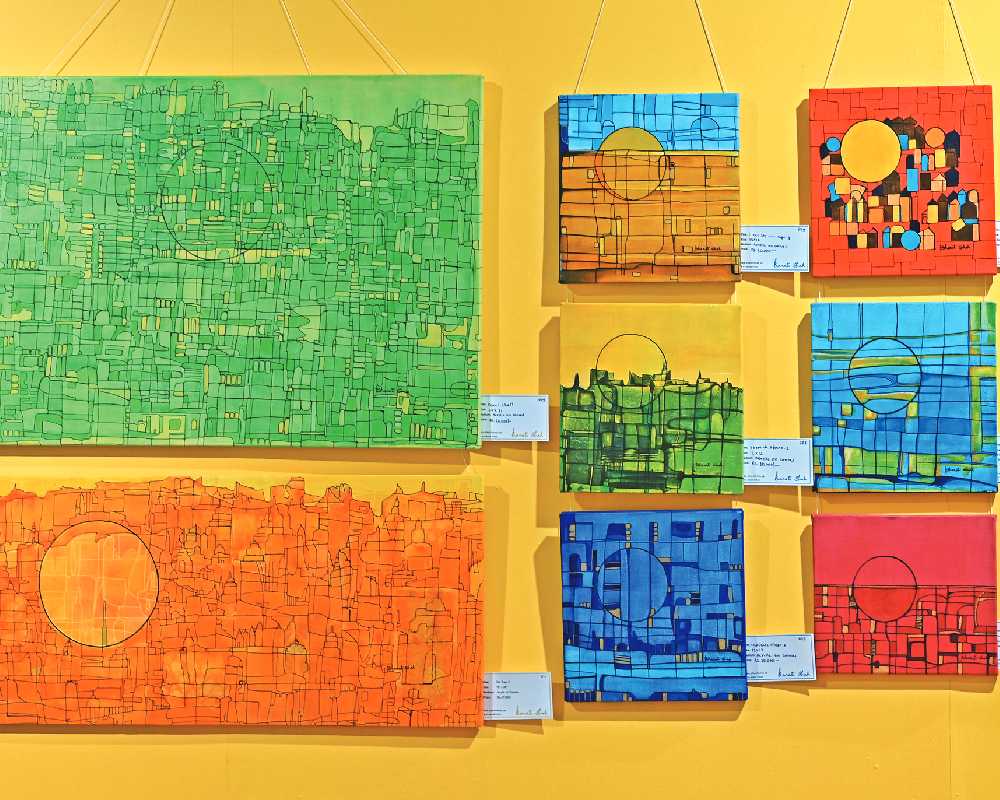
What is it that an artist truly confronts when she stands before a blank canvas — the world, or herself? Bharati Shah’s Rubaru, on view at Lalit Kala Akademi, New Delhi, invites that very confrontation — an intimate meeting between mind, matter, and movement. `The exhibition, her 68th and 16th solo show, reflects Shah’s lifelong engagement with abstraction, colour, and consciousness.
Painting for over three decades, she does not confine herself to themes. “I don’t get inspired by any theme or anybody. What comes to my mind is just pure mind,” she said. Her process is instinctive, with no planning or calendar-driven compulsion. “I have at least seven, eight exhibitions a year and only when I have exhibitions, I go out; otherwise, I’m in my studio working.
Ten hours a day I work.” The works in Rubaru are vivid and contemplative — acrylics on Italian linen and canvas that shift between stillness and energy. Gratitude 1, expansive and breathing, opens like an offering, its brushwork deliberate yet spontaneous. Jal Thal Nabh 2 carries a cosmic temperament, its palette reflecting the meeting of water, earth, and sky — an unbroken continuum of existence.
Colour becomes language in Vermillion Sun 2, where warmth spills across the frame in waves that seem to radiate memory. In contrast, Midnight Blues 1 is an inward whisper — indigo layered with reflection, a nocturnal space where light and thought coexist. Shah’s Harmony 2 is a quieter symphony, a visual arrangement that feels like listening to silence itself. When asked how she wishes her visitors to perceive these works, her reply was immediate: “When I finish a painting, I’m done with it. I want them to have their own perspective and make their own story. And I like to listen to what they are.”
This openness turns her exhibition into a dialogue. Every viewer becomes a co-creator, completing the artwork through personal reflection. Her world is filled with colour, literally and philosophically. “It’s a temple, it’s really colourful,” she said, describing one of her pieces. “Everything is colourful — our moods, our clothes, our flowers, our way of life. Everywhere you see colours.” Her canvases bring this sensory abundance alive. Works such as Serenity 2 and Solace 1 move through delicate transitions of light, invoking quiet renewal, while Doors and Windows 2 and Brahma the Creator play with form and suggestion, offering glimpses into inner and outer thresholds.
Though her works bear traces of cubist structure — a lineage tracing back to Picasso and Braque — Shah approaches the form intuitively, independent of its history. “I stumbled upon it not knowing the history behind it,” she said. “It allows me to explore and understand my mind without being tied down by any parameters. I am free to create not what my eyes see but what is deep in my soul.” Rubaru in Urdu means face-to-face — an encounter. Shah’s exhibition is exactly that: an encounter with the unseen currents that move within us. The viewer stands before each work as one stands before a mirror — without expectation, without direction, yet inevitably transformed.



