Besides being a major pilgrimage centre for Jains, Palitana’s Shatrunjaya Hill is an amazing architectural treasure trove for art lovers and history buffs, writes Chitra Ramaswamy
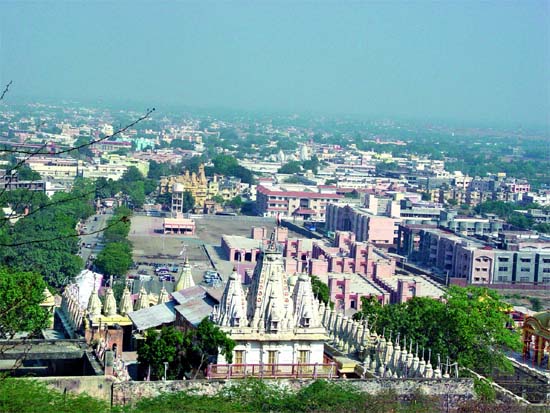
The Shatrunjaya Hill is the holiest of the five sacred mountains of the Jains, considered as siddha-kshetras or place where most of their Tirthankaras attained nirvana. The hill, which towers 2,000 ft above the town of Palitana, is home to about 863 magnificent and ornate temple structures, some of which date back to the 11th century and before. While the cluster of temples were built in two phases over a period of 900 years, mostly beginning from the 11th century, some of the early ones suffered damage at the hands of marauding Muslim and Mughal invaders. Mughal monarch Akbar, however, is believed to have accorded special status of Shatrunjaya during his reign, ensuring its protection from non-Jain influence and helping keep Jain traditions alive.
Palitana, fed by the Shatrunjaya river, was the capital of a small princely state that was founded by Shahji, a Gohel Rajput. At its zenith, the town was a flourishing industrial region known for horse breeding, diamond cutting and manufacture of harmonium reeds, the instrument essentially being a Western one, modified and adapted to Indian music. It is common knowledge among the townspeople that the credit of manufacturing the first Indian harmonium reeds goes to the Mistry family of Palitana who still remain one of the country’s biggest suppliers of the reeds.
Even today we spot tangas — the horse-drawn carriages — mules lugging water cans uphill, cows sauntering in lazy abandon through its various alleyways, cubbyhole shops selling a medley of goods, sadhus and sadhvis carrying their bright red pots, adding to the rustic charm of the place. The winter sun is just up on the horizon as we pander to the call of our rumbling bellies with a simple breakfast of Jain bhelpuri and chai. For a dedicated onion lover, I am sceptical about the bhel sans the bulbous tears-inducing vegetable, as I watch a weird concoction of ingredients being tossed in with a flourish by the humble dhaba wallahs at the several kiosks lining the street at the base of the Shatrunjaya Hill. Firm, semi-ripe shred papaya and glistening garnet-hued pomegranate get thrown in along with finely chopped green chilli and coriander leaves into the vessel containing the crispy sev. A few spice powders get sprinkled, lime is squeezed and the mixture is whirled and waltzed around in one swift motion before it is served to us on modest-sized saucers. The snack is deliciously sweet, sour and spicy, even refreshing, as we wash it down with a steaming cup of tea, our tongues on fire and eyes, a Niagara brimming with the lachrymal fluid.
In keeping with the tenets and principles of the Jain religion, we stash away our leather wallets that we have carried with us, in the lockers provided at the foot of the hill, our footwear in one of the several stands meant for them and begin our trudge up, hoping to make it to the top in good time, in not more than a couple of hours. Young Bahadur tails us, pleading with us to hire him as our guide. He even throws us a bait saying he will carry our slippers up for us! Touched by his enthusiasm, happy that he prefers to earn his way rather than beg, we hire him. Bahadur immediately takes off with his narrative, cajoling us once in a while when we stop to breathe in lungsfull of oxygen.
As we jauntily make our way up the 600m climb we pick up smatterings of conversations of fellow visitors, much as we fall into a chit-chat with some of them. We learn that it was on this hill that Pundarika aka Rishabh or Adinath, the first Jina, and son of Bharata, the chakravarti after whom India gets its name Bharat, attained nirvana. Archaeological evidence points to the Adinath idol having been installed in 1006 AD. The temples, we are told, have been renovated from time to time, having been damaged by marauding Muslim and Mughal invaders.
Every few hundred yards, weary travellers are provided respite with fresh and cool water from earthenware pots. On our way up we meet Meena, doling out water. In true orthodox style, she has had a few years of schooling and while still in her early teens, is all set to tie the nuptials! Who cares whether she desires to pursue further studies or do something else. But contentment is writ larger over her face as she refills glass after glass of water, making the passage of climbers that much easy. There are several other youngsters like Meena and Bahadur who pitch in their lot in the service of mankind and to supplement their family incomes. We notice even some girls carrying the dolis uphill, but of course, they are not manned — they lug the bags and possessions of visitors. It is obvious they enjoy their chores and stop in the way with smiles to pose for us, giggling as they see themselves on our digital frames.
Several myths are associated with the temples of Palitana. An oft repeated one relates to the idol of Adinath in the main temple atop the hill, having breathed seven times when it was first installed there! Yet another tale that has been doing its rounds is that the idol gets a layer of silver every night and this serves as the earnings of the priest as a gift from God for his services! Some quarters of devotees believe that a small idol of lord Mahavira, the 24th Tirthankara, flew every night from one of the nearby temples to the palm of lord Adinath.
The temples, big and small, home to at least seven or eight thousand idols of the various Tirthankaras, are spread over the Shatrunjaya Hill, covering around 20acres. A set of 24 chauvisis or small identical shrines dot the route to the peak. After climbing a few hundreds of steps we come upon one of the bigger structures en route, the shrine dedicated to Padmavathy with its ornamented archway.
Bahadur tells us that Palitana and the hill acquire a spectacular hue on the full moon of Kartik month each year as pilgrims throng it in hundreds of thousands. A major part of the festivities includes processions of devotees carrying huge photographs of the sacred mountains, through the streets of the temple town. Obviously from hearsay, Bahadur informs us that it is important for every Jain to visit Palitana at least once in his or her lifetime to achieve the bhavya status, one that makes an individual fit for salvation.
It is well past six in the evening as we descend from Shatrunjaya and make our way towards a restaurant. Soon it strikes us that we are actually hunting for one that will serve us dinner at this “unearthly” hour. Obviously we have not realised the complete import of being in a Jain land, where the scriptures are followed almost to the last word — no food or water is partaken after sunset!
Famished from our day’s adventure, we are gleeful when we spot a modest café close to the Palitana bus station that is open for services. Wearily, hungrily, even greedily, we polish our plates clean and repair for the day, our heads full of the beauty and strange tranquility in the midst of bustle that is Shatrunjaya and Palitana. We even will ourselves to hear the melody from vibrating reeds of the harmonium as we lull ourselves to sleep with all thoughts blissful.
Copyright: Exotica, the wellness and lifestyle magazine from The Pioneer Group, available in all rooms of select five-star hotel chains