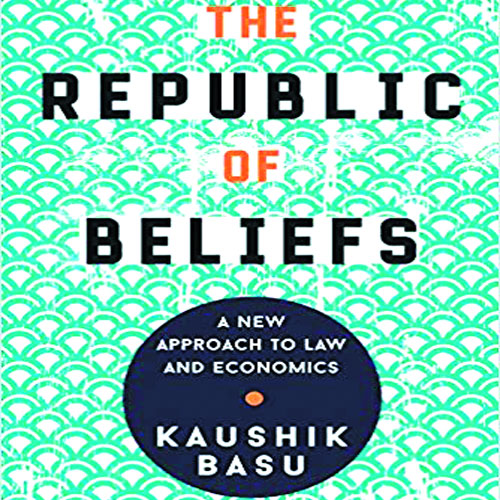
THE REPUBLIC OF BELIEFS
Author - Kaushik Basu
Publisher - Princeton University, Rs 699
Kaushik Basu puts out an entertaining variation on Nash’s Game Theory to argue that laws must make sense for the enforcers as well as the people and must be in agreement with the economic context, writes Gautam Mukherjee
Kaushik Basu currently teaches Economics and International Studies at Cornell University in the US. He has had an illustrious career, with distinguished stints as chief economist and senior vice president at the World Bank, and later, in this neck of the woods, Basu was chief economic adviser to the Government of India during UPA rule. Basu mostly leans Left in his economic ideas, and is a former student, amongst several others, of Nobel Laureate and “Welfare†economist Amartya Sen — who is also from India and a fellow Bengali too.
This latest, extensively researched book, that quotes many thinkers to illustrate his points, has Kaushik Basu exploring the co-relationship between laws and economics. It tries, to an extent to speak to the ordinary reader, but is, in fact, quite an academic tome. Still, some of its basic premises are readily graspable. Why are some laws both obeyed and enforced, he asks, while others stay quite ineffective on the statute books? In India, he points out, there are, in fact, many laws that are rarely used or enforced. Basu writes, that in order for a law to be properly implemented and used, it must intersect at a “focal point†with society and its economic ideas.
In other words it must make sense both to the enforcers of the law and the people it is intended for. Otherwise, both are likely to collude in its subversion or leaving it on the shelf.
“The most important ingredients of a republic, including its power and might, reside in nothing more than the beliefs and expectations of ordinary people going about their daily lives and quotidian chores. It is in this sense that we are all citizens of the republic of beliefs,†writes Kaushik Basu. He goes on to write: “The focal point is a somewhat mysterious concept that emerged from modern game theoryâ€. This concept of intersecting beliefs however, is the main point of this book, and Basu’s suggestions towards a more effective socio-legal environment essential for orderly progress, are predicated upon it.
Basu believes one of the purposes of law, which is an instrument of the State as a collective, is to influence and alter the collective behavior of its people towards preset objectives. In this, he goes beyond the more usual objective of an “orderly society†so that economics can do its stuff in peace. He actually wants to influence the populace via the laws adopted. He writes, “The focal point approach relies on the expressive function or suggestive power of the law and not on any human irrationality. It is purely a device that uses suggestion to facilitate coordinationâ€. Basu clarifies further: “What the focal approach to law and economics does is to take on the full economy game, including the police and the judge, and then tries to explain how and why the law worksâ€. In other words, you need all the ingredients to be in some form of tacit agreement on the premises assumed by both the given law, and the economic context it operates in, for it to be widely adopted and used.
But, quite often, “It is not evident what constitutes a focal point for different groups of peopleâ€. In a highly diversified country like India this becomes doubly relevant and even more difficult to arrive at. Traditional laws, he says, were less inclusive in their approach, and usually were made up based on the consensus of a few, and then, sometimes imposed, when they were vigorously enforced, upon the many. He states that is why they often did not work, even though his outright demoting of the traditional approach without very much ado, is less than convincing.
However, for a left-leaning thinker, inclusiveness must appear far more attractive as a basis to build upon, rather than a top-down approach to economic order and law-giving. Even if the latter method goes back to the Hammurabi Code and Moses’ Ten Commandments.
Basu is an admirer of the ancient Greek City States, and the way they went about their business. He wants to see the principles enunciated then, spread across a 21st century global canvas to the extent possible. But this tends to be an impossible seduction, as the many self-contradictory effects in Democracy show. The idea is pleasant, but it is not easy to remain democratic in a so-called Democracy!
Focal points can be arrived at via custom, and tradition, writes Basu, as in the “tenacious†Indian caste system. They can also be arrived at by discrimination. That is, by giving advantages to a specific group over another or several others. But predictably, Basu is not for allowing free play to it with its overtones of apartheid.
He writes: “The popular view is that if you leave it all to the market, with no Government regulations and intervention, discrimination will go away, is not valid. Discrimination arises from a free market. If you want to stop discrimination, you may, in fact, need regulation and conscious affirmative actionâ€.
Kaushik Basu is certainly not for rank Capitalism. He writes: “Once we move beyond payoff-focused critiques to generalised ones, many challenges open up. Human beings are guided not just by their own payoffs but also by habit, fairness, altruism, empathy, envy and many other emotional and psychological proclivities... Conservative economists , who condone selfishness by believing Adam Smith’s concept of the invisible hand will invariably lead such a society to optimal results, end up creating failed societiesâ€.
Is Basu right? That depends on your own politics and economics. But he certainly puts out an entertaining variation on Nash’s Game Theory to support his plumping for the old economic concept of the Focal Point.
Is such a thing rather theoretical when it comes to Law and Economics? My view is that it certainly is. And also it is not the job of Law so much as Justice to set Society on the right track. Economics marches to its own drummer. Recent progressive Supreme Court judgements on Homosexuality, Triple Talaq, and women between the ages of 12 and 50 being allowed to go to a revered temple that kept them out for millennia, are all cases in point.