About the Book
Book: ‘One foot in the ruin and other poems’ - The poem book
Author: Janhwij Sharma, Dev
Publisher: Dev
Price: Rs 2,495 Pages: 218
Janhwij Sharma’s One Foot in the Ruin and Other Poems is a captivating blend of evocative photography and reflective poetry that explores the intersection of history, memory, and the human spirit, writes SWATI PAL
We’ve all heard the adage: never judge a book by its cover. While this is sound advice, there are exceptions. One Foot in the Ruin and Other Poems by Janhwij Sharma is one such exception where the cover perfectly mirrors the book’s essence. The image—a lone wayfarer treading an uneven, weathered path amidst ruins, with distant figures barely visible—evokes a sense of solitude and introspection. Towering hills frame the background, while trees and bushes border the ruins in the foreground. Rendered in shades of black, white, and grey, the photograph conjures an atmosphere steeped in history, timelessness, and philosophy. It invites the reader to reflect: What is life if not a journey, and what are we if not wayfarers navigating an unpredictable path? This evocative cover sets the tone for the meditative and poignant journey that unfolds within the book.
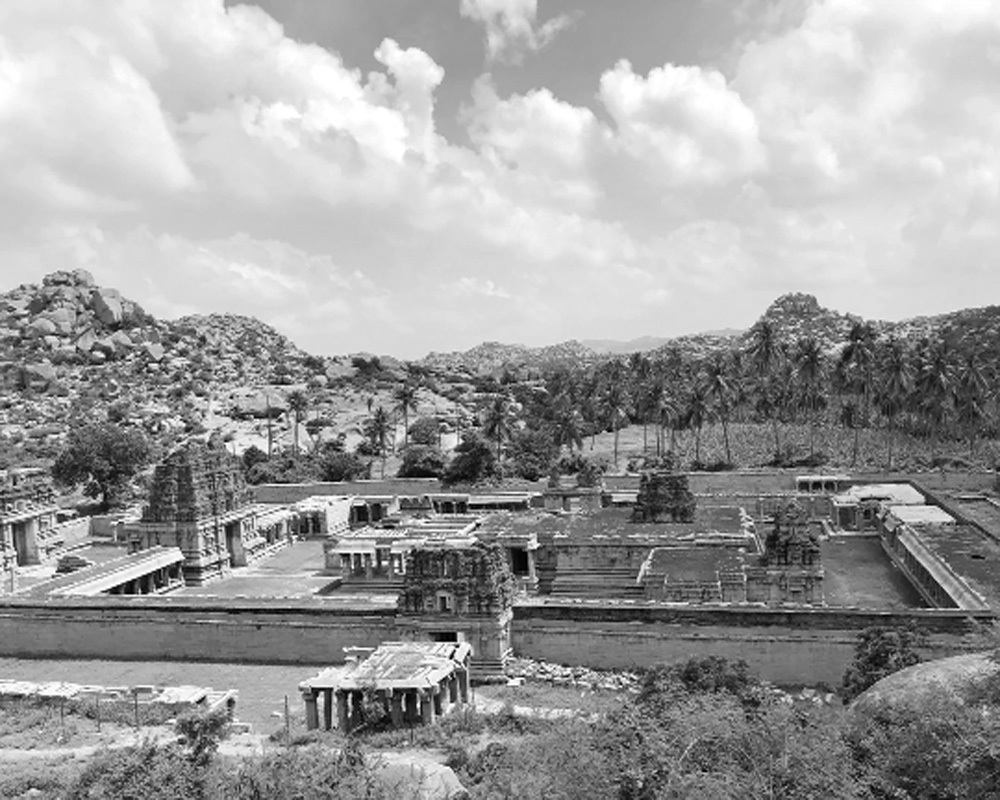
The title poem, “One Foot in the Ruin,†found on page 166, epitomises this theme. Accompanied by a photograph of an abandoned street in Hampi, the poem reads:
One foot in the ruins…
I walk on the weather-beaten path
setting one foot in the ruin
I may wander
wander aimlessly
carelessly ceaselessly
but never to get lost
but maybe at times to
find new paths, new goals
embark on a new journey
or simply to return home.
Traditionally, ruins evoke somberness, loss, and mystery. Sharma, however, takes a refreshingly different approach. He portrays the ruins not as dead relics but as sites of exploration, learning, and renewal. The poet walks through them not to lose himself but to discover new meanings, new paths, and, ultimately, a way home. In these lines, Sharma shares a hopeful philosophy: life, no matter how unpredictable or transient, holds potential for growth and return.
This hopeful outlook resonates in another short poem, “Silent Spaces,†on page 41, paired with a photograph of the Red Fort’s barracks in Delhi:
Silent spaces
haunting…
filtering rays of hope
for the ruin.
Here, Sharma’s ruins filter light, offering glimpses of hope rather than despair. Similarly, in “Is There a Way†(p. 77), paired with a photograph from Fatehpur Sikri, the poet muses on the stories ruins whisper:
Is there a way to hear the ruins
still telling tales of its
proud past with all
moments it lived
cherished and felt…
Time feels alive
within these ruins…
all that will one day remain
will be the ruin’s whispering tales
to those who could hear.
Sharma’s ability to hear and convey these “whispering tales†makes this collection profound. Of the book’s five sections—North, West, Central, South, and East—each rooted in different regions of India, the Central section lingers in memory. For example, the poem “Excavated†(p. 159), paired with a photograph of Sarnath, explores time and its interplay with history:
Unearthed remains brought to fore
testaments of the era silent long back…
Time unwinds and time unwraps
bringing ruins to another life
time now stands still…
Similarly, “In His Shelter†(p. 162), set against an image of a shrine in Hampi, reflects on the timeless pursuit of divine shelter:
In perpetual obeisance
prostrations before the divine
seeking His shelter and blessings
humbly forever…
Sharma’s poems often delve beneath the surface of ruins to unearth enduring values, faith, and hope. This sentiment finds expression in “Stones Speak†(p. 120), inspired by the Ellora Caves:
Hewn out of rock/sculpted over time/lasting forever.
Stones speak/louder than words/echoing memories/with ceaseless gaze.
The poet also captures spiritual and surreal elements, as in “The Other World†(p. 203), paired with an evocative photograph from Assam:
Passage for the ultimate departure
there is deathly silence around…
one never dies as they say
no need to ever mourn those who leave…
Balanced against these profound reflections are moments of lightheartedness, as in “Craftsman’s Prank†(p. 112), inspired by a seemingly purposeless carved handle on a wall at Adalaj Vav, Gujarat:
Why is it there/I ponder
what purpose does it serve/makes me think harder…
Surely he is having a good laugh/even in his grave.
This blend of spirituality, history, and human touch showcases Sharma’s ability to see both the solemn and the whimsical in his subjects. Whether contemplating eternity or musing on a craftsman’s playful detail, his poems bridge past and present, light and shadow, permanence and impermanence.
The book’s concluding poem, “Through the Ruin†(p. 32), paired with a photograph from Sarai Amanat Khan in Amritsar, encapsulates the collection’s overarching message:
Through the ruin…
And I walk alone/framed through the ruin
ravaged by time…
And I walk ahead/through the voids of the ruin
reaching the destination/where my future will be.
As we reflect on the book’s title and its solemn promise, we find that One Foot in the Ruin does not burden readers with heaviness. Instead, it uplifts, offering hope and perspective. Sharma’s work reminds us that ruins, like life, hold stories worth hearing and lessons worth cherishing. Both the poetry and photographs take readers on an evocative journey across India, making this book a treasure worth exploring.
-- Swati Pal, Professor and Principal, Janki Devi Memorial College, University of Delhi, has been a Charles Wallace; John McGrath Theatre Studies and Fulbright Nehru fellowship, scholar. She has published on theatre, creative and academic writing, education and translates from Hindi to English. In Absentia and Forever yours and other poems are two volumes of poetry by her; many of her poems feature in anthologies as well