Pilots’ body Airlines’ Pilots Association (ALPA) India on Friday took “strong” objection to safety regulator DGCA’s “selective and unsafe” relief to domestic carrier IndiGo, amid widescale cancellations, saying the decision sets a dangerous precedent.
The Directorate General of Civil Aviation (DGCA) earlier in the day granted IndiGo temporary exemption from stricter night duty rules for pilots. In a letter to the DGCA on Friday, ALPA-India said the decision not only sets a “dangerous precedent” but also undermines the very principle and purpose of the civil aviation requirement under which the norms have been formulated.
It also said on the pretext of passenger inconvenience, IndiGo is seeking relief despite having knowingly increased their winter operations while being fully aware of the implementation of the second phase of the pilots’ flight duty and rest period norms.
ALPA India had on Wednesday alleged that this (IndiGo cancelling huge number of flights) situation points to a “failure of proactive resource planning by dominant airlines, potentially exacerbated by an effort to pressurise the regulator to dilute the new FDTL norms for commercial gain”.
And on Thursday, the DGCA in a statement said it has directed the airline to submit the flight duty time limitation (FDTL) relaxations required to normalise the flight operations, after the airline informed the regulator that “it was facing significant transitional challenges in roster planning and crew availability under phase-2 FDTL requirement”.
IndiGo was the first carrier to oppose the new FDTL norms for pilots when they were introduced in January 2024 with March 2024 as the timeline for implementation.
The latest FDTL norms, which entail increased weekly rest periods to 48 hours, extended night hours, and limiting the number of night landings to only two, as against six earlier, were initially also opposed by domestic airlines, including IndiGo and Tata Group-owned Air India.
But they were subsequently rolled out by the DGCA following the Delhi High Court’s directives, albeit with a delay of over one year, in a phased manner, and with certain variations for airlines like IndiGo and Air India.
While the first phase of these FDTL norms came into force in July, the second phase, which reduced the number of night landings from six to two earlier, was implemented from November 1.
“By granting selective exemptions to IndiGo, the DGCA has opened the door for all other operators to cite their own operational, commercial, or scheduling reasons to demand similar dispensations,” ALPA India said in its Friday statement.
“It also said that if dispensations can be granted based on each operator’s requirements, then the relevance, authority, and intent of the FDTL CAR is defeated entirely.”
Stating that the decision has been taken despite repeated representations, formal letters, and direct discussions with the DGCA office, ALPA India said, “During our meeting on November 24, it was unequivocally agreed that no dispensation, exemption, or variation, particularly those motivated by commercial interests would be granted to any operator.”
“The consensus was clear: FDTL norms exist solely to safeguard human life, and any dilution of these limits would expose pilots, passengers, and aircraft to unacceptable risks. Yet, in complete contradiction to this understanding, your office has extended selective dispensation to IndiGo for Phase II implementation, allowing them to operate beyond the safety envelope prescribed by the CAR,” it said.
Interestingly, at the time of implementation of these regulations, then Civil Aviation Minister Jyotiraditya Scindia had said, “these changes — that are very much in line with international best practices — will ensure India has the necessary arsenal, as it prepares to clinch the largest domestic aviation market title in the future.”
IndiGo shares down over 7 pc in four days
Shares of InterGlobe Aviation, the parent of IndiGo, dropped over 7 per cent in the past four days ever since a crisis engulfed the airline, where it cancelled a large number of flights, leaving thousands of passengers stranded for several hours.
In the past four trading days, the stock has lost 7.23 per cent on the BSE. On Friday, the stock declined 1.22 per cent to settle at `5,371.30 apiece. During the day, it dropped 3.15 per cent to `5,266. On the NSE, shares of the firm ended 1.27 per cent lower at `5,367.50 each. In the last four days, the stock has declined by 7.30 per cent. The company’s market valuation has eroded by `16,190.64 crore to reach `2,07,649.14 crore since December 1.
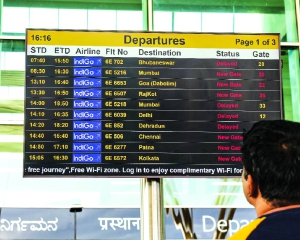
Air travel across India remained in chaos for a fourth straight day on Friday as IndiGo, the country’s largest airline, cancelled more than 1,000 flights, including all departures from New Delhi, leaving thousands of passengers stranded for several hours at a stretch with little clarity on alternatives.
Airline’s CEO Pieter Elbers on Friday said the situation is anticipated to normalise between December 10-15.
Elbers, in a video message, apologised for the major inconvenience caused to the passengers due to the disruptions.
“Regrettably, earlier measures of the last few days have proven not to be enough. So we decided today for a reboot of all our systems and schedules, resulting in the highest number of cancellations so far, but imperative for progressive improvements starting tomorrow onwards.
“With these actions, we expect Saturday to have cancellations below 1,000. The support of DGCA, in providing specific FDTL implementation relief, is of great help,” Elbers said. Aviation regulator DGCA has kept in abeyance the implementation of the new Flight Duty Time Limitations (FDTL) norms, and gaps in planning the second phase implementation of these norms are one of the key factors for the current flight disruptions.