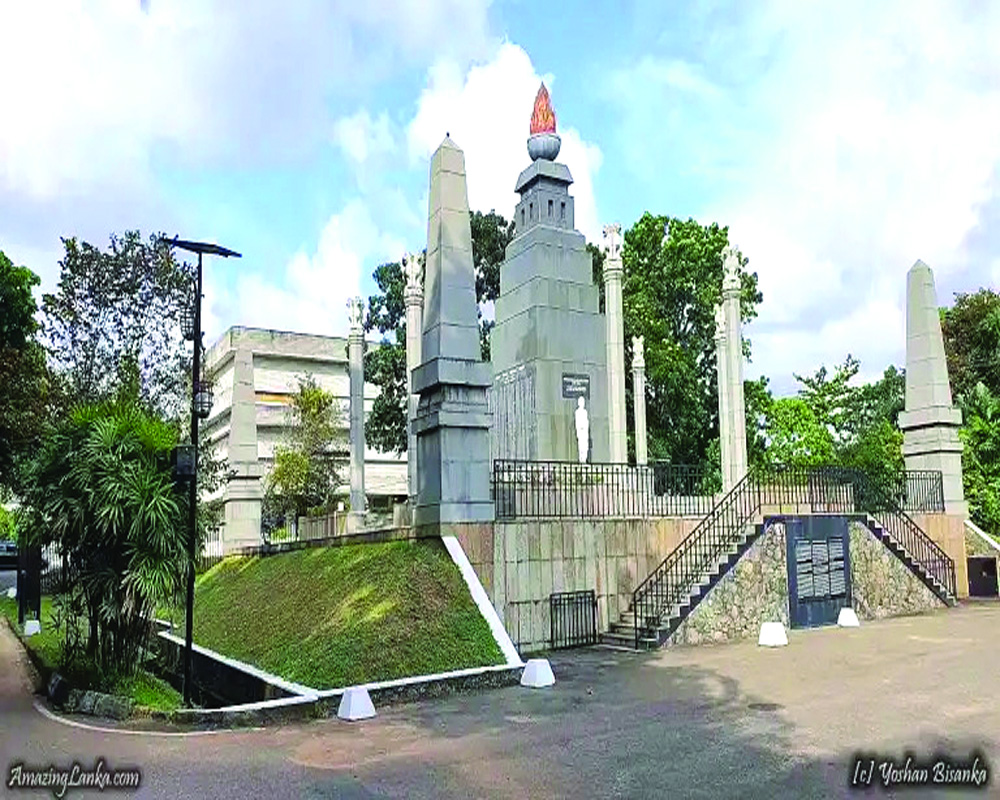
While memorials like the IPKF site in Colombo preserve the sacrifices of Indian soldiers abroad, the absence of similar recognition at home reflects a paradox in how India honours — or overlooks — sacrifices of bravehearts at the altar of regional stewardship
On India’s 79th Independence Day, Prime Minister Narendra Modi alluded to India’s strategic sovereignty (autonomy) while dealing with US tariffs, while honouring Op Sindoor, a non-contact undeclared war. Britain had ruled over all of South Asia and South-East Asia except Nepal and Thailand, which were not colonised. Both were hereditary kingdoms. India inherited the trappings of British colonial power without the intellectual and military instruments to exercise influence over South Asia after Independence, though it assumed derived authority was intact and would be respected. Tibet was the first casualty, even after British generals had recommended its occupation, which was said to be not feasible, for which India has had to pay a heavy price.
Similarly, the 1962 war with China was due to illusions of power and failure to recognise the enemy. India, on the other hand, was able to successfully integrate 565 princely states, including Hyderabad and J&K, which required employment of expeditionary forces. Portuguese and Dutch colonies likewise required the use of force. Overall, the record was impressive, though military assets had been depleted; divided between India and Pakistan.
The first test of India’s diplomacy was in the Himalayan kingdoms of Nepal, Sikkim, and Bhutan, where Treaties of Peace and Friendship were re-negotiated between 1949 and 1950 based on earlier arrangements with Britain. Each had different levels of autonomy, freedom, and independence.
An early test of India’s influence was in Nepal, where Delhi was able to restore the monarchy in 1951, and a decade later, Kathmandu’s tryst with India-induced democracy failed. Indian troops were involved in both these game-changing events. In the early 1990s, Nepal requested IAF helicopters to assist in locating victims of air crashes in Kathmandu. India was the first responder during the decade of the Maoist civil war, ensuring maintenance of democracy and mainstreaming the Maoists. Today, India does joint exercises at battalion level in the Surya Kiran series, the highest level of training with any country.
In 1970-71, India was forced to project power in East Pakistan to help it create a new country, Bangladesh, which inherited the traits of Islamic fundamentalism and periodic military rule from its parent, Pakistan. Following its third revolution, Dhaka is undergoing yet another transformation, the contours of which are still unpredictable. 3,483 Indian soldiers sacrificed their lives for the restoration of democracy, which ultimately failed to bring political stability and economic prosperity. The legacy of the 1971 War of Liberation was politically miscarried by India, making it a Delhi victory. Still, the Sheikh Hasina Government was able to build a memorial at Ashugunj, Brahmanbari, for which a foundation stone was laid in March 2021. Prime Ministers Hasina and Modi were to inaugurate it in early 2025, but events willed otherwise.
India’s Op Cactus Lily in the Maldives prevented a regime change by Tamil rebels in 1988. There is no symbolic structure in Malé to commemorate the event. On the other hand, India–Maldives relations have been strained. But in next-door Colombo, Sri Lanka, India has managed to preserve its gains during Op Pawan, in which the IPKF succeeded in considerably weakening the LTTE in the north-east of the island. By helping in holding presidential, provincial (for the first time), and parliamentary elections, IPKF reset democracy in the north-east.
The story of the construction of the IPKF memorial in Colombo is unknown, and what little is known is based on conjecture. The IPKF memorial is largely the result of efforts by President Chandrika Kumaratunga, who had expected MiG-29 aircraft from India in return to fight the LTTE. Political opposition to the memorial came from the Buddhist clergy and members of both mainstream political parties, SLFP and UNP.
The spadework for the memorial was done by Adm Ravi Wijegunaratne, former CDS and Navy Commander, when he was Defence Advisor in Delhi. In 2001, Lt Gen Lionel Ballagalle visited Delhi, where in the Battle Honours Mess, he announced that the Sri Lankan Government had decided to build the IPKF memorial to enshrine the sacrifices made by Indian military in preserving the sovereignty and territorial integrity of Sri Lanka, when no similar idea was ever mooted in Dhaka after the Liberation War. But discussions about the memorial had begun in the 1990s, though overcoming political opposition and locating suitable land were the main hurdles. An earlier location considered was in the heart of Colombo, near a World War II memorial, which never got approval.
The Admiral and I saw this piece of turf swallowed by tall grass. Finally, land was located in Battaramulla on Ape Gama grounds next to the Sri Lankan Parliament and its own national war memorial. Work was entrusted to Sri Lankan naval architects and Navy engineers in cooperation and coordination with the Indian Defence Advisor in Colombo. Several additions and deletions were made, and the memorial was ready in 2008, but was formally inaugurated by Indian High Commissioner Ashok Kantha on August 15, 2010.
Since then, many have paid homage to 1,169 martyrs whose names are inscribed on the memorial. PM Modi laid a wreath at the IPKF memorial in Colombo twice: 13 March 2015 and April 5, 2025. In 2015, he said: “The IPKF is a source of inspiration and courage.” But in Delhi, it is a different story. IPKF veterans are allowed merely a silent and time-specific commemoration on March 24, whereas Op Vijay (Kargil), which is described as a skirmish at the National War Memorial, is celebrated with full ceremonial honours.
The last, fifth, silent and private commemoration went unrecognised. The IPKF’s Op Pawan memorial is located only in Colombo (another smaller one exists at Pallaly in Jaffna), though PM Modi has called it a source of inspiration and courage. It is surprising that it is not commemorated officially at the National War Memorial. The new VCOAS, Lt Gen Pushpendra Singh, earned his spurs with 4 Para (Special Forces) in Op Pawan, fighting gallant actions in which he was wounded. He would be the right person to support the campaign of IPKF veterans to obtain official recognition.
The writer, a retired Major General, was the Commander of IPKF South, Sri Lanka, and a founder member of the Defence Planning Staff, which is currently the Integrated Defence Staff