











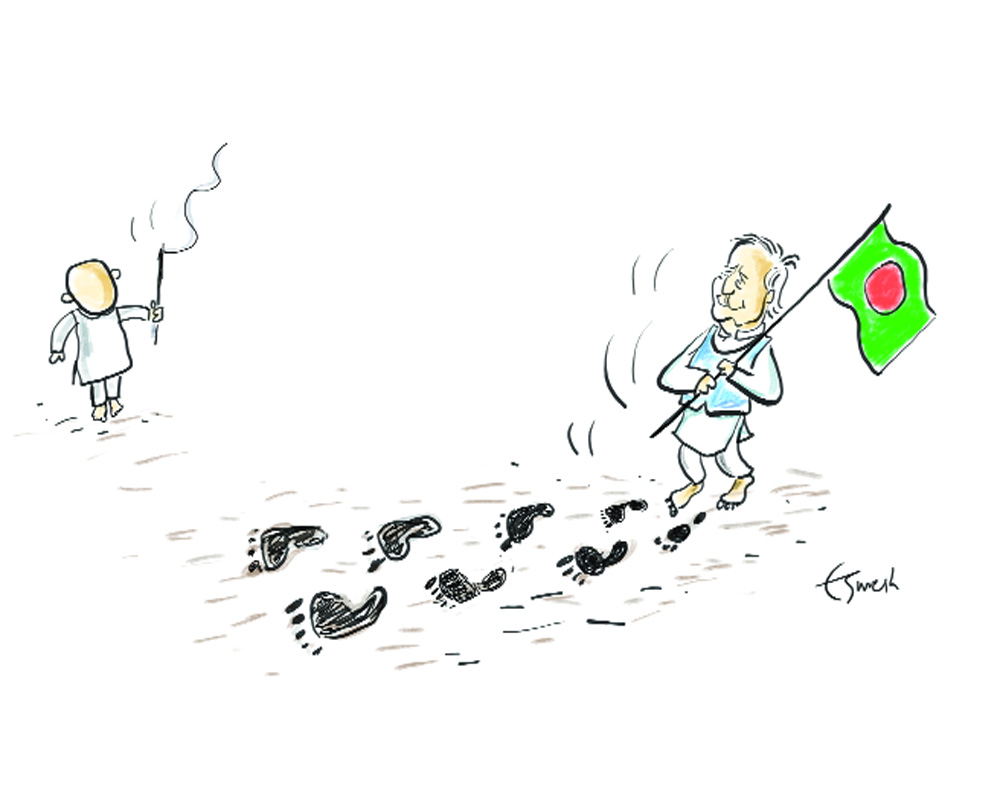
Once hailed for secularism and cultural vibrancy, Bangladesh now finds itself at a critical crossroads. Islamist fundamentalist groups like Jamaat-e-Islami are regaining prominence, with alarming implications
Is Bangladesh moving once again towards becoming a cradle of Islamist fundamentalism and terrorism? Fundamentalism does not always mean terrorism, but it does create a discourse that facilitates the rise of extremism through the promotion of intolerance, leading to hatred towards those considered infidels and violence against them. Now, is Islamist fundamentalism waxing in Bangladesh? One needs to ask this because fundamentalist organisations like the Jamaat-e-Islami (Jamaat) and Hefazat-e-Islam (Hefazat) are having a ball. The Jamaat had fully cooperated with the Pakistani Army during the liberation war of 1971 and was complicit in the latter’s mass murders, rapes and other atrocities. Besides, its members and leaders — as well as those of affiliated bodies like Al-Badr, Al-Shams and Razakars — perpetrated unspeakable atrocities themselves. On 1 August 2013, Bangladesh’s High Court had cancelled its registration as a political party, upholding a writ petition by an organisation called the Tariqat Federation, saying that the Jamaat was a religion-based political party which did not believe in Bangladesh’s independence and sovereignty. It further claimed that the country’s Representation of People Order did not allow the registration of a communal outfit as a political party.
The High Court had also observed that the Jamaat had no moral right to be in the country’s political arena, given the atrocities it had perpetrated during the liberation war.Following the order, Bangladesh’s Election Commission issued a gazette notification on 28 October 2018, cancelling the party’s registration. On 19 November 2023, Bangladesh’s Supreme Court dismissed the Jamaat’s appeal against the High Court’s verdict, as its counsels did not appear at the hearing. As a result of the High Court’s order, the Jamaat could not participate in the parliamentary elections of 2014, 2018 and 2024. Besides, four of its top leaders — Abdul Quader Mollah, Kamaruzzaman, Ali Ahsan Mohammad Mujahid and Motiur Rahman Nizami — were executed, and several others given long prison terms, following convictions in cases related to genocide and war crimes by the International Crimes Tribunals established in 2010 and 2012 under the International Crimes (Tribunals) Act of 1973, as amended in 2009. Finally, Sheikh Hasina’s government banned the Jamaat and its students’ organisation, Islami Chhatra Shibir (Shibir), on 1 August 2025 under the Anti-Terrorism Act 2009. The grounds cited were their responsibility for genocide and crimes against humanity during the Liberation War of 1971, and involvement in terrorist activities.On 28 August 2024, the Bangladesh interim government, headed by Chief Adviser Muhammad Yunus, reversed the order, saying that there was no proof that the Jamaat and the Shibir were involved in terrorist activities. On 23 October 2024, the Appellate Division of Bangladesh’s Supreme Court restored the Jamaat’s appeal, which the Supreme Court had rejected on 19 November 2023.
Meanwhile, the Jamaat is now politically fully active — holding meetings, demonstrations, meetings with other parties and foreign diplomats, and projecting itself as a major force to be reckoned with in the forthcoming elections, whenever they are held. Its ideology is quite clear. Its website says, “Jamaat performs as a spiritual party as spiritual life is important in Islam. Jamaat performs in political arena because Islamic law can’t be implemented without political force.†The Hefazat-e-Islam was formed in 2010 to oppose the Awami League government’s women’s development policy, promising women equal rights to property. It has considerable power to mobilise in the streets. Its intensely anti-India orientation was reflected in its violent protests against Prime Minister Narendra Modi’s visit to Dhaka on the occasion of the 50th anniversary of Bangladesh’s independence on 26 March 2021. Thirteen persons were killed and scores injured in clashes between its supporters and members of the security forces and Awami League’s supporters. The Hefazat is a hard-core Islamist organisation. This is clear from its 13-point charter of demands in support of which it held a rally in Dhaka on 5–6 May 2013. The Hefazat’s 13-point programme includes the enactment of an anti-blasphemy law with provision for the death penalty; exemplary punishment to all bloggers and others who “insult Islamâ€; cancellation of Bangladesh’s policy for women’s development; bans on the erection of sculptures in public places, the mixing of men and women in public, candlelight vigils, and “shameless behaviour and dressesâ€; besides declaring Ahmadiyas as “non-Muslims.†Nadia Sarmin, covering its rally for ETV, was mercilessly beaten for daring to be a woman “in a men only†event. Grievously injured, she was rescued by other journalists.
The rally in May was extremely violent. A BBC report datelined 6 May 2013 cites one witness as saying that the demonstrators “were very aggressive, some people were throwing stones and the situation quickly become violentâ€. The interim government has close and warm relations with the Hefazat. It has lifted the ban on the organisation. The Adviser for Religious Affairs, AFM Khalid Hossain, is the latter’s Nayeb-e-Amir. Chief Adviser Mohammad Yunus had a long and cordial meeting on 31 August 2024 with Mamunul Haque, the organisation’s head. The Hefazat is holding rallies and processions all over the country. Doubtless, neither the Jamaat nor the Hefazat has been resorting to terrorist violence. Their elevated salience, however, gives a certain respectability to fundamentalist doctrines and encourages other fundamentalist organisations to flex their muscles. One of their principal targets is Bangladesh’s moderate and liberal ethos — shaped by its rich literary and philosophical heritage, shaped by Rabindranath Tagore and the country’s highly talented writers, poets and performing artists. A spiritual leader, philosopher, mystic poet and social reformer, Lalon articulated a weltanschauung, which encompassed the essence of the Bhakti cult and Sufism, rejected all distinctions of caste, class and creed, and opposed theological conflicts and racism. A gathering of sadhus and a Lalon fair was to be hosted in Madya Narsingpur, Kashipur Union Parishad in Narayanganj, on 22 November 2024.
The district administration, however, ordered its cancellation. According to a report in The Daily Star (23 November 2024), Hefazat-e-Islam leader Maulana Abdul Auwal had warned the administration to stop the event or face intervention by protestors. The celebration of Pahela Baishakh, the first day of the annual Bengali calendar, has been an important part of Bangladesh’s cultural scenario. However, a stage constructed for the purpose was vandalised on 13 April 2025 in Chittagong city. Earlier, the district administration had permitted the organisers to hold the celebrations but reduced the timings and requested them not to include any song that would be deemed “controversial.â€
In Dhaka, a theatre group was all set to stage a play titled Shesher Kobita on 13 and 14 April. The authorities of the auditorium concerned, however, decided to cancel the programme on the 13th after receiving a threatening letter from a mob. The police offered protection following a public outcry. The show scheduled for 13 April was shifted to 15 April. Earlier, on 10 February 2025, a group calling itself “Towhidi Janata†attacked a publishing house’s stall at Bangladesh’s celebrated Amar Ekushe Boimela for displaying Taslima Nasrin’s books. Instead of taking action against the attackers, police shut down the stall and detained the publisher, Shatabdi Bobo, at the fair’s control room.Whither Bangladesh?
(The author is the Consulting Editor of The Pioneer. Views are personal)



