India formulated its latest National Education Policy, NEP-2020, after a long gap, as the earlier National Policy on Education was formulated only in 1992. There was a major attempt to formulate a new curriculum framework for school education 25 years ago. It was released on November 14, 2000, the birthday of Pandit Nehru, by the then Minister of HRD, Dr Murli Manohar Joshi.
Based upon it, the school textbooks, some of which were more than three decades old, were rewritten and revised. Focus must now be on where we stand at this juncture in education and how far we are preparing ourselves for the future in the national and global context. Unprecedented changes are taking place both in the content and process of education everywhere. Simultaneously, there is an ever-increasing global realisation of the interdependence of nations, communities, and people all around. It is now left to India to resume its leadership role in the process of the reshaping of the world, which was taking shape anyway! It needs to create a vibrant knowledge society, a highly acculturated people, and excellence in spirituality. Obviously, it has to be achieved only by seriously envisioning and implementing a dynamic and visionary Indian education system.
New challenges were emerging before the education systems globally, and every nation has to decipher its own challenges. India attempted the same through the reformulation of its education policy, the NEP-2020: “This National Education Policy envisions an education system rooted in Indian ethos that contributes directly to transforming India, that is Bharat, sustainably into an equitable and vibrant knowledge society, by providing high-quality education to all... The vision of policy is to instil among the learners a deep-rooted pride in being Indian, not only in thought, but also in spirit, intellect, and deeds, as well as to develop knowledge, skills, values and dispositions that support responsible commitment to human rights, sustainable development.” This is a very comprehensive statement that would require not only tremendous efforts in implementation but also a modern comprehension of the Indian tradition of knowledge quest, which in the ancient days commanded global respect and adulation. It shall have to be supplemented by the global philosophical and epistemological comprehension.
The Centre for Contemporary Studies, PMML, Teen Murti Bhavan, New Delhi, has been re-energised under Nripendra Misra, chairman of the executive committee. He inspired a study on how education development during the second half of the 20th century could be reviewed and recalled for the benefit of the millennials, who would be holding the reins of power in practically every country in years to come. This study has been completed over a period of two years, and a manuscript of 553 pages entitled Millennial Transition: Leadership, Education, Culture, and Social Cohesion has been written. It has been prepared as an outcome of the study and submitted to the organisation on July 8, 2025. The National Book Trust of India, NBT, has accepted it for publication.
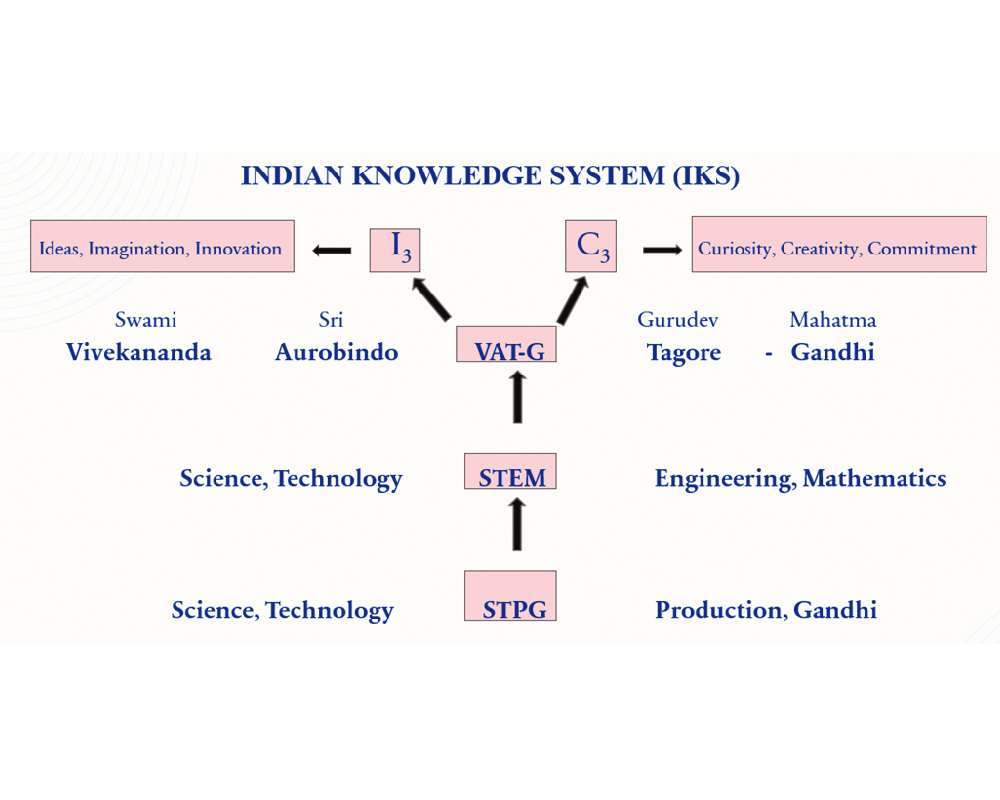
This study finds that India initially began its post-independence journey of education, knowledge, and development under the shadow of the times that were characterised by STPG: Science, Technology, Production, and Gandhi, an acronym often used by an outstanding scientist and academician, Prof Daulat Singh Kothari. This motto was the futuristic vision of those days and has subsequently been substituted by STEM: Science, Technology, Engineering, and Mathematics. It was incorporated for implementation in the National Policy on Education, 1986, which was revised in 1992. Afterwards, there was a long gap, and the next policy formation was completed only in 2020. The biggest challenge that India faced during the first five to six decades after independence was to take education to every child.
Focus at this stage is on excellence and skill acquisition. Today the biggest challenges are acculturation, social cohesion, and religious amity. Towards this, the passage passes through VAT-G, the ideas, thoughts, philosophy, and pragmatism of Swami Vivekananda, Sri Aurobindo, Gurudev Tagore, and Mahatma Gandhi. Swami Vivekananda was the most brilliant interpreter of the Indian quest for knowledge and wisdom in the contemporary context for international audiences. Sri Aurobindo, who understood Western culture and its inadequacies and dwelled in great depth on the universality of the Indian interpretation of spirituality in the global context, and the Gurudev, who developed a subtle comprehension of the beauty of the man-nature interdependence. The comprehension of the thought, philosophy, and pragmatism of the great quartet offers an effective understanding of India, its knowledge traditions and systems, and its relationship to the global developments. Crossing this stage, one could go deeper into the works of the galaxy of illustrious persons and their works. Gurudev Tagore had highlighted the need to encourage the divine gift of the power of ideas and the power of imagination given in abundance to every child. The two I’s, if inspired and nurtured with empathy, would lead to the third, Innovations, which constitutes the I³. To make it easier for the teachers and learners, three C’s — Curiosity, Creativity, and Commitment — are also added: C³. Thus, the VAT-G, together with the I³ C³, constitutes the perfect combination for those interested in understanding and also in finding a solid base for Indian education, rooted in culture and committed to progress.
This identification comes after a thorough study and analysis of the initial post-independence emphasis on STPG — Science, Technology, Production, and Gandhi. It was followed by the STEM — Science, Technology, Engineering, and Mathematics. Whatever the challenges, a nation like India cannot ignore its national and international responsibilities in the world of knowledge and skill acquisition. As the Indian tradition of knowledge quest, which is not confined to a particular region, community, religion, or language, has to be studied in its broader framework and, more importantly, in light of the modern traditions of knowledge generation and creation being developed on the international map.