











In Alfred Tennyson’s Morte d’Arthur, a wounded and dying King Arthur tells Sir Belvedere, one of his most loyal knights and the only Knight of the Round Table to survive the battle of Camlann, “I am going a long way…/ To the island-valley of Avilion;/ Where falls not hail, or rain, or any snow,/ Nor ever wind blows loudly; but it lies/ Deep-meadowed, happy, fair with orchard lawns/ And bowery hollows crowned with summer sea,/Where I will heal me of my grievous wounds.”
Clearly, King Aurther did not associate rain —as indeed hail, snow and loud wind — with an idyllic place. Many, this writer is sure, would share his view. Rain can be trying, putting one under house arrest while it pours. And it can pour for a long time. This writer had once been stuck in the mountains for 36 hours when sheets of water descended from the sky causing a flash flood below and burying 18 persons in a couple of landslides.
Things, doubtless, are rarely so grim, though cloudbursts and flash floods are becoming increasingly common as climate change progresses apace, with leaders pontificating, and action hobbling far behind expressions of resolve to take much-needed steps, Floods are becoming a regular feature of life and taking a deadly toll. The one sweeping through parts of Texas in the United States on July 4, 2025, has claimed at least 135 lives.
Flash floods are set to becoming regular occurrences (say, at least once a year), at a time when profit and not necessity is the mother of invention and necessity is increasingly defined by advertising and the possessions of the Joneses. Deluge management, therefore, is set to spawn new products and perhaps, even industries. Consider, for example, houses designed like mini-Noah’s Arks to float with surging waters.
The question arises as to what happens when the water recedes and the floating homes are stranded far away from where they were originally. Ingenuity, however, can move homes as faith can move mountains. Caterpillar tracks, as in tanks, would enable them to return negotiating rough terrains and battery-driven engines can move them forward.
Mao Ze-dong would perhaps frown in the hereafter (one wonders whether he has made it to heaven!) watching a thousand companies bloom against his hundred flowers.
Or would he? He may have ceased to care given the capitalist trajectory China’s economy has taken in the post-Deng Xiaoping era. In any case, history shows that nostrums are ephemeral and arguments on politics and economics can stretch from here to eternity. Hence, back to the monsoon and rains, celebrated both in poetry and songs, ranging from the resonant majesty of Tagore’s song-and-dance drama, Barshamangal, to the lilting sound of Robert Redford as Sundance kid cycling and singing “Raindrops keep falling on my head” in the 1969 film, “Butch Cassidy and the Sundance Kid” in which Paul Newman acted as the former.
The celebration of the monsoon is hardly surprising. It is a cliché that the world would die without it. It is, however, a cliché with more than a massive kernel of truth, which becomes clear when one ponders the havoc — from crop failure to forest fires — that droughts inflict. While the increasing frequency of droughts is a cause for worry, so are the deluges that follow monsoons. But then the season of rains can also be fun. Consider dancing and getting drenched as the skies open up. It is a special time for romance. A famous poem by Rabindranath Tagore runs, “Emon dine tare bola jaye/ emon ghor ghana barishaye/ Emon dine mon khola jaye/ Emon meghswhare badal jharjhare/ Tapanhin ghana tamashaye.” This writer’s translation of the same would read, “One can tell her on a day like this/ In this intense and dense rain/ One can open one’s heart on a day like this/ Amid the voice of clouds and the pouring rain/ In this sunless and dense darkness.”
Even otherwise, rains have inspired the muse. William Wordsworth wrote in ‘How Beautiful is the Rain,’ “How beautiful is the rain! /After the dust and heat, /In the broad and fiery street,/ In the narrow lane, How beautiful is the rain!” And, of course, there is “Rainy Night” by Irene Thompson which reads,/ “I like the town on rainy nights/ When everything is wet/ When all the town has magic lights/ And streets of shining jet! / When all the rain about the town/ Is like a looking-glass,/ And all the lights are upside-down/ Below me as I pass./”
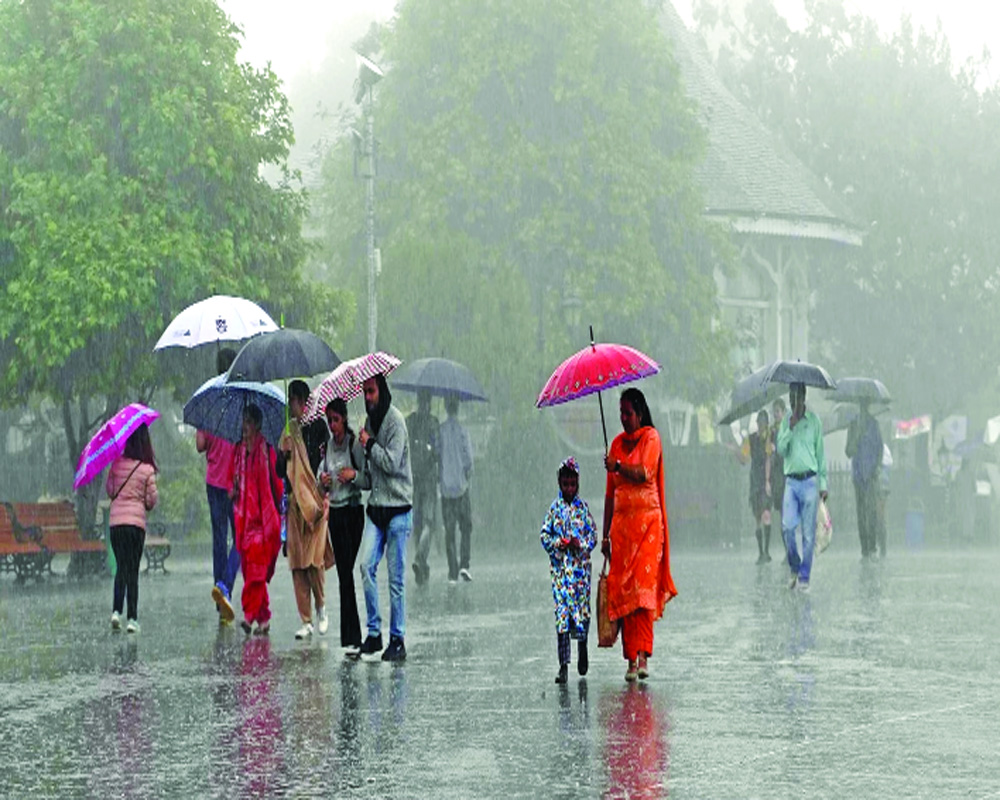
Much, no doubt, would depend on where one is. A Bedouin in the Arabian Peninsula would have no idea of a monsoon which has a special charm in the hills, where one can see the rains advancing across valleys and over hill tops like silver curtains, hear the wind roar down valleys and susurrate among leaves of pines, oaks and deodars, and see the anaemic mountain streams of summer turn into roaring rivulets.
All this will vanish and a tremendous blight come over India if the monsoon disappears from the country, a possibility one cannot rule out. The irregularity of its arrival and intensity is already causing concern.
The Reserve Bank of India’s Bulletin titled Monsoon and Indian Agriculture — Conjoined or Decoupled? dated May 11, 2015, observes, “Over the years, the volatility of monsoon outcomes has, in fact, increased undermining the accuracy of forecasting and contingent planning. Structural factors such as climate change and rising greenhouse emissions could be at work alongside one-off events such as El Nino.”
In India’s case, the major cause of monsoons is the heating of the Indian sub-continent’s landmass during summer.
As the warm air above it rises upwards, cool, precipitation-laden air from the Arabian Sea in the South-west and the Bay of Bengal in the South-east moves in and takes its place. The danger lies in the fact that the temperature difference driving this movement will decrease if, thanks to global warming, ocean waters continue to become hotter, which is what seems to be happening in the equatorial area.
The landmass, on the other hand, is getting cooler, thanks, among other things, to the massive presence of aerosols — minute particles suspended in the atmosphere — makes things worse. Caused by fossil fuel combustion, smoke from the burning of post-harvest plant stubble, the working of incinerators, smelters and power plants, and increase in the presence of dust particles following droughts, deforestation and over-grazing, aerosols absorb solar radiation — some of them even deflect them outwards —reducing the quantum of it reaching the earth’s surface, making it cooler.
The possibility of the monsoon vanishing from India, therefore, cannot be ruled out. The results would be disastrous. As early as 1925, the Royal Commission on Indian Agriculture described India’s economy as a gamble on the monsoons. Earlier, Viceroy Lord Curzon had said the same thing.
According to Economic Survey 2024-45, the area under irrigation increased from 49.3 per cent to 55 per cent of the gross cropped area between 2016 and 2021. Agriculture also accounted for 46.1 per cent of those employed and 16 per cent of the GDP. A fall in the income of such a large section would adversely affect its purchasing power and the demand for a wide range of manufactured products. Decline in food production would be another serious consequence. Even though the percentage of irrigated area in India has increased to 55 per cent, 45 per cent is without it. Clearly, difficult times are ahead.
(The writer is consulting Editor with The Pioneer)



