




As the Rashtriya Swayamsevak Sangh celebrates its centenary this month, a hundred years on, it remains a powerful force in shaping India s socio-political narrative — commanding both reverence and criticism in equal measure
This month, the Rashtriya Swayamsevak Sangh (RSS) celebrates its 100th anniversary, having been founded by Dr Keshav Baliram Hedgewar in Nagpur. This centenary coincides with Vijaya Dashami on October 2.
The RSS is one of India’s most powerful Hindu nationalist organisations and often faces criticism from the Opposition for promoting divisive ideas — allegations it firmly denies. The organisation describes itself as a movement focused on Hindu revivalism and social upliftment. However, it has often been criticised for viewing Muslims as adversaries.
The RSS has produced two BJP Prime Ministers — Atal Bihari Vajpayee and Narendra Modi — who have both led the country successfully. At an event in Delhi, Prime Minister Modi shared stories from his early days as a pracharak (campaigner) and praised the RSS for its nation-building role. He also unveiled a new coin featuring the national emblem on one side and Bharat Mata in the “Varad Mudra” on the other. It was the first time Bharat Mata appeared on Indian currency. Modi highlighted the RSS’s crucial role in shaping India’s vision for 2047.
While the RSS claims to be non-political, it has a significant influence on the Bharatiya Janata Party (BJP), with many of its leaders and ministers having begun their careers within the organisation. Over the past decade of Modi’s rule, the RSS’s ideological influence has deepened further. Opposition to the RSS is not new; it dates back to the British era and has often been politically motivated. Interestingly, for the RSS, the ultimate goal is not the state itself but the creation of a unified Hindu society.
The RSS has been involved in some of the most debated chapters of India’s modern history — from being linked to the assassination of Mahatma Gandhi in 1948 to the demolition of the Babri Masjid in 1992. The organisation maintained that the mosque stood on the ruins of a Ram temple.
Last year, Prime Minister Modi inaugurated the new Ram Janmabhoomi temple in Ayodhya — a milestone long associated with the Sangh’s ideological vision. Despite its controversies, the RSS has shown a willingness to evolve. It now seeks to address contemporary challenges such as economic development, environmental sustainability, and social inequality. RSS chief Mohan Bhagwat, in his centenary address, spoke on key issues including the Indo-Pak conflict, climate change, and economic disparity.
He emphasised that the organisation’s main goal for its 100th year is to strengthen Hindu society by preserving India’s cultural heritage while promoting unity and patriotism. Bhagwat called for a resilient and inclusive India, rooted in the idea of a Hindu Rashtra — where cultural and moral values guide public life — stressing unity, self-reliance, and “belongingness.”
The organisation adopted its current name, Rashtriya Swayamsevak Sangh, about six months after its founding. On April 17, 1926, Dr Hedgewar held a meeting with 26 volunteers at his home, where the name was formally agreed upon after discussion.
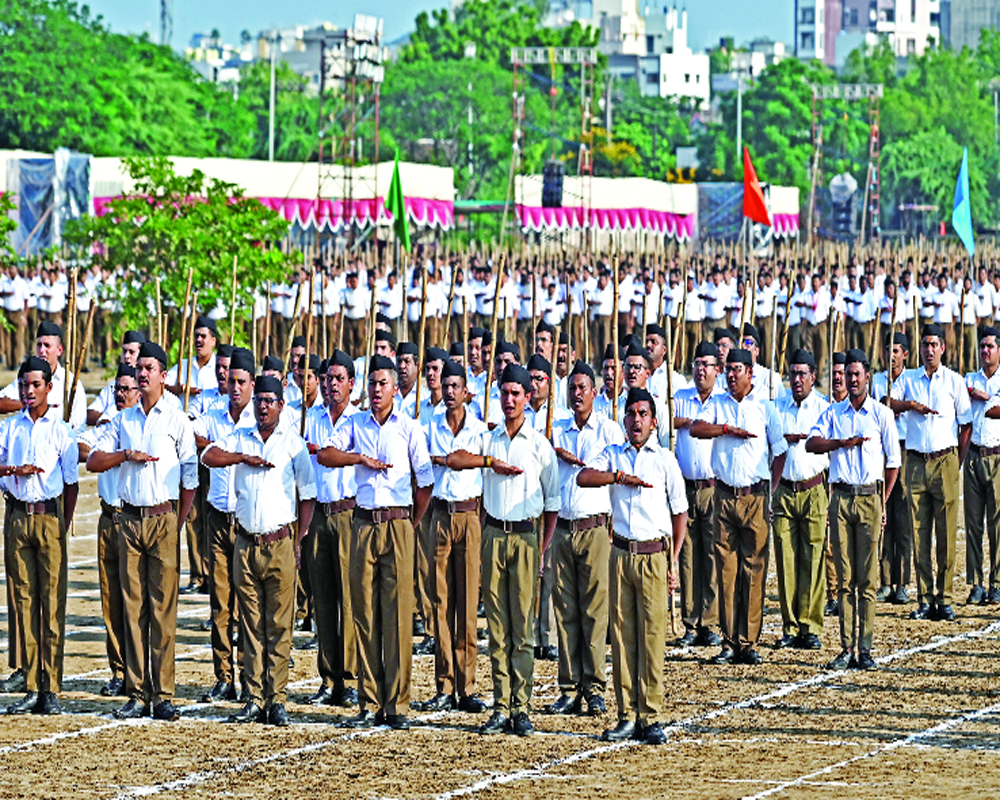
In recent years, the RSS has witnessed rapid expansion across the country. It currently operates 72,354 shakhas in 45,411 locations, conducting daily activities in thousands of neighbourhoods. Last year alone, the organisation launched 6,645 new shakhas as part of its centenary outreach, aiming to reach every village in India. The coordination between the RSS and the BJP — including Prime Ministers, Chief Ministers, and senior ministers — remains close. Many key appointments within the party and Government are often made in consultation with RSS leadership.
The RSS has also expanded globally, establishing a strong presence in countries such as the United States and the United Kingdom. It has developed influential networks abroad and frequently lobbies in support of Indian interests. According to the RSS mouthpiece Organiser, the Panch-Parivartan initiative — focusing on education, social harmony, environmental protection, family values, and economic self-reliance — will be a major area of work in the years ahead. Recent meetings in Kashi and Mathura reaffirmed the organisation’s commitment to resolving disputes peacefully, through dialogue and legal means. Historically, the RSS’s influence on civil society has been channelled through disaster relief, rural development, tribal outreach, promotion of Hindu festivals, and the teaching of Sanskrit. Over time, the Sangh has modernised its methods while remaining rooted in Hindutva and Indian culture.
Once known for keeping records manually in diaries and registers, it has since digitised its operations and updated its uniform — symbolic of its willingness to adapt to changing times.
As India faces 21st-century challenges such as economic disparity, social fragmentation, and national security threats, the RSS seeks to align itself with the nation’s broader development goals. Looking ahead, it plans to focus on social and political initiatives while continuing to work behind the scenes — influencing policy, leadership, and ideology within the BJP and beyond.
The writer is a popular columnist