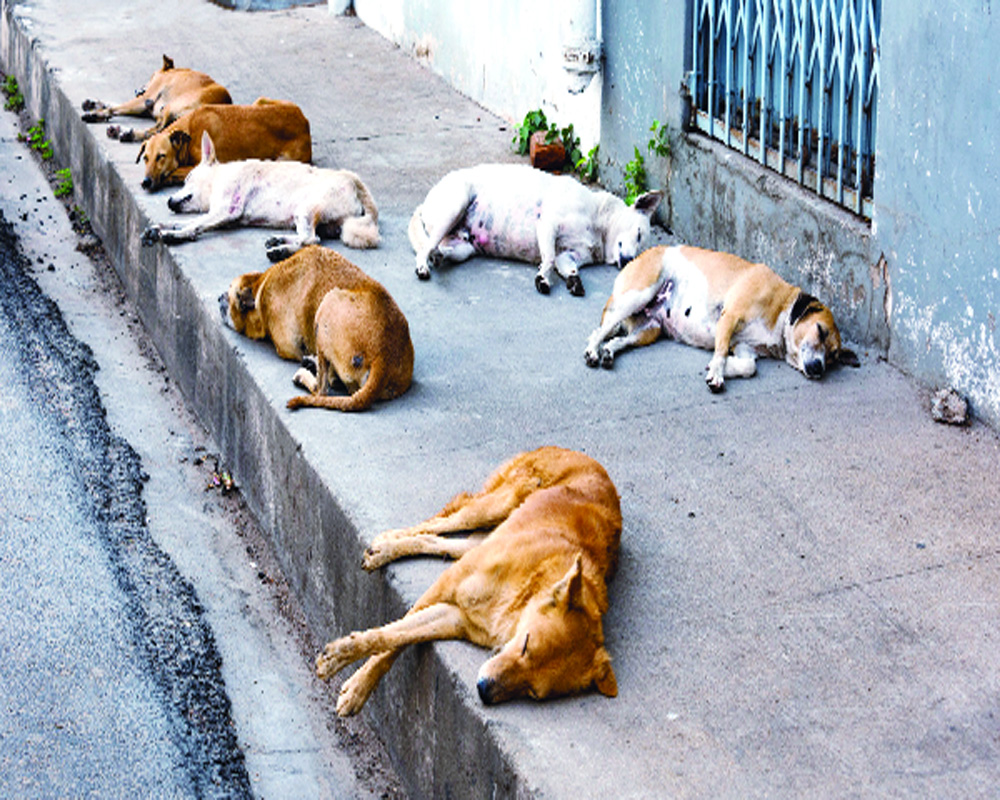
Sheltering all of Delhi's 600,000 stray dogs is unfeasible and costly, requiring vast land and funds. Even if implemented, it won't solve the issue, as unsterilised dogs from neighbouring states would continue entering the city, making the effort unsustainable
The demand for herding all stray dogs in Delhi in shelters misses two points — it is impracticable and will not end their presence in streets and public places. The impracticability of it becomes clear on considering the number involved. The latter will determine the number of shelters needed, the built-up area of each, the land needed for building shelters, the cost and time of construction, and the number of administrators, veterinary doctors, para-medics and other staff needed to run them. It will also determine the recurring operating costs in terms of salaries, electricity and water charges, vaccines, medicines and food for dogs.
The last census of stray dogs covering the whole of Delhi, conducted in 2009 by the NGO Wildlife SOS, on behalf of the Municipal Corporation of Delhi (MCD), put the stray-dog population across Delhi at 262,740-252,000 in areas under the MCD, and 7,630 and 3,110 respectively in areas under the New Delhi Municipal Council (NDMC) and the Delhi Cantonment.
At its third meeting on January 17, 2019, Delhi Legislative Assembly’s “House Committee to Examine the Issue of Stray Dogs and Monkey Menace in Delhi (henceforth House Committee),” appointed a sub-committee tasked with making Delhi rabies free. The committee’s report mentions that the sub-committee had estimated that Delhi had 800,000 stray dogs. The report does not provide any supporting evidence. Nevertheless, the actual number may well have been around that. A survey by the global NGO, Humane Society International (HIS), conducted on behalf of the South Delhi Municipal Corporation (SDMC) in 2016, found that there were 189,285 stray dogs in SDMC’s four zones.
This was during the interlude when the MCD had been trifurcated into the SDMC, North Delhi Municipal Corporation (NDMC) and the East Delhi Municipal Corporation (EDMC). Stray dogs in areas under the NDMC, EDMC, New Delhi Municipal Council and the Cantonment Board — none of which had conducted a street canine census that year — had to be counted to arrive at the total number of stray dogs in 2016. Hence, figure must have been quite high and might have risen to around 800,000 in 2019 — and even higher thereafter as few sterilisations were done during the Covid-19 pandemic in 2020-2021.
Arbitrarily choosing a figure that is likely to be lower than the actual, one may assume that there are 600,000 stray dogs in Delhi. Six hundred shelters would be needed even if 1,000 of them are to be put in one.
What should be the principle determining the size of the land granted for each of them? One needs here to look at the Basic Management Guidelines for Dog and Cat Shelters (henceforth ‘Guidelines’), prepared by Animal Asia and Humane Society International for the second Companion Animal Welfare Conference at Guangzhou, China, on November 10 and 11, 2007. It stated, “Most importantly, they [shelters] should be a place of safety and comfort for the animals….Stress reduction and disease control should be your goals when determining how to house animals.”
According to the Guidelines, each dog “should have ample room to stand, lie down, turn around and sit normally.” This required a minimum area of 4 feet by 4 feet (16 square feet) for each dog. A shared 5-feet by 10-feet kennel (50 square feet) should hold no more than two large or medium, or three small dogs.
Assuming that in a shelter for 1,000 dogs, 600 lived in single, and 400 in shared, kennels, and three dogs lived in each shared kennel, one would require a floor area of 9,600 (600 x 16) square feet plus 6666.6 (50 divided by three and multiplied by 400) square feet = 16,266 square feet respectively. This would come to 1,511.1 square metres.
Space will also be required for administrative offices, reception centres, veterinary clinics, sick room for dogs, quarantine areas for dogs with infectious diseases, stores, staff quarters and parking space for vans and ambulances and other vehicles. All this would require a minimum of 1,000 square meters. Hence each shelter housing 1,000 dogs would require at least 2,511 square metres (1,511.1 + 1,000 square metres).
That this calculation is more or less correct is suggested by the House committee’s report indicating that an estimated “1000-1200 sq. metres” would be needed for setting up a sterilisation centre. A shelter would require a much larger area as it would not only have to sterilise unsterilised dogs coming in but permanently house the dogs and accommodate the other requirements for space mentioned above.
Six-hundred dog shelters would need 1,506,660 square metres (2511.1 x 600). Where would the land come from? And the money to build and run them? The operating cost per month would have to include salaries for at least two veterinary doctors/surgeons (Rs 100,000 x 2 = Rs 200,000), five para-vets (Rs 20,000 x five = Rs 100,000), 10 helpers and cleaners (Rs 15,000 x 10 = Rs 150,000), two cooks to prepare meals for the dogs (Rs 30,000 x 2 = Rs 60,000) and two cooks’ assistants (Rs 20,000 x 2 = Rs 40,000). The total comes to Rs 550,000.
Other salaries would have to include that of the shelter’s administrative head (Rs 100,000 per month), an accountant (Rs 75,000 per month), a van/car driver (Rs 30,000) and his/her assistant. The total comes to Rs 345,000.
The total of all the above amounts would come to Rs 895,000 per month. In addition, at the rate of Rs 20 per head per day, the cost of feeding 1,000 dogs would come to Rs 600,000 in a month of 30 days. Add to this the cost of medicines, vaccines, injection syringes, buying of mattresses for dogs to sleep on, electricity, water, fuel for van/cars, servicing and repairing charges for the latter, and one would get a total of at least another Rupees two lakh or so. This would make for a total monthly operating expenditure of Rs 1,695, 000 or an annual expenditure of Rs 20340000 or Rs 2.034 crore. The estimated annual expenditure on 600 shelters would be Rs 1220.4 core
The expenditure of even this astronomical amount will be fruitless. The reason is simple. According to the Guidelines for Dog Population Management, released by the WHO and World Society for the Protection of Animals (WSPA) in May 1990, “Each habitat has a specific carrying capacity for each species.
This specific carrying capacity essentially depends on the availability, quality and distribution of the resources (shelter, food, water) for the species concerned. The density of the population for higher vertebrates (including dogs) is almost always near the carrying capacity of the environment.”
Under the ABC programme, street dogs are picked up, sterilised, vaccinated against rabies, and returned to the area from which they had been taken. Being territorial, they keep unsterilised and unvaccinated dogs out of their areas, and the authorities can concentrate on sterilising and vaccinating in new areas until all stray dogs in a city or district are covered. Putting all dogs in an area in shelters would enable unsterilised, unvaccinated dogs from other areas to come in and the authorities will have to return again and again to the same area to remove the new arrivals. Until the promulgation of ABC Rules, the number of stray dogs continued to increase in India despite relentless mass killings.
With Delhi’s stray dogs locked in shelters, those from Uttar Pradesh and Haryana will move into the national capital — unless, of course, Delhi Police sets up check posts, manned 24x7, in every road, lane and by-lane along the borders of its two neighbouring states, to keep stray dogs from these out.
One cannot see that happening.
The writer is Consultant Editor of The Pioneer and former Editor of Hindustan Times. He has authored four books in English and two novels in Bengali