











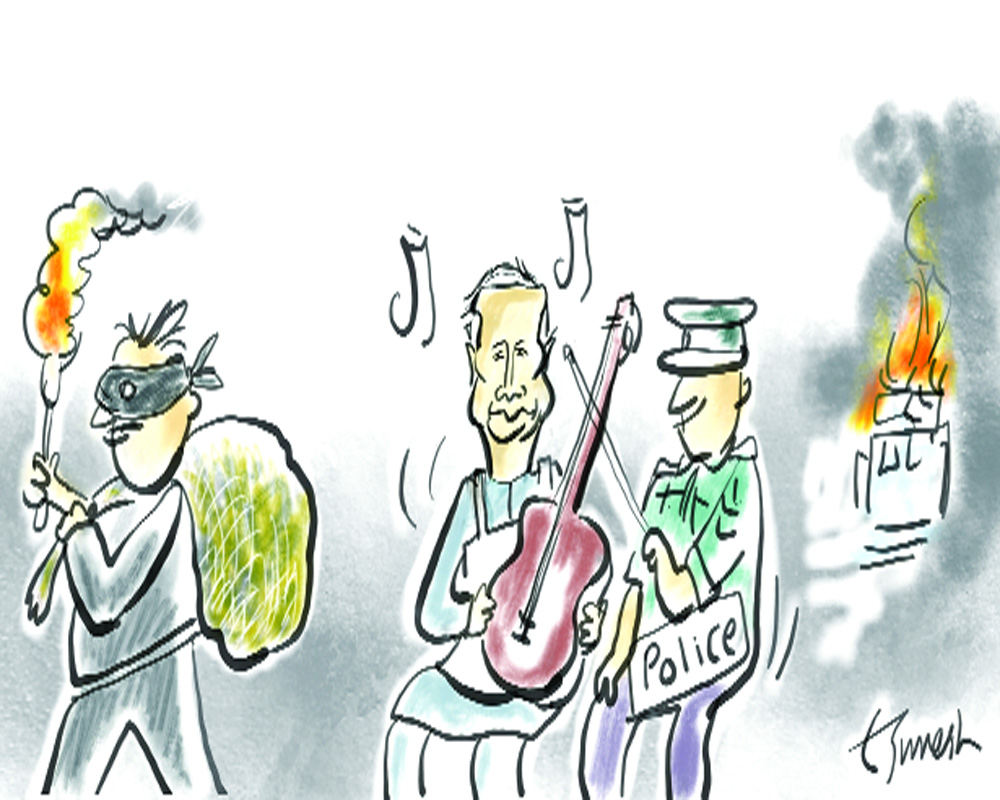
Human rights reports and police data reveal a grim picture of a nation where criminal gangs flourish with impunity, law enforcement remains demoralised and overstretched, and the general public is left vulnerable and afraid
The precipitous decline in the law-and-order situation in Bangladesh under the interim Government headed by Chief Adviser Muhammad Yunus is causing widespread concern in the country. An editorial, published in Dhaka Tribune on February 23, 2025, under the heading, “When will we get back law and order?” stated, “Bangladesh has been suffering due to a severe void in law and order since the fall of the previous Government in August last year. With a noticeable uptick in the number of criminal activity, of varying size and scope, the country has been in the grips of a veritable crime wave, and the recent robbery of a moving bus along the Dhaka–Rajshahi route is only further proof that our law enforcement has been nothing if not inadequate for the past few months in carrying out their duties.”
Expressions of alarm continued as the situation worsened. An editorial carried in The Daily Star on July 4, 2025, under the heading “We must send an undiluted message against mob violence,” stated, “Even the interim Government, while repeatedly assuring us that no mob activities would be tolerated, has frequently fallen short of backing those assurances with swift and firm action.”
The alarm is understandable given the seriousness of the situation. There has been a massive upsurge in crimes of every nature — murder, mob violence, lynchings, drug trafficking, mugging, armed robbery, rape, molestation and abuse of women, thefts, assaults, forcible occupation of property and business establishments.The situation started deteriorating almost immediately after the forcible ouster of Sheikh Hasina’s Government on August 5, 2024. According to a report by Nuruzzaman Labu appearing in Dhaka Tribune of December 22, 2024, under the heading, “Mugging, murder rates climb nationwide despite increased efforts,” there were 583, 399 and 337 murders respectively in the whole of Bangladesh in September, October and November, 2024. The corresponding figures for the same months in 2023 were 278, 258 and 227. On February 27, 2025, Prothom Alo English carried a report by Partha Shankar Saha under the heading “Mob beatings claim 121 lives in 6 months, what does the law say.” It attributed to the human rights organisation Manabadhikar Sanskriti Songstha (henceforth Shongstha) the figure of 121 persons being killed in mob violence between August 2024 and January 2025. According to another human rights organisation, Ain o Salish Kendra, 146 people were killed in such incidents in 2024 against 51 in 2023. A report by a staff correspondent, as updated on March 31, 2025, and appearing under the heading “Number of rapes in March over double that in February,” in Prothom Alo English, attributed to the Shongstha the statement that there were 132 rapes in Bangladesh in March 2025, against 57 in February. The number of gang rapes in these two months were 17 and 25 respectively.
According to the same organisation, 52 cases of political violence in March affected 459 persons, of whom 12 were killed and 447 injured. An editorial titled “Tackling the rising tide of crime” in Dhaka Tribune of January 11, 2025, stated that 1,361 murders were reported nationwide in Bangladesh from August 1 to November 30, 2024, against 1,158 from April 1 to July 31 of the same year. Criminal gangs have mushroomed. A report by Mehedi Khan, appearing under the heading “Over 50 criminal gangs active under various names in 4 thanas of Dhaka” on June 9, 2025, states, “Criminal gangs have sprouted up in four thanas of the capital’s western zones — Adabor, Mohammadpur, Dhanmondi, and Hazaribagh. The criminal groups are active in these densely populated areas, involved in various offences including drug trafficking, mugging, robbery and extortion. These gangs openly brandish weapons and engage in various criminal activities. They have also become embroiled in deadly clashes over territorial control and dominance in the area.” It is not that efforts have not been made to control the situation. As early as September 17, 2024, Bangladesh’s interim Government issued an order giving commissioned officers of Bangladesh’s Army the magisterial powers vested in executive magistrates and put them under district magistrates or deputy commissioners. Among other things, this gave them the power to make arrests and disperse unlawful rallies. The order, which was to come into effect immediately, was for a period of 60 days. The order was renewed for the fourth time on May 8, 2025, and for the same duration, with effect from May 14, 2025.
A much-vaunted effort was the launching of what was termed as “Operation Devil Hunt.” According to a report by Ali Asif Shawon published in Dhaka Tribune on February 9, 2025, under the heading “What is Operation Devil Hunt,” Bangladesh’s Home Affairs Adviser, Lt-Gen (Retd) Jahangir Alam Chowdhury told reporters that the operation would focus on detaining individuals who threatened the nation’s stability and would continue until all the devils were brought to justice. It would incorporate not only the police but also personnel from the Bangladesh Army, Navy, Air Force, Border Guard Bangladesh (BGB), Ansar, and the Coast Guard, he added.The result was a damp squib despite the arrest of 11,882 persons until March 1, 2025.
A core committee, meeting at the Home Adviser’s residence on March 2, 2025, decided that the operations by joint forces to control crime would continue but without the nomenclature of Operation Devil Hunt. Why did it fail? In an article under the heading “Gutsy women in Uttara and the Government’s Operation Devil Hunt” in Prothom Alo English, the paper’s Joint Editor and a poet, Sohrab Hasan, wrote, “From media reports it is apparent that 90 per cent of those being detained under Operation Devil Hunt are leaders and activists of the toppled Awami League. That means they have been caught for past crimes. It is certainly a good initiative to bring to book those who misused state power in the past. But will those who are presently carrying out criminal activities be able to slip free?” The basic cause of the failure was the weakness of Bangladesh’s police and its lack of confidence to act firmly. Its personnel had mostly gone into hiding in the face of fierce mob attacks following Sheikh Hasina’s fall. There was no policeman in the streets from the evening of August 5 to August 8, 2024, when Yunus’ interim Government assumed office. They slowly and fearfully trickled back to work thereafter, but some did not, and manpower remained short. There was lack of mobility. Five hundred police vehicles were burnt during mob attacks in Dhaka alone and there were no replacements. Massive purges of police personnel at all levels, accused of perpetrating atrocities during the uprising in July 2024 against Sheikh Hasina, played havoc with the force’s cohesion and command structure.
This was made worse by the fact that those from outside Dhaka, who filled the places of the ousted personnel, knew very little about Dhaka and the demands of policing the complex city. Nor did they have any network of informants. And this at a time when much of the force’s time was — and is — spent in tracking down and jailing Awami League leaders and activists in hiding. Criminals are flourishing and are filled with a feeling of impunity. Hundreds of them, who were incarcerated by Sheikh Hasina, were released on bail in the couple of days following her ouster. Many who had fled abroad have returned.
Turf wars between their gangs followed and continue. And all of them prey on the common people.
(The writer is Consulting Editor with The Pioneer. Views are personal)



