











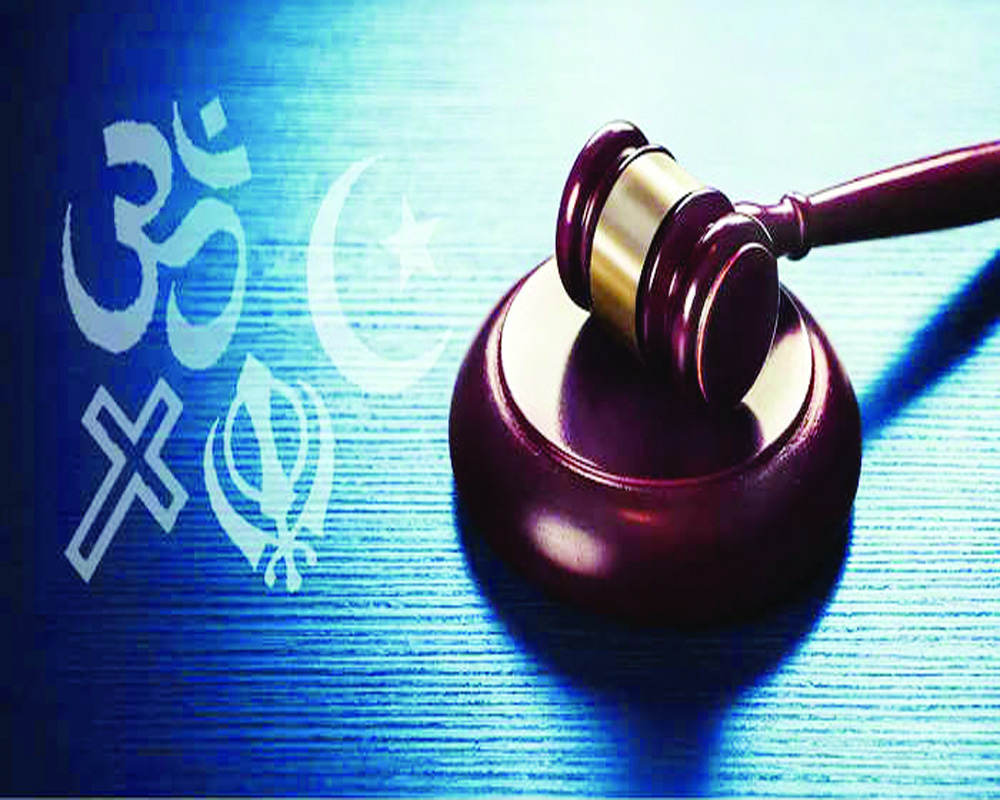
As the BJP frames the Uniform Civil Code as a step toward national integration and gender justice, critics warn of growing unrest and constitutional challenges ahead
After the controversial passage of the Waqf Bill, the Modi Government plans to implement the equally or even more contentious Uniform Civil Code (UCC) passed last year.
This raises the question of whether it is the right time to push for the UCC amid ongoing protests against the Waqf Bill, which began after the UCC was approved in Parliament last year.
The BJP has released a video recently on the achievements of Modi’s first year in his third term and is preparing for the UCC implementation. The video, titled ‘Big Moves Under Modi 3.0 — The Journey Has Just Begun...’, suggests prioritising the UCC. The video presents it as an important step towards national integration and gender equality.
Despite being proposed and withdrawn twice in 2019 and 2020, the UCC bill was eventually approved by Parliament last year. For the BJP, the UCC is a crucial part of its political agenda, alongside the completion of the Ayodhya temple and the abrogation of Article 370 in Jammu and Kashmir. The UCC is a complex issue.
It has several angles, such as political, legal, legislative, religious, gender, and Constitutional perspectives. The country witnessed angry agitations even during the passage of the law. Just as the Waqf Act creates unrest, the UCC is bound to trigger nationwide agitations.
It is worth noting that while many countries like France, the United Kingdom, the United States, and Australia have a UCC, others like Kenya, Pakistan, Italy, South Africa, Nigeria, and Greece do not.
Prime Minister Modi defended the implementation of the UCC in Lok Sabha in December last year, stating that the Constituent Assembly, which drafted the Indian Constitution, wanted the Uniform Civil Code to be enacted by an elected Government.
He also highlighted that BR Ambedkar, the chief architect of the Indian Constitution, strongly advocated for a uniform civil code preventing one-sided claims.
The Apex Court also emphasised the need for a Uniform Civil Code (UCC) in 1985 to maintain national unity and recommended a single law for all citizens in 1995. In 2019, the Modi Government reaffirmed its commitment to the UCC.
The Court had also declared Triple Talaq unconstitutional, promoting gender justice. Minority groups feel that personal laws are vital to cultural and religious identities, and implementing a Uniform Civil Code (UCC) could infringe on religious freedom under Article 25 of the Constitution. India currently has separate personal laws for various religious communities, including Hindus, Muslims, Christians, and Parsis, which govern issues like marriage, divorce, and inheritance. The UCC supporters argue for one law for all citizens.
Moreover, experts warn that the UCC could overstep state legislative authority, challenging the principles of cooperative federalism. The Portuguese Civil Code, introduced in the 19th century, is still in effect in Goa and has not been replaced since the state’s liberation.
Early this year, Uttarakhand implemented the UCC for the state. Other BJP-ruled states like Assam and Maharashtra want to push it through.
The BJP may want to replicate this in different states.The challenges of implementing the UCC are many.
While supporters argue for a UCC implementation, others caution against it, citing the need to respect religious and cultural diversity. The lack of consensus among political parties presents a formidable challenge. Many opposition parties and even some NDA allies, and some communities like the Muslims, have strongly opposed it. Ensuring effective implementation across the vast and diverse India is formidable, as it requires preparations for administration, infrastructure, resources, and significant public awareness and education about the UCC. Implementing the UCC brings up concerns about religious freedom and cultural identity.
While the Supreme Court upholds the constitutional validity of the Uniform Civil Code, implementing it remains a contentious issue in Indian society and politics. It is a highly sensitive issue in India, with diverse cultures.
Many minority communities are concerned about the potential risks to their religious liberties, highlighting the complexity of the issue.
The Modi Government claims that the Uniform Civil Code (UCC) will secure equal property rights for women, ensuring fair distribution of a deceased person’s assets among the spouse, children, and parents. Previously, only mothers inherited the property.
Both parties need to give grounds for divorce. Some communities, like Muslims, are apprehensive that a UCC could undermine this and the protections that the Constitution has provided. Implementing a UCC due to concerns about losing their cultural identity or traditional practices is a key fear. It will be prudent to address the complexities of the implementation before pushing it through, mainly to avoid law and order agitations at the ground level.
There are already demonstrations against the Waqf Bill, and the intention to implement the UCC will only add to the unrest. Therefore, a balanced approach, ensuring the rights of all communities, is the only way forward apart from mobilising a political consensus.
(The writer is a popular columnist. Views are personal)



