Today, we stand at the cusp of a profound transformation — one so sweeping it threatens to knock us off our feet. As we abandon cherished traditions and uncritically adopt Western ideals, we face a growing crisis: a loss of direction, a fading sense of purpose, and a restless rush without meaning — like headless chickens chasing shadows. The irony is striking; the problem is both real and surreal, so deeply embedded in modern life that we often fail to recognise it at all.
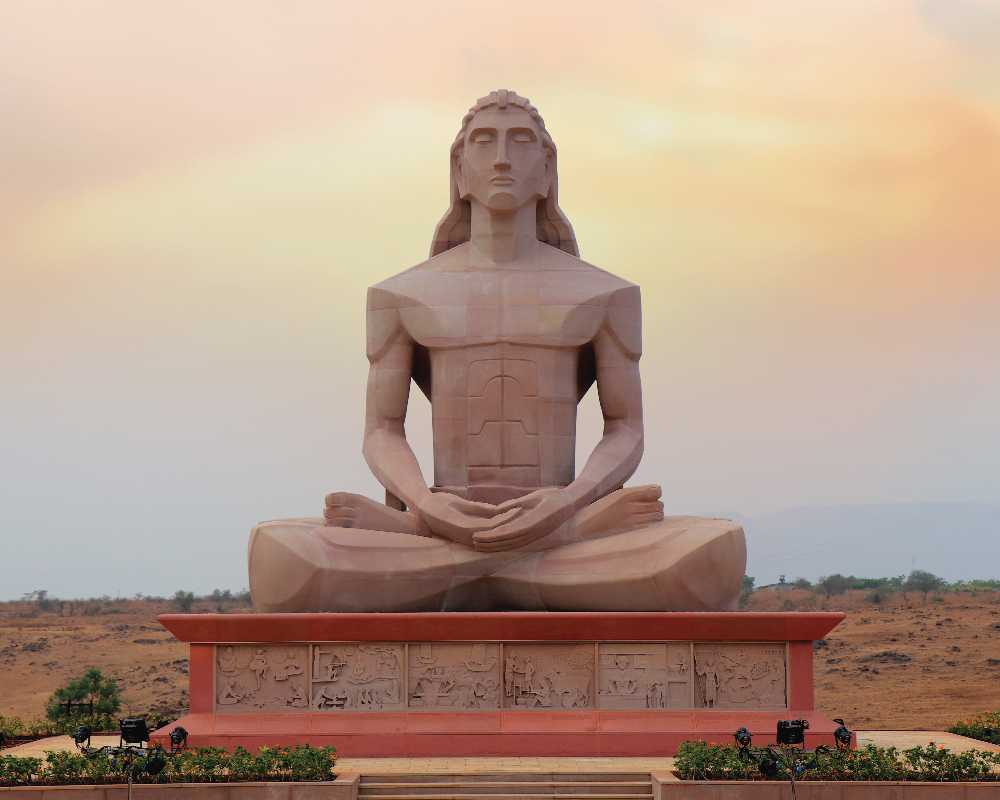
To confront this challenge, Abhay Firodia has taken it upon himself to introduce India’s enduring ideals to the public, particularly the youth. His vision took shape in the form of a museum that would offer not only a glimpse into India’s ancient value systems but also a space where visitors could meaningfully engage with them. This vision materialised as the Prabhavana Museum, spread across acres of land on the outskirts of Pune, Maharashtra — a state-of-the-art cultural institution.
Prabhavana stands as a living repository of India’s timeless wisdom and civilisational heritage. Unlike conventional museums that simply display artefacts, Prabhavana invites visitors on a journey of consciousness — a rediscovery of India’s ancient values, philosophies, and the ethos that shaped its identity.
From the moment one steps into its serene premises, Prabhavana feels less like a museum and more like a passage through time. It reflects the harmony between the material and the spiritual — a balance at the heart of India’s ancient worldview.
Each gallery presents a narrative not of kings and conquests, but of thought, creativity, and inner evolution. The exhibits trace India’s journey from the Vedic age to the present, highlighting the development of philosophy, art, education, and science through the lens of dharma (righteousness), artha (purpose), kama (creativity), and moksha (liberation).
Visitors encounter rare manuscripts, sculptures, and recreations of ancient learning spaces such as gurukulas, where education was not about information but transformation. Interactive displays illuminate how Indian sages viewed knowledge as a pathway to self-realisation and social harmony, rather than a means of personal advancement.
The museum’s exploration of Indian sciences — from Ayurveda and Yoga to mathematics and astronomy — underscores how knowledge in ancient India was always guided by ethics and ecological sensitivity. This holistic worldview, which saw the self, society, and nature as interconnected, is presented not as nostalgia but as a philosophy urgently relevant to today’s fragmented, material-driven world.
Prabhavana is not about glorifying the past; it is about reviving timeless values that can guide the future. Throughout the museum, one encounters a quiet emphasis on core principles such as:
•Respect for all life (Ahimsa)
•Reverence for knowledge (Vidya as sacred)
•Harmony between the individual and society (Dharma)
•Inner balance and self-awareness (Yoga and meditation)
Once fundamental to Indian civilisation, these values are being rediscovered as humanity searches for answers to moral, ecological, and psychological crises. Through its programmes, workshops, and experiential sessions, Prabhavana encourages visitors — especially students and young people — to consider how these ancient ideals might find expression in contemporary life, governance, education, and innovation.
What makes Prabhavana truly distinctive is its integrated approach: it does not separate culture from consciousness. The museum brings together art, philosophy, and meditative experience to allow visitors to feel the rasa — the essence — of India’s spiritual heritage. Audio-visual installations, sacred chants, and reflective spaces offer a multisensory immersion that goes far beyond intellectual understanding.
The message is subtle yet profound: India’s greatness has never lain solely in its monuments or empires, but in its inner vision — the belief that true progress begins with self-knowledge and compassion.
In an age of rapid globalisation, digital distraction, and cultural homogenisation, institutions like Prabhavana serve as vital reminders of who we are and what we stand for. They rekindle pride in India’s civilisational wisdom — not as sentimentality, but as a source of enduring relevance.
Prabhavana calls upon each visitor to become a custodian of these values — to embody truth, harmony, and mindfulness in everyday life. In doing so, it revives not only the past, but the spirit of India itself: ever ancient, ever new.