Punjab has come a long way from those dark days and darker nights. However, sinister forces abroad are yet to accept defeat. India cannot afford to be complacent
Recently, while sorting some old papers in my study, I came across a clipping from The Statesman dating back to 1989. It was a report I had filed from Punjab while touring the State on assignment. The fraying piece of newsprint went into the wastepaper bin, but it brought back a rush of memories of a particularly dark period in our recent history. India, more so Punjab, had to pay a terrible price on account of the Khalistani separatist movement during the 1980s and 1990s; countless human lives were lost, innumerable families were devastated and young minds were scarred forever.
The genesis of those years of blood-letting was the cynical ploy of the Congress to promote a preacher of hate, Jarnail Singh Bhindranwale, as a countervailing force to the Akali Dal. Rajiv Gandhi, as a callow politician being groomed for the ‘big’ job by Indira Gandhi, much like his son, Rahul, is being groomed today by Sonia Gandhi, had famously described Bhindranwale, responsible for the slaughter of innocent men, women and children, many of them Sikhs, as a “man of religion”.
We know the tragic consequences of that initial blunder by the Congress — Operation Blue Star was Indira Gandhi’s desperate attempt to put an end to a strategy that had gone horribly wrong; it didn’t quite serve that purpose. In the end, this Frankenstein’s monster, as in the story, devoured its creator, triggering the horrendous pogrom that saw Congress lynch mobs massacring 4,733 Sikhs, most of them in the streets of Delhi.
But the blood-soaked Khalistan story did not end in 1984. Next year, ‘Emperor Kanishka’, Air India’s Flight 181/182 from Toronto to Mumbai via Montreal, london and Delhi, was blown up off the Irish coast, killing all 329 people on board. Peace continued to elude Punjab where casualties had ceased to matter. Pakistan’s terror-sponsoring agency, Inter-Services Intelligence, by then in command of the Khalistanis, kept the fire of separatism alive, fuelling it with money, Kalashnikovs and explosives. It took the combined efforts of a determined Chief Minister, Beant Singh, and a tough police chief, KPS Gill, to douse the blaze.
Beant Singh’s assassination was perhaps the last act of terrorism before the guns began to fall silent. With the Khalistanis routed, there was jubilation in Punjab and across India. I recall spending a week travelling across Punjab, marvelling at the peace that had descended on the troubled land. Accompanied by my wife and my elder daughter, who was then a child, we travelled at night on roads that till a few months ago were known as ‘death zones’.
Gurdwaras that had been taken over by extremists now wore a festive look. Our most moving encounter was with a young granthi who had deserted the Army after Operation Blue Star to join Babbar Khalsa, but later repented his decision and surrendered to the police. Dedicating his life to the Panth was his way of seeking forgiveness; it was his act of repentance. But many others like him were not so lucky — they either fell to police bullets or just disappeared, leaving behind families burdened with memories.
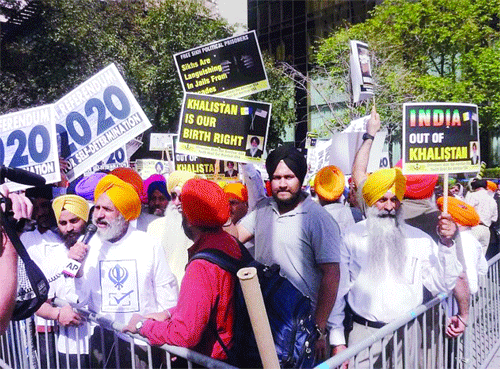
Strangely, those who played Dr Faust to Pakistan’s ISI and instigated young men to pick up AK-47s have never been brought to justice. They continue to be ensconced in their plush homes in the US, Canada and Britain, and still dream of Khalistan. Gurmit Singh Aulakh, ‘President’ of the ‘Council of Khalistan’ with offices in Washington, DC, has access to huge ‘private funds’ and continues to lobby with American politicians to press his case, though without any success.
Among those who once actively backed Aulakh were Edolphus Towns, then member of the House of Representatives from New York who wanted the US to declare India a “terrorist state”, former Senator Jesse Helms and, across the Atlantic, lord Avebury in Britain. Aulakh’s website was indicative of his faith in terrorism, yet the US Administration chose not to touch him. When I met him in Washington in the fall of 1990, Aulakh spent more than an hour lecturing me about the “atrocities being committed by India against Sikhs” in the “occupied nation of Khalistan”. After listening to his jaundiced version of events, I retorted that he was talking gibberish. The Indian American who had set up the meeting was horrified by my feisty response; Aulakh looked at me witheringly; and the tea never came. Twenty-two years later, he is older but not wiser. Or else he would not still dream of Khalistan.
Jagjit Singh Chauhan, who described himself as the ‘President of Khalistan’, was more welcoming when we met in london at a common friend’s house in Islington. Having served as Finance Minister and Deputy Speaker of the Punjab Assembly, Chauhan continued to maintain a vast network of contacts in the State even after moving to Britain in 1971. There was no dearth of funds and he even had ‘Republic of Khalistan’ passports, currency and postage stamps printed that he would provide in exchange of British pounds and American and Canadian dollars. If I remember correctly, one Khalistani ‘dollar’ was valued at one American dollar. I was tempted to purchase a Khalistani passport as a keepsake, but better sense prevailed.
By 2001, Chauhan was a decrepit man, resigned to the fact that he would not live to see Khalistan. He struck a deal with the Government of India and returned to his hometown, Tanda, in Hoshiarpur district. His Khalsa Raj Party remained a letterhead organisation and the man who had once hoisted the ‘Flag of Khalistan’ at Anandpur Sahib died a broken man. But there are many wealthy Sikhs in Britain who continue to subscribe to Chauhan’s separatist ideology and ardently believe that Amritsar shall be the capital of Khalistan. Funds continue to be collected; it is anybody’s guess as to how the money is spent.
If we were to look for the real instigators trying to rekindle the flames of Khalistani terror, we would find them in Canada, more specifically in British Columbia. To a certain extent, American and European authorities have realised the folly of not cracking down on Khalistanis during the 1980s and 1990s. But in Canada, the Government continues to remain as indulgent as it was in 1985 when ‘Emperor Kanishka’ was bombed over the Atlantic.
Just how indulgent the Canadian Government is can be gauged from the fact that neither Ripudaman Singh Malik nor Ajaib Singh Bagri, who plotted the bombing of ‘Emperor Kanishka’, has had to pay for his sins. They were declared ‘not guilty’ by a judge who refused to accept overwhelming evidence against them as being conclusive enough to convict them. Both went on to claim damages running into millions of dollars. They were never shamed or shunned.
(The writer is a current affairs analyst based in NCR)