










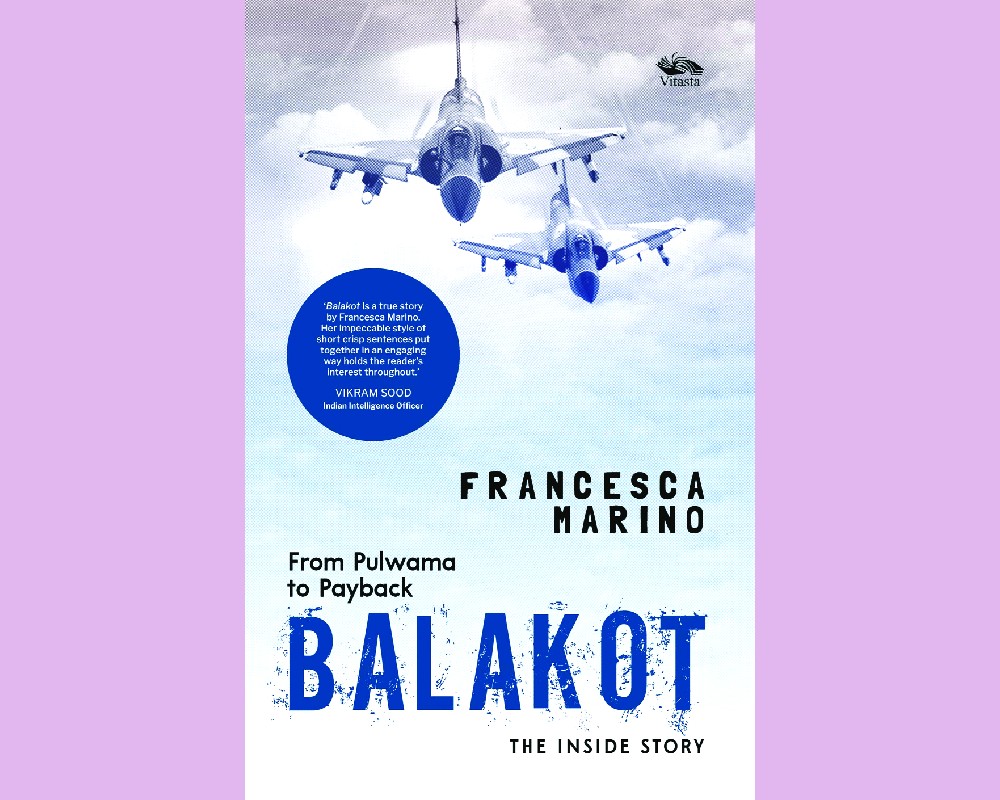
More than six years after the Balakot air strikes, Italian journalist Francesca Marino brings readers a sharp, meticulously documented account of what really happened on the night of 26 February 2019. Balakot: From Pulwama to Payback cuts through political noise, propaganda, and deliberate misinformation to present one of the clearest factual narratives of the Indian Air Force’s strike on a major Jaish-e-Mohammed (JeM) training camp deep inside Pakistan. The result is a book that is simple in its language but uncompromising in detail-a rare combination in reporting on the India-Pakistan conflict.
The core claim established in the book is unmistakable: the Indian strike hit its intended target, a functioning JeM training facility, killing between 150 and 170 terrorists, including trainers from outside Pakistan. Marino’s evidence is neither speculative nor second-hand. She presents eyewitness testimony from a man who was at the camp that night — an account that describes the immediate chaos after the strike, the rapid arrival of Pakistani soldiers, and the urgent evacuation of bodies and injured militants to a nearby military hospital. According to this witness, the site was thereafter swiftly sanitised. Debris was removed overnight and dumped in a river; families of the dead were summoned and paid off-and silenced with threats. It is rare to find such direct testimony from
inside a terror camp, and Marino uses it appropriately.
Where Pakistan attempted to weave a narrative of “missed targets”, “fallen trees”, and “dead crows”, Marino demonstrates how that story was constructed for Western media consumption. Pakistan insisted that Indian aircraft intruded and then fled, dropping bombs in empty fields. Marino’s book dismantles this narrative with satellite imagery, independent intelligence, and on-ground reports from her long-established network in Pakistan-built over thirty years of reporting on South Asia. Her work exposes how Pakistan’s establishment produced a coordinated cover-up to hide the scale of the damage, even going so far as to rebuild structures with the same rubble material to ensure that nothing looked new when the foreign press visited weeks later.
But Balakot is more than an investigation into one night’s events. Marino places the strike against the long, grim history of Pakistan’s terror machinery. She traces the origins of JeM, profiles its leadership and trainers in meticulous detail, and explains its links with Pakistan’s shadowy power centres and the ISI. Through biographies, funding trails, and the mapping of multiple training camps, she shows how deeply the Pakistani state — not just its rogue elements — has been invested in terrorism. These sections sometimes read like intelligence dossiers,
but they enrich the reader’s understanding of the larger ecosystem in which Balakot occurred.
A key strength of the book lies in its laying out of how ordinary Pakistani citizens — many of them migrants in Europe — are drawn into this system. Marino documents how money is channelled from overseas to keep the terror infrastructure running, and how networks of mosques and religious schools contribute to ideological recruitment. She also discusses the use of social media platforms by these terror outfits-Twitter, Facebook, and X — as tools of propaganda, radicalisation, and fund-raising. The book does not exaggerate these points; it presents them plainly, supported by sources and patterns that have been observed for years.
One of the most important sections in Balakot is Marino’s exclusive interview with Air Chief Marshal Birender Singh Dhanoa, who was heading the Indian Air Force at the time of the strike. Dhanoa offers a clear, jargon-free explanation of the operation: the choice of bombs, the precision of the targeting, and the unique method of triggering explosives inside a cavity to maximise shrapnel and contain the blast radius. His account stands in stark contrast to the Pakistani narrative — it is measured, technical, and evidence-based. For readers trying to understand what exactly happened that night, this interview alone is worth the price of the book.
Some parts of the narrative read with the pace and tension of detective fiction-Marino pieces together movements, timelines, intelligence inputs, reactions, and cover-up operations with the skill of a storyteller. Other chapters, listing camps, biographies, and funding chains, are more sober and documentary in tone. Together, they form a comprehensive picture of the terror apparatus, the international media’s frequent gullibility, and the geopolitical stakes that continue to define India-Pakistan relations.
Marino is a journalist who has taken risks that few foreign reporters have been willing to take in Pakistan. Her access to both official sources and ordinary locals, especially those wary of the Pakistani state, gives the book its depth. This combination-of high-level interviews and grassroots testimony-allows her to connect dots across borders and institutions in a way that few journalists can.
At a recent launch event in New Delhi, questions were raised by panellists-including Shiv Aroor and retired Lt General Raj Shukla-about why the world so readily accepts Pakistan’s claims but demands “proof” from India. Marino’s book tackles this head-on. It shows how Pakistan manipulated the international press, how evidence was destroyed before journalists were allowed in, and how structural damage was artificially covered up. The book implicitly asks why only India must justify its counter-terror operations, while Pakistan’s long history of sponsoring terror is rarely interrogated.
Balakot: From Pulwama to Payback is, ultimately, a book that forces readers-and policymakers-to confront uncomfortable questions. Are we assertive enough in putting out our narrative to the world? Why do we allow Pakistan’s disinformation to fill the vacuum created by our own silence? Marino does not answer these questions for us, but she provides the facts needed to start asking them seriously.
Hard-hitting, factual, and essential, this book stands as one of the clearest counter-narratives to Pakistan’s denial of Balakot. It is not just a report of an air strike — it is an exposé of an entire system of state-sponsored terrorism that has shaped India-Pakistan relations for the past eighty years.







